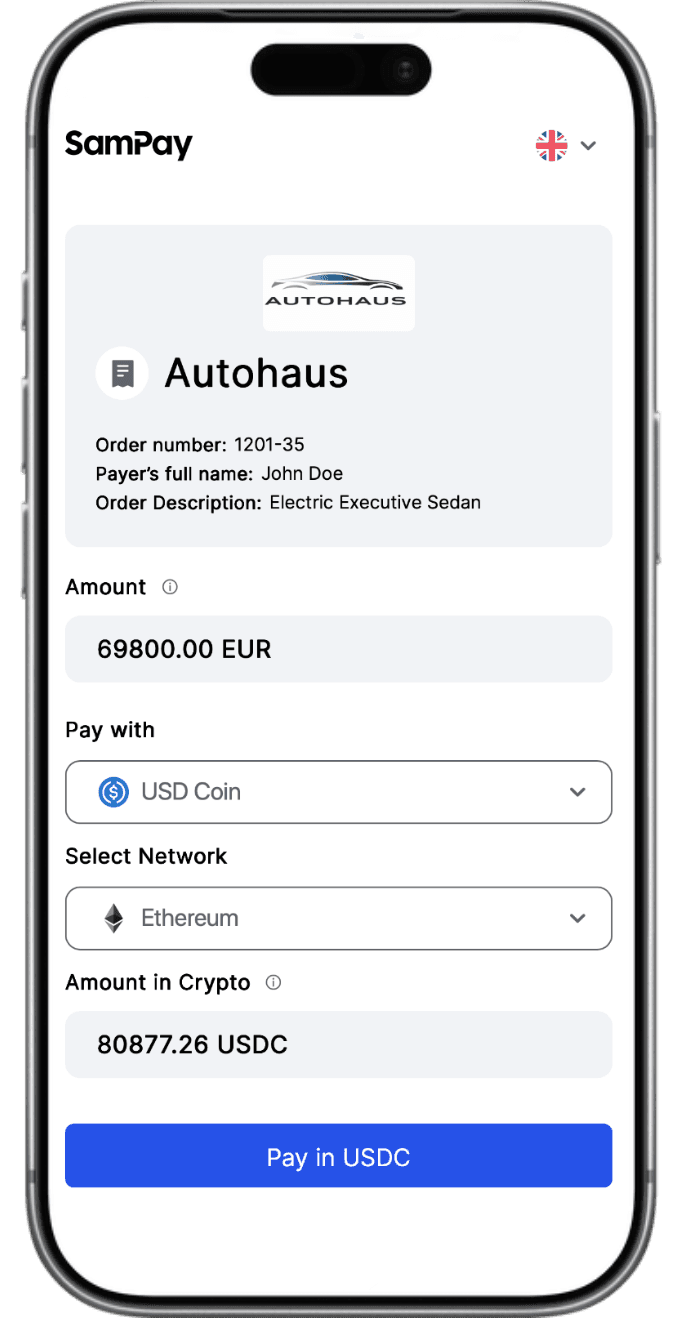
If you are evaluating crypto payments for business, the first question often sounds simple: should the invoice be issued in crypto or in EUR? On paper, both may seem possible. In practice, this is where many operational problems begin. For a business that sells cars, real estate, jewelry, or premium services, the amount you charge must stay predictable from the moment the deal is agreed to the moment the money reaches your bank.
That is why the real issue is not whether a client wants to pay in USDT or another digital asset. The real issue is whether your business can keep pricing, settlement, accounting, and reporting stable while giving the client a modern payment option. If the invoice itself is tied to a volatile asset, the amount becomes uncertain, internal approvals become harder, and finance teams lose the clarity they need.
Why EUR is the natural starting point
When you sell something high-value, you do not think in tokens. You think in the agreed commercial price. A car costs a certain amount. A property has a fixed sale price. A luxury watch is listed at a specific value. Your contracts, offers, internal approvals, and accounting all revolve around EUR because that is the currency in which your business operates.
This is exactly why invoicing in EUR matters. It preserves the logic of the transaction. The commercial agreement stays unchanged, and the client simply chooses a different way to settle it. That distinction is important, because it keeps crypto in the background where it belongs. Your business is not becoming a crypto business. You are simply allowing a client to pay using crypto while you continue operating exactly as before.
The problem with denominating invoices in crypto
The difficulty starts the moment the invoice amount is set in crypto rather than EUR. At first, this may seem flexible or modern. But once you look at it from the perspective of an operator, accountant, or founder, it creates avoidable instability.
If the invoice says 10,000 USDT or 2.5 ETH, the conversation immediately shifts away from your actual sale and toward market value, timing, and exchange-rate interpretation. Even if the customer intends to pay quickly, there is still a question: what is the exact EUR value of that amount when the payment is initiated, when it is detected, and when it is settled? Those differences may look small on low-ticket transactions, but on large invoices, even minor fluctuations can become a real issue.
For finance teams, this is where discomfort begins. The sales team may think the deal is closed, but accounting sees a moving target. Treasury sees uncertainty. Management sees a transaction that may no longer match the original commercial agreement. Instead of simplifying the payment, direct crypto handling adds friction around the amount itself.
What volatility looks like in real business
Volatility is often discussed as a market concept, but in business it shows up as a workflow problem. You agree a price with a client. Your team prepares an invoice. Internal stakeholders expect one exact amount to arrive. Then payment timing shifts, the market moves, and the final value no longer matches what your company expected.
That creates very practical questions. Do you ask the client to top up the difference? Do you absorb the shortfall? Do you issue a revised invoice? What if the amount received is higher than expected because the market moved the other way? What if the customer claims they paid exactly what was requested in crypto terms, while your accounting team sees a mismatch in EUR?
For high-ticket businesses, this is not a minor inconvenience. It affects reconciliation, margin control, and customer experience. A premium sale should feel clear and controlled. It should not turn into a debate about market timing after the client has already sent the funds.
Why uncertainty is a bigger risk than many expect
In many companies, the first reaction to crypto payments is not legal concern but operational hesitation. Someone internally says, "We can probably accept it," and then someone from finance asks the harder question: "What exactly are we accepting, and how do we book it?" This is where denominating the invoice in EUR becomes critical.
If the invoice remains in EUR, the amount due is fixed from the start. Everyone in the company sees the same number. The customer knows the target amount in business terms. Accounting knows what to reconcile. Management knows what revenue to expect. Your bank statement later reflects the same logic. That continuity matters more than the payment method itself.
By contrast, if the invoice is effectively tied to crypto value, you import market uncertainty into a process that should be deterministic. That is not a payment innovation. It is an accounting problem waiting to happen.
Why traditional businesses need a EUR-first model
This matters even more if your company is not crypto-native. Most traditional merchants do not want crypto exposure on the balance sheet, and they do not want internal teams dealing with conversions, wallet management, or value interpretation. They want to know one thing: how much EUR was sold, and how much EUR was received.
That is the right instinct. You sell cars - you continue selling cars. You sell real estate - nothing changes. You receive EUR - always. The purpose of a well-designed crypto payment flow is not to pull your business into the crypto world. It is to let the client use crypto while your side of the transaction remains fully familiar.
This is why EUR-denominated invoicing is not just a convenience. It is the structure that keeps the business side clean. It ensures that crypto is only the customer's payment instrument, not your operational burden.
How the process should work in practice
A workable model is simple: the invoice is created in EUR, the client pays in crypto, the payment is checked automatically, the crypto is converted into EUR, and your business receives EUR by bank transfer. That sequence removes the main source of uncertainty because the commercial amount is fixed at the beginning and the settlement currency is fixed at the end.
Before showing the customer side, it helps to see what this means operationally. The merchant does not prepare a crypto invoice, estimate token values, or manage wallet balances. The business simply issues an invoice in EUR as it normally would.
This is the central idea: the transaction starts in the same currency your company already uses for pricing, contracts, and reporting. That is what makes crypto to EUR workable for a traditional business. The customer may pay in crypto, but your commercial logic never leaves EUR.
Why this also helps with compliance and banking
Once a company starts handling crypto directly, the question is no longer only about payment amount. It also becomes a question of source of funds, traceability, banking comfort, and internal controls. Your bank does not want vague explanations. Your finance team does not want exceptions. Your auditors do not want ambiguity.
That is why compliant crypto payments need to include automatic checks before settlement. Not because your team wants to become experts in blockchain analysis, but because every payment must be screened in a way that protects the business. In business terms, this means you do not have to wonder where the funds came from or how to explain them later.
This step should be built into the flow rather than delegated to your staff. The merchant should not be investigating wallet history or manually reviewing transactions. All of that complexity should be invisible on your side.
When this is handled correctly, the payment process becomes something your finance team can accept. Not because they suddenly want crypto exposure, but because they still receive EUR into the bank account, with checks already built in.
What the customer sees versus what your business receives
From the customer's perspective, the experience should still feel clear and professional. They should see how much they need to pay and complete that payment without confusion. But their payment method should not dictate how your business books revenue.
A good flow separates those two sides properly. The customer gets a simple payment page and clear instructions for completing the transfer in crypto. Meanwhile, your business remains anchored to the EUR invoice amount and waits for EUR settlement.
That separation is what makes it possible to accept crypto payments in Europe without changing the way your company functions internally. The client gets flexibility. You get predictability. And that is the only version of crypto acceptance that makes sense for most traditional businesses.
Where SamPay fits into this model
This is exactly where SamPay becomes relevant. SamPay is not built around the idea that merchants should hold or manage crypto. It is built around the opposite idea: merchants should continue operating in EUR, while the platform handles the crypto side in the background.
With SamPay, the invoice is denominated in EUR, the customer pays in crypto, the transaction goes through AML/KYC/KYT checks, the crypto is converted, and the merchant receives EUR via bank transfer. No crypto sits on your balance sheet. No internal team has to manage wallets. No one needs to guess what amount should be recognized in accounting. The structure is clear from the beginning.
This is what compliant crypto payments should look like for a non-crypto business. You do not adopt volatility. You do not create accounting ambiguity. You do not increase banking friction. You simply open the door to clients who want to pay in crypto while preserving the EUR-based framework your business already trusts.
Why EUR fixation is the key to stability
If you strip the topic down to the actual business decision, the answer is straightforward. The invoice should be denominated in EUR because your costs, reporting, approvals, and bank settlements are denominated in EUR. Anything else introduces uncertainty into a process that should remain controlled.
This is especially important in high-value transactions, where even a small mismatch becomes difficult to ignore. A stable commercial amount protects your margin, simplifies reconciliation, and makes internal acceptance much easier. It also keeps the customer conversation cleaner, because the agreed value does not need to be renegotiated around market moves.
That is why fixing the amount in EUR is the key to stability. SamPay uses exactly this model: crypto comes in from the customer, EUR goes out to your bank account, and your business continues to function as it always has.
The obvious next step
If your company is exploring crypto payments for business, the goal should not be to "become crypto-friendly" in some abstract sense. The goal should be to remove sales friction without creating finance, compliance, or banking problems on your side.
A EUR-denominated model is what makes that possible. It gives your customers another way to pay, while your business keeps its pricing, accounting, and treasury logic intact. That is the practical path for any company that wants to accept crypto payments in Europe without taking on crypto risk directly.
If you want to explore compliant crypto payments without changing how your business operates, SamPay is the obvious next step to evaluate. The model is simple, stable, and business-first: your client pays in crypto, and you receive EUR, exactly as before.
Book a demo
Let your clients pay in crypto while your business keeps operating in euro.
Book a demo to see how SamPay helps merchants accept crypto payments with compliant EUR settlement and a familiar operational flow.