Published April 5, 2026
Why banks block crypto-related transactions
If you are considering crypto payments for business, the first question is usually not technical. It is much more practical: what will my bank do when this money arrives? That is the point where many otherwise sensible discussions stop. Not because the client is not willing to pay, and not because the sale is not real, but because your finance team already knows what happens when a bank sees something it considers unclear, unusual, or high-risk.
In practice, this is why many traditional businesses hesitate. You may sell cars, real estate, jewelry, or premium services, and your business works perfectly well in EUR today. The concern is not whether some customers want to pay in crypto. The concern is what happens after that payment: how it is documented, how it is explained, whether the source of funds is acceptable, and whether your bank decides to slow everything down or freeze it entirely.
This is the part that matters most: the problem is not accepting crypto. The problem is everything that comes with it. If the payment creates compliance questions, accounting complications, or banking friction, then the transaction is no longer just a sale. It becomes an operational issue for your business.
Why banks become cautious the moment crypto appears
Banks do not usually block transactions because they dislike innovation. They block or review transactions because they are responsible for managing risk. From the bank's perspective, anything connected to crypto can raise questions very quickly: where did the funds come from, who sent them originally, what checks were done, and whether the receiving business can prove the transaction is legitimate and compliant.
That is especially important for high-ticket sectors. If you are receiving a large payment linked in any way to crypto, your bank is not only looking at the amount. It is looking at the payment trail. If that trail is incomplete, difficult to explain, or inconsistent with your usual business profile, the bank may decide it needs more information before releasing funds. Sometimes that means delays. Sometimes it means requests for documents. Sometimes it means the funds are held while the case is reviewed.
For a merchant, this creates a strange situation. You may have done nothing wrong. The client may be legitimate. The deal may be perfectly real. But if the transaction reaches your bank in a way that looks risky or poorly documented, the burden falls on you to explain it.
What a bank actually sees as risky
Unclear source of funds
The most obvious reason for a block is that the bank cannot comfortably understand where the money came from. If you accept crypto directly, that payment does not automatically arrive with the kind of clear banking history traditional institutions expect. Your client may say the funds are clean, but that is not enough. Your bank wants evidence, not assumptions.
This is where businesses get into trouble. The sale itself might be documented, but the payment source still needs to make sense to the bank. If there is no proper screening, no clear transaction record, and no compliance layer between crypto and your company account, your bank may treat the incoming funds as high-risk until proven otherwise.
Mismatch with your business profile
Banks monitor whether transactions fit the normal pattern of your business. If you are a dealership, agency, broker, or luxury retailer operating in EUR, and suddenly there is visible crypto-related activity around your payments, that can trigger internal review. Not because your business has changed, but because from the bank's side, the activity may no longer look standard.
This is why direct crypto handling creates unnecessary exposure. The moment your company starts receiving, storing, converting, or explaining crypto itself, you are no longer simply selling your product or service. You are also taking on a risk profile your bank may not be comfortable with.
Why direct crypto handling creates friction inside your business
At first glance, accepting crypto directly can sound simple. A client pays. You receive the funds. Then you convert them and move on. In reality, this is where the complications begin. Your accounting team has to understand what was received, at what valuation, when conversion happened, and how to document the transaction properly. Your compliance team has to be ready to justify the payment source. Your bank may ask questions your internal team is not equipped to answer quickly.
For most traditional businesses, that is not a good use of time or attention. You sell cars - you should continue selling cars. You sell real estate - nothing about your operating model should need to change. You receive EUR - always. The moment crypto starts appearing on your balance sheet or in your treasury workflow, the transaction becomes heavier than it should be.
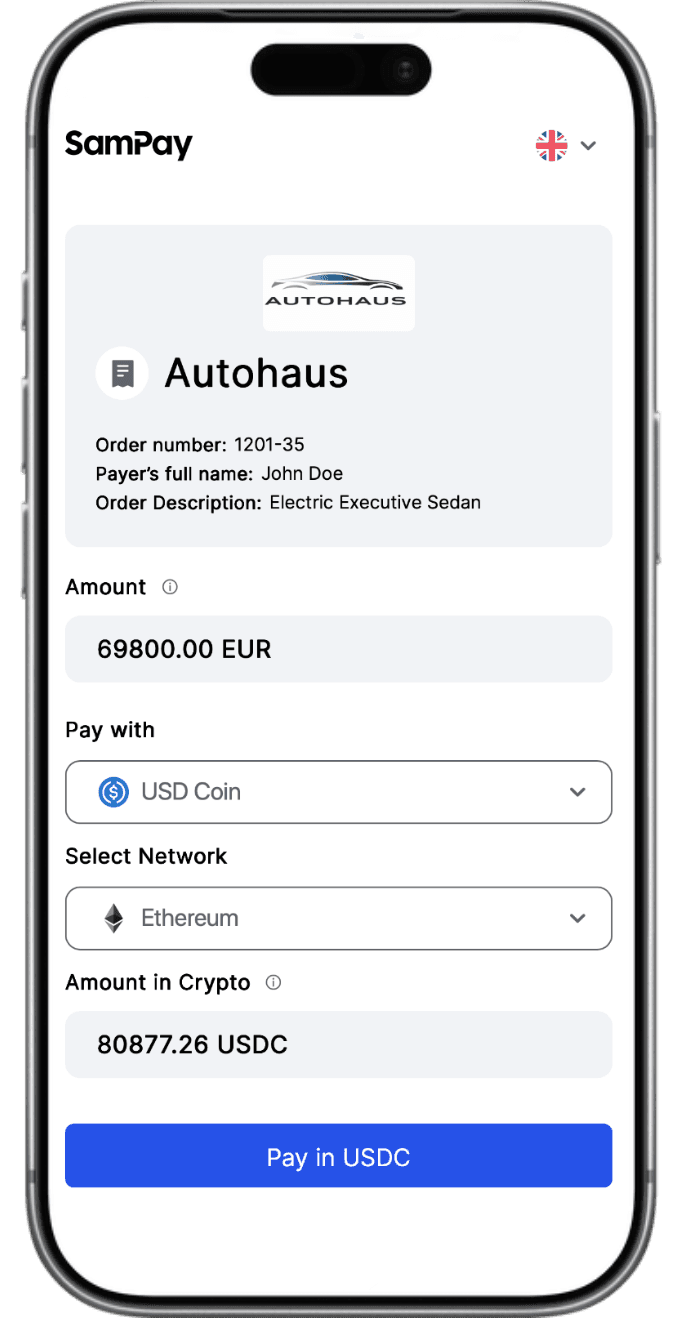
Before going further, it helps to look at what a safer merchant-side process should feel like. The business should stay in its usual operating currency from the start.
The point here is simple: your invoice is still issued in EUR because that is how your business already runs. You are not rebuilding your commercial process around crypto. You are keeping your normal pricing, your normal accounting logic, and your normal settlement expectations.
Why banks are more comfortable with compliant crypto payments
The key difference is whether the bank receives a transaction that looks unmanaged, or one that comes through a structured, compliant flow. Banks are far more comfortable when the crypto side is handled before the funds reach the merchant, and what finally lands in the business account is EUR with proper documentation and checks behind it.
That means the right model is not "merchant receives crypto and figures it out later." The right model is much cleaner: the customer pays in crypto, the transaction is checked, the funds are converted into EUR, and the merchant receives a standard bank payout. In other words, the crypto part is handled in the background, while the business continues operating normally.
This structure matters because it removes the very signals banks tend to react to. Instead of unexplained crypto exposure, there is a documented payment flow. Instead of the merchant holding digital assets, there is predictable EUR settlement. Instead of asking your finance team to defend the transaction after the fact, the checks happen before payout.
A simple payment workflow also helps keep the process familiar for your team. The operational side should not feel like a new business line.
What matters here is not the technology itself. It is the business effect: your team can send a payment request in a way that feels controlled and straightforward, while the customer gets a crypto payment option without pushing that complexity back onto you.
The compliance layer banks expect to see
When a bank reviews a suspicious or unusual transaction, it is usually trying to answer a practical question: was this payment properly checked before it entered the financial system? If the answer is vague, that is when problems start. If the answer is clear, documented, and structured, the risk level changes immediately.
That is why compliant crypto payments matter. Every payment should be screened automatically so you do not have to worry about where the money came from or how to explain it later. Identity verification, transaction screening, and risk filtering should happen as part of the payment flow, not as a manual emergency after funds are already in question.
This is the kind of step that reduces tension both for the merchant and for the bank.
For your business, the value is very practical. You are not building an in-house compliance process around crypto. You are not trying to interpret wallet activity yourself. You are using a model where risk review is built into the flow before payout reaches your account.
That changes the conversation internally as well. Finance teams usually do not object to revenue. They object to uncertainty. If there is a clear mechanism that checks payments, converts them, and pays out in EUR, the issue becomes much easier to evaluate.
The correct model: crypto in, EUR out
This is the model traditional businesses actually need if they want to accept crypto payments in Europe without creating banking friction. The customer pays in crypto. The payment goes through AML, KYC, and transaction monitoring checks. The crypto is converted into EUR. The merchant then receives EUR by bank transfer through standard rails such as SEPA or SWIFT.
The important part is not just that conversion happens. It is that the merchant never holds crypto on the balance sheet. That removes volatility concerns, avoids unnecessary accounting complexity, and significantly reduces the risk of awkward explanations with your bank. From your side, it still looks and feels like a EUR business.
This is where a solution like SamPay becomes relevant. Not because it helps you "go crypto-native," but because it allows you to accept clients who want to pay in crypto while keeping your own business model unchanged. SamPay manages the compliance flow, handles the conversion from crypto to EUR, and sends payout directly to your bank account. You do not need to receive, store, or manage crypto yourself.
For many businesses, that is the real answer to the banking problem. The bank is not being asked to accept vague crypto exposure on your balance sheet. It is receiving a cleaner, more structured payout flow that is much easier to understand and support.
Why this matters for high-ticket businesses in Europe
If you deal with large payments, delays are expensive. A blocked transaction does not just create administrative work. It slows down delivery, affects client trust, and creates friction between sales, finance, and operations. One held payment can disrupt a much larger commercial process.
That is why "we will explain it later if the bank asks" is not a serious strategy. By the time the bank asks, the damage is already happening. A compliant crypto to EUR model works better because it removes the uncertainty earlier, before your team is forced into reactive problem-solving.
This is especially relevant if you want to accept crypto payments in Europe while staying aligned with traditional banking expectations. You do not need a dramatic shift in how your company operates. You need a controlled way to let clients pay how they want, while your business receives funds in the same reliable form it already uses.
Before the transaction is complete, the merchant should already know how the end result will look: settled, documented, and familiar.
That is the real benchmark. Not whether a crypto payment can technically happen, but whether it can finish in a way your business, your accountant, and your bank are all comfortable with.
The safer way to accept crypto payments
If banks block crypto-related transactions, it is usually because they see unmanaged risk. They do not want unclear source of funds, weak documentation, or merchant exposure to activity that does not fit a normal EUR operating model. And from a business perspective, that concern is understandable.
The solution is not to force your company deeper into crypto. The solution is to remove crypto from the merchant side as much as possible. Through a compliant flow, the risk drops significantly. The client pays in crypto, the checks happen automatically, the funds are converted, and you receive EUR in your bank account.
That is why this model makes sense for traditional businesses, especially in luxury, offline, and high-ticket sectors. You keep your pricing in EUR. You keep your accounting in EUR. You keep your banking relationships intact. And at the same time, you stop losing clients who prefer to pay in crypto.
If you are evaluating compliant crypto payments, this is the obvious next step to explore. SamPay solves the part that banks worry about most by making the flow structured, checked, and settled in EUR. You are not taking on crypto operations. You are simply giving clients another way to pay, while your business continues exactly as before.
Book a demo
Let your clients pay in crypto while your business keeps operating in euro.
Book a demo to see how SamPay helps merchants accept crypto payments with compliant EUR settlement and a familiar operational flow.