If you are looking into crypto payments for business, the first question usually sounds simple: what exactly is a crypto invoice?
On the surface, it seems like the crypto version of a normal invoice. You define an amount, send it to the client, they pay, and the transaction is done. But when you look at how this works in real business operations, the invoice itself is only a small part of the process. The real issue starts behind it: how the wallet is created, how the amount is calculated, how the payment is tracked, and what happens after the funds arrive. That is where many businesses realize that the problem is not accepting crypto - it is everything wrapped around that payment.
If you run a dealership, sell luxury goods, work in real estate, or handle any other high-ticket transaction, you do not want a new payment method to create extra operational risk. You want the payment to fit into the business you already have. You sell cars - you continue selling cars. You sell real estate - nothing changes. You receive EUR - always. That is the standard any practical solution should meet.
What a crypto invoice actually is
A crypto invoice is a payment request sent to a customer who wants to pay in cryptocurrency. From the customer's side, it looks straightforward: they receive a payment page or wallet address, send the required amount in crypto, and wait for confirmation. From the merchant's side, however, a proper invoice must do much more than just show an address.
A usable invoice needs to define the transaction clearly. It should specify the amount due, link the payment to a specific order or client, calculate the crypto equivalent of the EUR amount, and make sure that the payment can be identified automatically once it is sent. If this is not structured correctly, your team ends up manually checking transfers, comparing amounts, and trying to understand whether a payment is complete, underpaid, or sent to the wrong place.
In other words, the invoice is not just a document. It is the mechanism that connects a business transaction to a crypto payment in a way your operations team can actually work with.
Why invoice mechanics matter more than most businesses expect
When finance teams first hear "crypto invoice," they often assume it is just another billing format. In practice, it is closer to a payment workflow. That is why invoice mechanics matter so much. If they are poorly handled, what looks like a simple request for payment quickly turns into a manual, risky process.
Let's say your business wants to invoice a client for €18,500. If you try to accept crypto directly, someone on your team now has to decide which coin to accept, generate or assign a wallet address, calculate the exact amount of crypto required at the current rate, communicate that to the client, and then monitor the blockchain to see if the right amount has arrived. If the market moves between invoice creation and payment, you also need to decide what happens next. Does the client owe more? Do you absorb the difference? Does accounting recognize the full EUR amount or whatever the crypto was worth on arrival?
This is where the topic becomes operational, not theoretical. The business does not need "more payment options" if those options force your team to behave like a crypto desk.
The hidden problems behind a manual crypto invoice
Creating wallet addresses is not a business workflow
The first issue is address management. If you handle crypto directly, you need a reliable way to generate and assign wallet addresses. That may sound technical, but the business implication is simple: if this process is manual or inconsistent, payments can be misrouted, mixed together, or hard to reconcile later.
For a business that normally issues invoices in EUR and receives bank transfers, this is an unnatural workflow. Your team should not have to think about wallet hygiene, address reuse, or whether a payment was sent on the correct network. Yet that is exactly what happens when there is no structured payment system in place.
Before anything is paid, the ideal process should already feel familiar: create an invoice in EUR, link it to the customer, and send it out without having to touch crypto infrastructure yourself.
This is the difference that matters. The invoice starts in EUR, not in crypto logic. Your business defines what it wants to receive, and the payment layer handles the rest.
Calculating the amount is harder than it sounds
The second issue is amount calculation. A normal invoice states a fixed amount. Crypto introduces a moving exchange rate, which means your team needs to convert the EUR amount into crypto at the right moment and present it to the customer clearly.
If this is done manually, mistakes are almost guaranteed over time. The client may send too little because the rate moved. They may wait before paying and use an outdated number. Your staff may calculate one amount while another system records something else. Then finance has to resolve the difference, sales has to explain the delay, and the customer experience becomes less professional than it should be.
For businesses that want to accept crypto payments in Europe, this is one of the most overlooked issues. The invoice must lock in a clear payment amount and connect that amount to a real business transaction. Otherwise, every payment becomes a case-by-case exception.
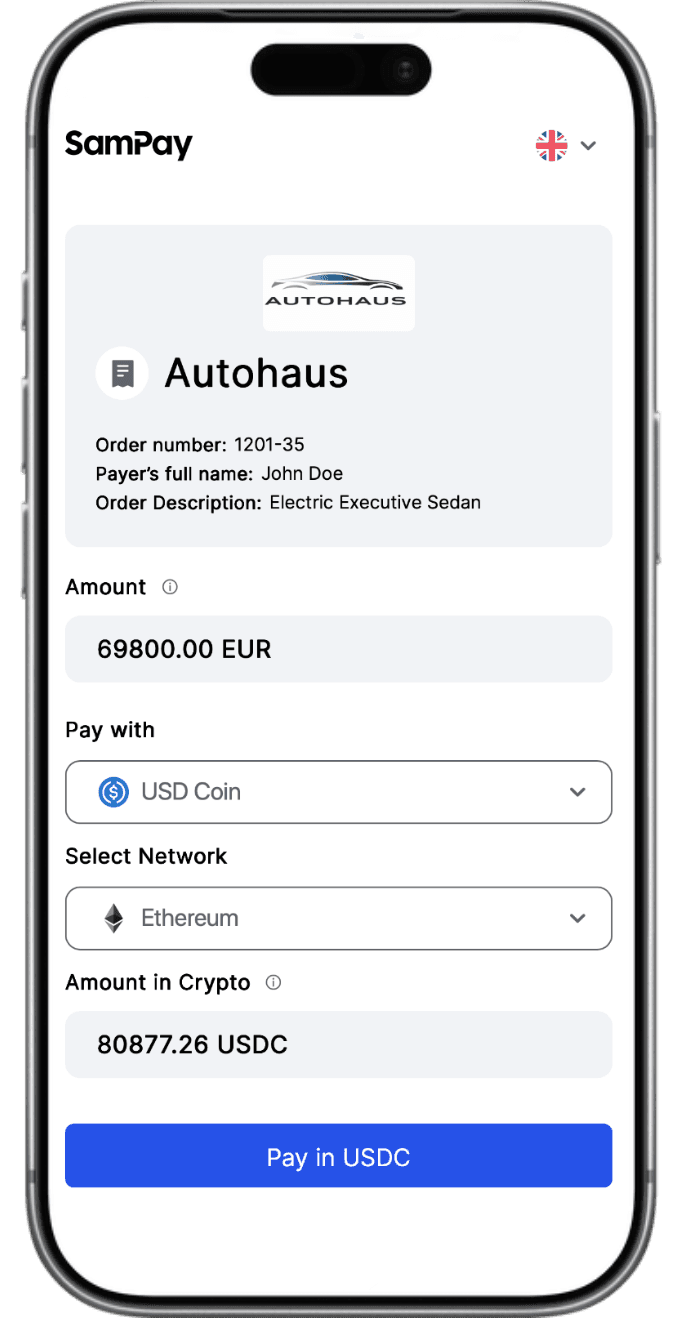
A proper payment page solves this by presenting the client with a clear, structured payment request rather than forcing your team to explain rates and wallet details manually.
Processing the payment is where complexity really starts
Even after the client sends the crypto, the job is not finished. Someone needs to detect the transaction, verify that it matches the invoice, wait for sufficient confirmation, and determine whether the payment can be accepted. If your business handles this directly, the payment process immediately raises questions that most merchants do not want to manage themselves.
Where did these funds come from? Is the transaction linked to a risky wallet? Can your bank ask questions later? What does your finance team record while the payment is still in crypto? If a transaction is delayed or comes in partially, who follows up with the client? None of this looks like invoicing in the usual sense, but all of it becomes your problem when you accept crypto without the right infrastructure.
That is why many merchants hesitate, even when they see real customer demand. The business risk sits in the handling, not in the invoice title.
When payment detection is automated, your team does not need to monitor wallets manually or guess whether funds have arrived. The workflow becomes traceable and consistent, which is exactly what finance and operations teams need.
A crypto invoice should not turn you into a crypto business
This is the point where many decision-makers step back and ask the right question. Not "can we accept crypto?" but "what exactly are we taking on if we do?"
If the answer includes wallet management, rate calculations, transaction monitoring, source-of-funds concerns, accounting uncertainty, and possible banking friction, then the setup is wrong. A traditional business should not have to absorb all of that complexity just to get paid by one segment of clients.
You are not trying to become an exchange. You are not trying to hold digital assets on your balance sheet. You are not trying to explain blockchain flows to your accountant or your bank. You simply want to accept a customer who prefers to pay in crypto, while the business itself continues operating exactly as before.
How the correct invoice model works
The practical model is much simpler than direct handling. Your business creates an invoice in EUR. The customer pays in crypto. The provider handles the payment flow, checks the transaction, converts the crypto into EUR, and sends the EUR payout to your bank account through SEPA or SWIFT. From your side, the result is the same as any other EUR settlement.
This changes the role of the invoice completely. Instead of being a technical workaround, it becomes a normal business document connected to an automated payment process. The customer gets a clear way to pay in crypto, while your business gets predictable EUR settlement and a workflow that fits normal finance operations.
This is also the compliant way to think about crypto to EUR. The payment is screened, the operational checks are built in, and the merchant does not hold the crypto. That means fewer internal questions, fewer accounting complications, and far less chance of friction with banking partners.
Why compliance must be built into the invoice flow
For most non-crypto businesses, compliance is where hesitation becomes real. It is one thing to receive a payment. It is another to explain where the funds came from and whether proper checks were performed before the money reached your business.
That is why compliant crypto payments cannot be treated as an afterthought. The verification needs to happen inside the payment flow itself. If a provider screens transactions automatically, your business is not left trying to assess wallet risk after the fact or justify unusual incoming funds to a bank.
In business terms, this means the invoice process is not only easier; it is safer. Your team can focus on the transaction you are closing, not on building internal procedures for crypto risk review.
Where SamPay fits into this model
This is where a provider like SamPay becomes relevant. SamPay does not ask your business to "start working in crypto." It automates the part that should never sit on the merchant side in the first place.
You create the invoice in EUR. SamPay generates the payment request and the wallet details behind it. The customer pays in crypto. The payment is checked, processed, and converted. Your business receives EUR directly to its bank account. No crypto sits on your balance sheet, and your team does not need to manage wallets, exchange rates, or payment tracking manually.
That is the key business value. The merchant experience remains familiar, even though the customer is using a different payment method. This is exactly how crypto payments for business should work for traditional companies.
For a dealership, that means the sale process stays the same. For a real estate firm, the transaction remains structured around EUR documentation and bank settlement. For premium services, it means you can say yes to more clients without creating internal disruption. SamPay handles the invoice mechanics and payment flow so that crypto is fully abstracted away from the merchant.
Why this is the obvious way to handle crypto invoices
If you strip away the buzz around crypto, the business requirement is very simple. You need a payment request that the customer can pay, your team can track, finance can reconcile, and your bank can live with. That is what a real crypto invoice should accomplish.
Trying to manage this directly creates unnecessary work at every stage: generating wallet addresses, calculating the payment amount, following the transaction, checking compliance, and then converting the result into something your business can actually use. A provider should remove that burden, not pass it to your staff.
SamPay does exactly that. It automates invoice creation, generates the wallet and payment flow, processes the crypto payment, performs the necessary checks, converts the funds into EUR, and pays out to your bank account. Your business keeps operating normally. Your client gets to pay in crypto. The complexity stays where it belongs - inside the infrastructure, not on your side.
If you are evaluating how to accept crypto payments in Europe, this is the model worth exploring. Not because it is more innovative, but because it is more practical. You do not need to become a crypto business. You just need a system that lets crypto-paying clients pay you while you continue receiving EUR, as always.
That is why, for most traditional merchants, this is the obvious way to do it.
Book a demo
Let your clients pay in crypto while your business keeps operating in euro.
Book a demo to see how SamPay helps merchants accept crypto payments with compliant EUR settlement and a familiar operational flow.