Published April 5, 2026
What happens if AML check fails in crypto payment
If you are evaluating crypto payments for business, the question is usually not whether a client can send digital assets. The real question appears one step later, when your finance team, compliance officer, or bank asks what happens if that payment turns out to be problematic. That is where many otherwise interested businesses stop. The sale itself may be simple, but the risk around the payment is not.
This is especially true if you sell high-value goods or services. A car dealer, real estate agency, jewelry business, or premium service provider does not want to spend time investigating wallets, explaining suspicious transactions to a bank, or discovering after the fact that money received may be linked to sanctions, fraud, or illicit activity. The problem is not accepting crypto - it is everything that comes with it.
Why AML failure matters more than most merchants expect
At first glance, it may seem like an AML check is just another background control in the payment flow. In practice, it is much more important than that. If a crypto payment is flagged, your business is no longer dealing with a normal sales process. You are dealing with a compliance event, and that changes the situation immediately.
The issue is simple to understand from a business perspective. If you accept crypto directly, and later discover the funds were risky, you may already have created internal exposure. Your team now has to answer questions you never wanted to own in the first place. Where did the funds come from? Why did you accept them? What should be done with them now? How do you document the decision? And if your bank reviews incoming activity connected to crypto, how do you explain that you handled it correctly?
What an AML check failure actually means
When an AML check fails, it usually means the incoming crypto payment is connected to risk indicators that should not be ignored. That can include exposure to sanctioned entities, dark market activity, theft, fraud patterns, mixers, or other sources that raise red flags. You do not need to understand the technical details of blockchain analysis to understand the business consequence: the funds are not clean enough to be processed normally.
For a traditional merchant, this is where direct crypto handling becomes dangerous. You are not in the business of tracing asset origins, assessing transaction risk, or deciding whether a payment can be accepted. You sell apartments, vehicles, watches, design services, or premium goods. Your job is to close legitimate deals and receive money safely in EUR.
How this problem appears in real business
Imagine a client wants to pay a deposit in crypto for a high-ticket purchase. The amount is large, the deal is important, and everyone wants to move quickly. If you accept the funds to your own wallet, the transaction may look complete from the customer's side, but from your side the uncertainty is only beginning.
Your accountant may ask whether the funds can be booked. Your operations team may ask whether the order can be released. Your bank may later ask questions if there is any visible connection to crypto proceeds. If the transaction is later identified as risky, you are left in an uncomfortable position: you have received something of value, but you may not be able to use it confidently, convert it smoothly, or justify it cleanly.
This is why many businesses hesitate when they think about how to accept crypto payments in Europe. Not because there is no demand, but because no serious company wants to accidentally accept "dirty" funds and deal with the consequences afterward. The opportunity is real, but the operational model matters even more than the payment method.
Why direct acceptance creates unnecessary exposure
The common misunderstanding is that accepting crypto is just another payment option, like adding card processing or bank transfer. It is not. The moment you receive crypto directly, you potentially take on screening, documentation, risk assessment, conversion, and banking exposure all at once.
That means your business may suddenly need procedures for blocked transactions, refund handling, source-of-funds concerns, and recordkeeping that can withstand compliance scrutiny. Even if you have a finance team, this is not the kind of work most merchants want added to their daily operations. All of this complexity should not exist for the merchant.
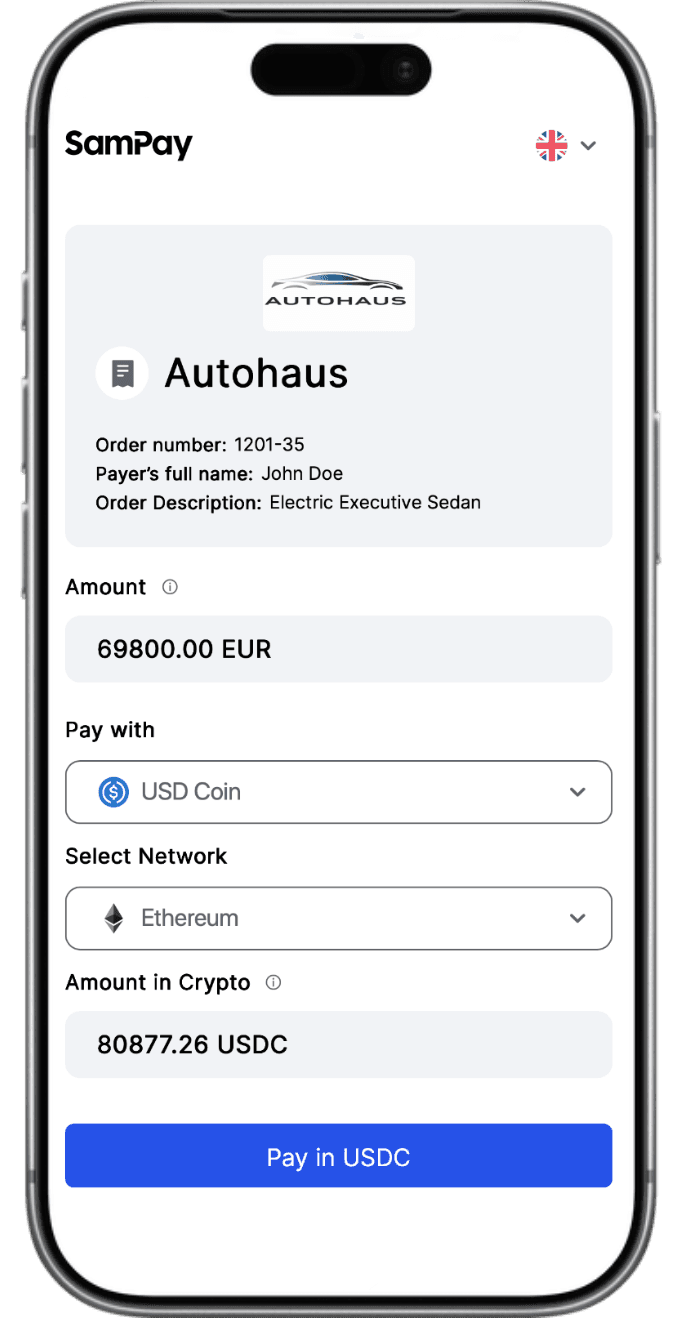
Before looking at the right model, it helps to see what a clean merchant workflow should feel like. The business side should stay familiar, with no need to manage wallets or manually assess transactions.
The payment process should begin in EUR, because that is how your business already prices, reports, and settles transactions.
When a payment starts this way, the logic is already different. You are not restructuring your business around crypto. You are simply giving the customer another way to pay while your internal operation remains in euros.
What should happen if AML check fails
The correct answer is not "the merchant reviews it manually" and not "the merchant accepts first and asks questions later." The correct answer is that the payment provider detects the issue, blocks the transaction from settling to the merchant, and manages the process according to compliance rules.
That is the model serious businesses need. If a payment fails AML screening, it should not quietly pass through and become your problem. It should be isolated before it reaches your balance sheet. The transaction should be reviewed within the provider's compliance process, and if it cannot be accepted, the funds should be returned or otherwise handled according to legal and operational requirements. Your business should not be improvising this in real time.
This is a critical difference in compliant crypto payments. The provider is not just enabling payment acceptance. The provider is standing between your business and the risk you should never have to absorb directly.
Before the customer completes payment, there should already be a clear and controlled payment path, not an informal wallet transfer.
That kind of structure matters because it makes the process trackable and manageable. Instead of funds appearing in a wallet you control, the payment enters a monitored flow where checks, detection, and conversion can happen in the right order.
The model that removes risk from the merchant side
This is where the right architecture matters more than the payment method itself. A safe business model looks like this: the customer pays in crypto, the provider performs AML, KYC, and transaction checks, the payment is converted from crypto to EUR, and the merchant receives EUR by bank transfer.
That last point is the one that changes everything. You do not hold crypto on your balance sheet. You do not need to convert it yourself. You do not need to explain why you received digital assets into a company wallet. You continue operating exactly as before, just with one more way for the client to pay.
You sell cars - you continue selling cars. You sell real estate - nothing changes. You receive EUR - always.
This is also what reduces banking friction. Banks are far more comfortable with a structured, compliant payout flow in EUR than with a merchant moving crypto in and out directly. For finance teams, that means less uncertainty in reconciliation, clearer reporting, and fewer awkward questions later.
Compliance controls should also happen automatically, not as a manual task for your staff. If a payment requires customer verification or additional screening, it should happen within the provider flow rather than through your own team trying to gather documents after the fact.
From a merchant perspective, this is exactly how it should work. The transaction is checked before settlement, not after your business has already accepted the risk.
Where SamPay fits into this process
This is the kind of model SamPay is built for. SamPay allows businesses to offer crypto payment acceptance without becoming crypto operators themselves. The customer can pay in crypto, but SamPay manages the compliance layer, the risk checks, the conversion, and the payout to your bank account in EUR.
That means if an AML check fails, the transaction does not become an internal problem for your accounting team to solve. SamPay handles the process. Risky payments are detected, blocked from settlement, and managed appropriately. If funds need to be returned, that process is controlled by the provider, not improvised by the merchant.
For your business, the difference is practical and immediate. You are not making judgment calls on suspicious transactions. You are not holding assets that may create compliance concerns. You are not trying to convert questionable funds and hoping your bank will be comfortable with the result. You stay on the commercial side of the deal, while the provider handles the payment risk framework.
This is what makes SamPay relevant for traditional businesses and premium offline merchants. It is not about becoming a crypto company. It is about opening a payment channel safely while staying entirely within a EUR-based operating model.
The same logic applies at the end of the flow. Once checks are passed and payment is completed, the process should end in a predictable, familiar way.
That finality matters because it gives your team something they can actually work with: a completed transaction, documented processing, and EUR settlement to the bank account you already use.
Why this matters for decision-makers in Europe
If you are a founder, operator, or finance lead, you are not deciding whether crypto exists. Your clients already know it exists. The real decision is whether your business can accept that demand without creating compliance and banking issues internally.
In Europe, that means the bar is higher than simply receiving digital assets. You need a process that is structured, reviewable, and safe for the business. The wrong setup creates operational burden. The right setup makes crypto invisible on the merchant side.
This is the part many providers fail to explain clearly. They talk about payment acceptance, but not enough about what happens when a transaction is risky. And that is exactly the point where a business needs the strongest protection.
The obvious way to handle failed AML checks
If an AML check fails in a crypto payment, the merchant should not be the one figuring out what to do next. The provider should block the transaction and return the funds where appropriate, while managing the compliance process end to end. That is the safe, business-ready model.
SamPay is designed around that principle. Your customer can pay in crypto, but your company continues receiving EUR, through a controlled and compliant flow that protects your operations. No crypto on balance sheet, no manual transaction risk handling, no unnecessary exposure to banking or compliance issues.
If you want to explore how to accept crypto payments in Europe without taking on crypto risk yourself, this is the next logical step. Review the workflow, test the model, and see what it looks like when crypto payments are handled the way they should be: outside your operational burden, and inside a provider-controlled compliance process.
Book a demo
Let your clients pay in crypto while your business keeps operating in euro.
Book a demo to see how SamPay helps merchants accept crypto payments with compliant EUR settlement and a familiar operational flow.