Published April 5, 2026
VAT and crypto payments: what businesses need to know
If you are looking at crypto payments for business, there is a good chance the first concern is not the payment itself. It is what happens after the payment lands: what exactly do you book, what amount do you put on the invoice, which value is used for VAT, and how do you make sure your accountant, auditor, and bank all see the same clean story. That is where many otherwise interested businesses stop. The issue is rarely demand. The issue is whether accepting crypto creates tax and accounting uncertainty that your team does not want.
This is especially true if you sell high-ticket products or services. In real estate, automotive, jewelry, premium travel, concierge services, or any business where one transaction can be substantial, a small ambiguity in valuation can become a large reporting problem. You may be open to new payment methods, but not if they make VAT treatment harder to explain or increase the chance of errors in your books. That hesitation is reasonable.
Why VAT becomes complicated the moment you touch crypto directly
At first glance, the idea seems simple enough. A client wants to pay in USDT, ETH, or another digital asset, and you want to close the sale. But the moment you accept the crypto directly, the practical questions begin. What is the taxable amount in EUR at the exact moment of payment? Which exchange rate or market source do you use? What happens if the value changes by the time your team records the transaction or converts the funds later?
This is where VAT and crypto payments become uncomfortable for traditional businesses. VAT reporting is built around clarity, timing, and documented value. Your finance team needs to know the tax base in EUR, issue an invoice that matches the actual sale, and maintain records that can be defended later if needed. When the incoming asset is volatile or comes in a form your accounting process was never designed for, you are no longer just taking a payment, you are taking on operational risk.
In practice, this usually does not fail because the rules are impossible. It fails because the workflow becomes inconsistent. One team member uses one valuation point, another records a different figure, the customer paid in crypto, the invoice is in EUR, conversion happened later, and now the accounting trail is no longer clean. If your business operates in Europe, that is not the kind of ambiguity you want anywhere near VAT.
The real issue is the tax base, not the payment method
When finance teams discuss crypto, they often get pulled into the wrong conversation. People start talking about coins, wallets, or market movements. But from a business perspective, the real question is much simpler: what is your taxable sale amount, and can you document it clearly?
That is why many merchants hesitate to accept crypto payments in Europe, even when there is clear customer demand. They are not rejecting the client. They are rejecting the uncertainty around valuation, reporting, and reconciliation. If the sale amount can be challenged, or if the accounting treatment depends on timing and interpretation, the payment method stops being convenient very quickly.
For VAT purposes, what matters is having a reliable euro-denominated basis for the transaction. If you sell a car, the tax should be based on the value of the car sale in EUR. If you sell real estate, the same principle applies. If you provide a premium service, again, the business logic does not change. You sell cars - you continue selling cars. You sell real estate - nothing changes. You receive EUR - always.
What usually goes wrong without a structured payment flow
The biggest problem without a platform like SamPay is not one dramatic failure. It is a series of small frictions that build up around the transaction. A customer pays in crypto, but your accounting team still needs a euro amount for the invoice. Your compliance team wants to know where the funds came from. Your bank may ask questions if converted proceeds arrive without a clear and standardized trail. Meanwhile, your finance team is left deciding how to define the tax base and how to document the conversion properly.
That is why direct crypto handling creates more than just accounting work. It creates internal uncertainty. Who is responsible for checking the origin of funds? Which timestamp determines the value? What if the amount received differs slightly because of market movement or network conditions? What if your bookkeeper records one value and your tax adviser expects another? None of these questions help you sell more. They simply appear because the merchant has been forced too close to the crypto side of the transaction.
For many traditional businesses, this is the point where the opportunity stops looking attractive. Not because clients are unimportant, but because the back office is suddenly carrying a burden it never asked for.
What a cleaner model looks like
The practical solution is not to build crypto expertise inside your company. The practical solution is to structure the payment so that crypto is only the customer's payment method, not your operating currency. That means the flow should be straightforward: the customer pays in crypto, the payment is checked automatically, the amount is converted into EUR, and your business receives EUR by bank transfer.
With this model, the logic becomes far easier for finance and operations. You are not holding crypto on your balance sheet. You are not managing exchange risk. You are not trying to decide later what the "real" EUR amount was for VAT. The settlement amount is already standardized in euro terms and lands where your business already works: your bank account.
Before going further, it helps to visualize what this means in practice. The merchant side starts with a familiar commercial action, not a crypto workflow.
The key point here is simple: the invoice is created in EUR because your business still sells in EUR. The customer may choose to pay with crypto, but that does not redefine your internal accounting model. This is exactly what traditional merchants need if they want compliant crypto payments without changing how sales, VAT, and reconciliation work on their side.
Why standardized EUR settlement makes VAT easier
Once the settlement is defined in EUR from the start, the tax base becomes much easier to manage. Your sale value is expressed in the same currency you already use for pricing, invoicing, VAT reporting, and bank reconciliation. Instead of trying to derive a euro equivalent from a crypto asset after the fact, you have a transaction structure that keeps the euro amount central from the beginning.
This matters because VAT processes depend on consistency more than novelty. Your finance team needs the invoice, payment record, and bank settlement to align. When those elements all point back to the same EUR amount, reporting becomes more defensible and more routine. There is less room for interpretation, fewer manual corrections, and much less stress when preparing filings or explaining payment flows to accounting partners.
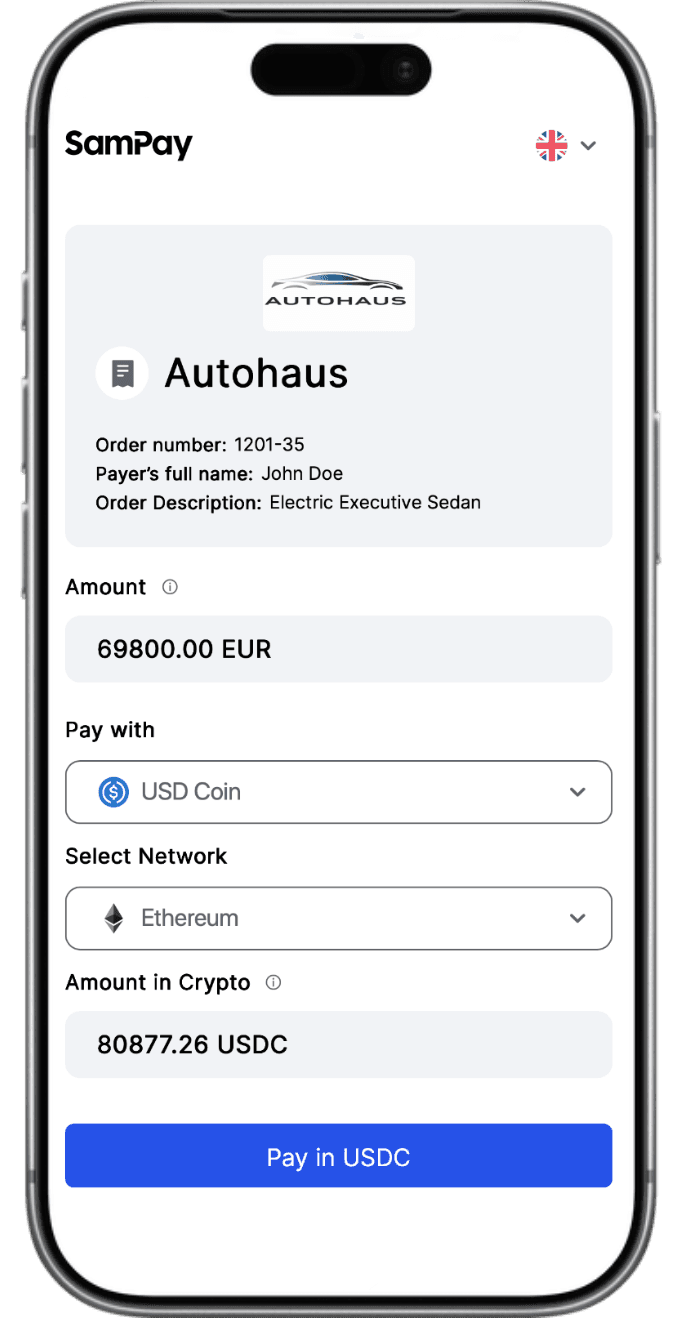
The customer experience can still remain simple. They receive a clear payment page, choose their crypto method, and complete the payment without your staff having to manage wallets or token details directly.
That clarity on the customer side supports clarity on your side. The client gets a modern way to pay, while your business continues to operate through familiar euro-based processes. That is the difference between offering crypto as an additional payment option and turning your company into a crypto-handling business.
Compliance and banking matter just as much as VAT
VAT is often the first concern finance teams mention, but it is rarely the only one. The moment crypto enters a transaction, questions about compliance and banking follow close behind. Where did the funds come from? Was the transaction screened properly? If your bank asks for supporting documentation, can you provide a clear explanation that fits your normal business activity?
This is why compliant crypto payments should not stop at conversion. The checks around the transaction matter just as much. Every payment should be reviewed automatically so your business is not exposed to unnecessary risk or forced to investigate the origin of funds manually. That is not just a compliance feature. It is what protects your ability to keep operating normally with banks, accountants, and auditors.
A structured flow includes these controls in the background, without turning them into daily work for your team.
For a merchant, the value is not technical. The value is that every payment is checked before it becomes your problem. You do not have to become an expert in AML, KYT, or wallet analysis. You simply need a process where those risks are handled before the funds are settled to you in EUR.
Where SamPay fits into this model
This is where SamPay becomes relevant. Not as a crypto tool you need to learn, but as a payment layer that removes the parts your business should not have to deal with. The customer pays in crypto. SamPay handles the transaction screening, verification flow, conversion, and payout. Your business receives EUR through bank transfer, including SEPA or SWIFT, and continues operating as it already does.
That changes the discussion internally. Instead of asking whether your business is ready to hold crypto, track crypto, or calculate tax exposure around crypto movements, the question becomes much more straightforward: do you want to accept more clients while keeping settlement in EUR? For most traditional businesses, that is the only version of crypto acceptance that makes practical sense.
The workflow itself stays simple enough for commercial teams to use without friction.
That simplicity is important because adoption fails when payment operations become too foreign. With SamPay, the merchant does not need a crypto treasury policy, a wallet management process, or a new accounting logic. You continue working in EUR, exactly as before.
What this means for your finance team
For founders, this means you can say yes to more clients without introducing unnecessary risk. For operators, it means the payment process remains manageable. For finance teams, it means there is a clearer path to invoicing, reconciliation, and VAT treatment because the commercial reality of the transaction stays euro-based.
This is the real business value of crypto to EUR settlement. It removes the mismatch between how the customer wants to pay and how your business needs to operate. You are not redesigning your company around a new asset class. You are simply allowing a broader range of clients to pay, while the business receives standard fiat settlement.
That is why this model works particularly well for luxury, offline, and high-ticket sectors. The sale remains what it always was: a car sale, a property transaction, a jewelry purchase, a premium service engagement. The payment method changes for the client. The merchant's operating model does not.
Conclusion: VAT becomes easier when the merchant stays in EUR
If you are evaluating how to accept crypto payments in Europe, VAT is one of the clearest reasons not to handle crypto directly. The challenge is not theoretical. It shows up in the tax base, in invoice matching, in reconciliation, and in every moment where your team has to explain what happened and at what value. That complexity does not help the sale, and it does not belong on the merchant side.
With EUR settlement, things become simpler. The transaction flow is standardized. The customer can pay in crypto, but your business receives EUR to its bank account. Compliance checks happen in the background, conversion is handled for you, and the commercial and accounting side of the sale remains familiar. That is exactly why SamPay is a practical solution for businesses that want compliant crypto payments without taking on crypto complexity.
If you want to explore crypto payments for business without creating VAT confusion, banking friction, or accounting headaches, the next step is simple: look at a model where crypto is abstracted away from the merchant entirely. SamPay standardizes the flow, keeps settlement in EUR, and lets you test whether this payment option fits your business without changing how your business fundamentally works.
Book a demo
Let your clients pay in crypto while your business keeps operating in euro.
Book a demo to see how SamPay helps merchants accept crypto payments with compliant EUR settlement and a familiar operational flow.