Published April 5, 2026
MiCA explained for businesses accepting crypto payments
If you are looking at crypto payments for your business, chances are the real question is not whether clients are willing to pay this way. The real question is much more practical: what does this mean for your company operationally, legally, and from a banking perspective? That is exactly where MiCA enters the conversation, and for many founders and finance teams, this is the point where interest turns into hesitation.
MiCA is often presented as a big regulatory milestone for Europe, but for a merchant, the important part is much simpler. You do not need a lecture on regulation. You need to know whether accepting crypto payments in Europe creates extra obligations for your company, whether you need a license, what your bank will think, and how to avoid building a compliance burden around a payment method you may only use occasionally.
This is where many businesses get stuck. Not because demand is unclear, but because the path looks too complicated.
What MiCA changes for merchants in practice
MiCA matters because it brings a formal regulatory framework to crypto-related activity in Europe. For businesses, that sounds reassuring at first. Regulation suggests clarity. But in practice, it also creates a new layer of questions. If your customer pays in crypto, are you simply receiving a payment, or are you now involved in a regulated activity? If crypto touches your balance sheet, do you need internal controls, reporting processes, or a specific provider setup to stay on the safe side?
That uncertainty is the real issue. A car dealer, property agency, jewelry showroom, or premium service firm usually does not want to spend internal time interpreting financial regulation. Your team is focused on sales, contracts, accounting, and settlement in EUR. The moment crypto enters directly into your workflow, the conversation shifts away from your core business and into compliance definitions, risk ownership, and banking explanations.
Why MiCA does not make direct crypto acceptance simple
One common misunderstanding is that regulation automatically makes direct crypto acceptance easy. It does not. MiCA may create more structure in the market, but it does not remove the operational responsibility from the merchant. In fact, it can make businesses more aware of how many questions they would rather not handle themselves.
If you accept crypto directly, you immediately run into practical issues. Who checks where the funds came from? Who decides whether a transaction is acceptable? What records do you keep if your bank, auditor, or compliance team asks for an explanation later? And if a transaction creates a red flag, who is responsible for identifying it and dealing with the consequences?
This is why many companies initially explore crypto payments for business, then pause. The payment itself is not the hard part. The hard part is everything around it: source-of-funds concerns, internal policy decisions, accounting treatment, and the risk of creating friction with banking partners. The transaction may look modern, but the back-office burden becomes very traditional very quickly.
The merchant problem: uncertainty about regulation, licenses, and responsibility
For most non-crypto-native businesses, MiCA raises three uncomfortable questions at once. First, are you entering a regulated area by handling crypto directly? Second, do you need a licensed partner or a specific legal structure? Third, even if you technically can do it, is it worth taking on the responsibility yourself?
This is especially relevant in high-ticket sectors. If you sell cars, real estate, luxury goods, or premium services, your payments are not casual purchases. They are larger transactions that attract more scrutiny. Finance teams do not just ask whether the client can pay. They ask whether the payment can be documented properly, whether the bank will be comfortable with it, and whether the company is exposing itself to avoidable risk.
In practice, this usually leads to a familiar internal conversation. Sales sees an opportunity. Operations asks how the process would work. Finance asks what hits the books. Compliance asks who screened the transaction. Legal asks whether the business is stepping into regulated territory. What seemed like one extra payment option suddenly becomes a cross-department problem.
Why holding crypto creates more exposure than most merchants expect
The moment your business receives crypto directly, even temporarily, you are no longer just offering another checkout option. You are now dealing with an asset your finance team may not want to hold, value, reconcile, or explain. That introduces volatility concerns, accounting complexity, and questions about how your banking partners view incoming and outgoing funds related to crypto activity.
MiCA does not remove those business realities. It may help define the market, but it does not make your accountant more eager to book digital assets or your bank more enthusiastic about unclear crypto flows. For many merchants, the real goal is much narrower: accept the client, complete the deal, and receive EUR exactly as usual.
That distinction matters. You are not trying to become a crypto business. You are trying to avoid losing clients who want to pay in crypto. Those are two very different things, and they require very different setups.
The model that makes sense: crypto in, EUR out
The cleanest way to approach compliant crypto payments is not to handle crypto yourself at all. Instead, the customer pays in crypto, the transaction is checked automatically, the funds are converted into EUR, and your business receives a bank transfer. Your company continues operating in EUR, your books remain in EUR, and crypto never sits on your balance sheet.
That is the model most traditional businesses are actually looking for, even if they do not phrase it that way at first. You do not want to become an expert in wallet handling, token screening, or regulatory interpretation. You want a payment flow that fits into your existing business without changing how your company operates day to day.
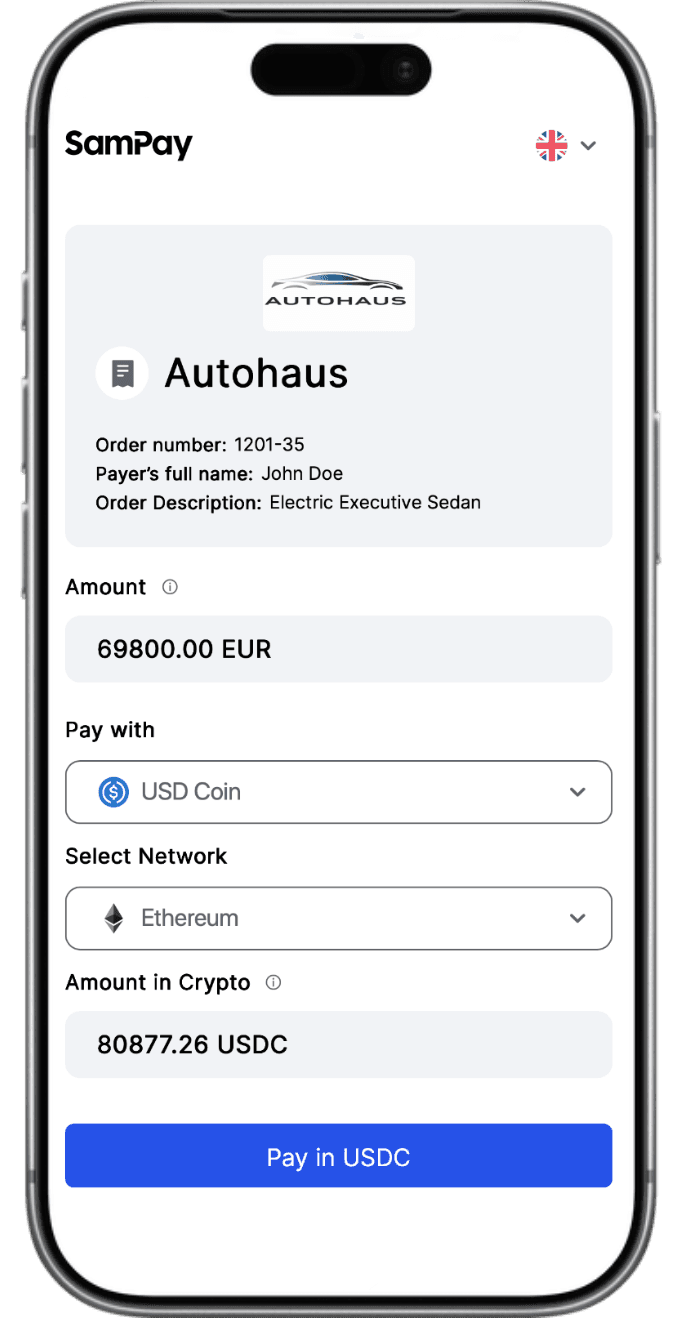
A good crypto to EUR workflow should start from the merchant side, not from the technology side. You issue an invoice or payment request in euros, just as you normally would. The client sees a clear payment path on their side, but for your team, the process remains familiar and controlled.
This matters because it keeps the commercial side of the deal simple. Your staff does not need to discuss exchange rates, wallets, or settlement mechanics with the customer. The price is set in EUR, the payment request is created in EUR, and the transaction begins from the framework your business already understands.
For many merchants, the next concern is whether the customer experience becomes complicated. It should not. If a client is going to pay in crypto, the flow needs to be straightforward on their side too, otherwise the sale slows down and confidence drops.
This is exactly how compliant crypto payments should work: easy for the client, controlled for the merchant, and structured in a way that does not drag your internal team into technical details. You are not teaching customers how to pay. You are simply giving them an additional method while your business remains anchored in EUR.
Where compliance actually belongs
MiCA makes one thing very clear for businesses: if crypto is involved, compliance cannot be an afterthought. But that does not mean your company should personally build and operate those controls. In a sensible merchant model, the screening, verification, and transaction monitoring happen within the payment infrastructure, not inside your sales or finance department.
That means every payment is checked before it becomes your problem. Instead of wondering whether you should investigate a transaction, document its source, or prepare an explanation for a bank later, the process is handled through a provider designed for that purpose. This is the practical difference between offering crypto payments and taking on crypto compliance yourself.
Before a transaction reaches settlement, identity and transaction checks should happen automatically. That is not a technical feature for its own sake; it is what protects your business from receiving funds you later have to justify.
From a business perspective, this is where the value really is. Your company should not need to interpret MiCA article by article, wonder about licensing boundaries, or create internal procedures around high-risk payment screening. Those responsibilities belong with a regulated and specialized provider.
Why licensed infrastructure matters more under MiCA
Once MiCA enters the discussion, the safest question is not "Can we do this ourselves?" but "Why would we want to?" For most merchants, self-managing crypto acceptance creates the exact kind of exposure they are trying to avoid. You take on uncertainty around process, reporting, banking, and accountability, even though your real objective is simply to close deals and receive EUR.
Working through licensed infrastructure changes that completely. The provider handles the crypto side, performs the required checks, manages the conversion, and sends EUR to your bank account. Your business remains on the merchant side of the transaction, not on the regulated infrastructure side of it.
This is where a platform like SamPay fits naturally. SamPay allows businesses to accept crypto payments in Europe without taking custody of crypto themselves. The customer pays in crypto, the payment goes through automated AML/KYC/KYT checks, the amount is converted, and your company receives EUR via bank transfer. From your business perspective, nothing fundamental changes.
You sell cars - you continue selling cars. You sell real estate - nothing changes. You receive EUR - always.
That is the key business logic under MiCA. Regulation may shape how crypto payment providers operate, but it does not need to turn your company into a compliance operator. The right setup keeps your business outside that complexity while still letting you serve clients who prefer to pay this way.
What this means for your decision
If your team is evaluating crypto payments for business, MiCA should not be read as a reason to build everything in-house. It should be read as a reason to choose the right structure from the beginning. The more clearly the market is regulated, the less sense it makes for a traditional merchant to improvise.
The decision is not really about whether crypto payments are possible. They are. The decision is about whether you want to own the risk, the checks, the banking conversations, and the operational burden that come with direct crypto handling. Most businesses do not, and frankly, they should not have to.
The practical conclusion for merchants
MiCA changes the conversation because it makes businesses think more seriously about who should carry responsibility in a crypto payment flow. And the practical answer is straightforward: not the merchant. If you work with a licensed provider, your business does not need to dive into regulatory complexity, interpret licensing requirements, or design its own compliance layer around crypto.
That is why the crypto → conversion → EUR → bank account model is the obvious one for traditional businesses. It gives you access to customer demand without changing your accounting reality, your treasury logic, or your day-to-day operations. You continue running the business you already have, while the difficult part stays where it belongs.
SamPay is built precisely for this model. It lets you offer compliant crypto payments while receiving predictable EUR settlements to your bank account, without holding crypto and without turning your team into specialists in regulation. If you are exploring how to accept crypto payments in Europe, this is the safest and most practical next step: keep the client experience flexible, and keep your business in EUR.
Explore the workflow, test how it fits your sales process, and evaluate it the same way you would any serious payment infrastructure. For most merchants, once the complexity is removed, the decision becomes much easier. This is the obvious way to do it.
Book a demo
Let your clients pay in crypto while your business keeps operating in euro.
Book a demo to see how SamPay helps merchants accept crypto payments with compliant EUR settlement and a familiar operational flow.