Published April 5, 2026
How to stay compliant when accepting crypto payments in EU
If you are looking into crypto payments for business, you are probably not asking a technical question. You are asking a business question: can your company accept this type of payment without creating legal, banking, and accounting problems later. That is the right question to ask, especially in the EU, where payment compliance is not something you can treat casually.
In practice, this is where many companies hesitate. The commercial side looks attractive because clients want more payment flexibility, especially in high-ticket segments such as cars, real estate, jewelry, and premium services. But the moment you move from "could we accept crypto?" to "how do we do this safely?", the issue becomes much bigger than payment acceptance itself.
Why compliance becomes the real issue
At first glance, it may seem simple. A customer wants to pay in crypto, you receive the funds, and the deal is done. But for a traditional business in Europe, that is not how the story ends. The moment you accept crypto directly, you also take responsibility for questions your finance team, accountant, compliance officer, or bank will eventually ask.
Where did the funds come from? Was the sender properly verified? Was the transaction screened? How do you document the conversion value? What appears on your books? And if your bank reviews incoming activity later, how will you explain the source and processing of those funds in a way that satisfies them?
This is why so many businesses delay the decision. It is not because demand is missing. It is because the operational burden quickly becomes disproportionate to the payment itself. You sell cars - you continue selling cars. You sell real estate - nothing changes. You receive EUR - always. That is how it should work, but direct crypto handling usually pulls your business into a role it was never built for.
A practical compliance checklist before you accept crypto payments in Europe
If you want to accept crypto payments in Europe in a serious and sustainable way, it helps to think in checklist form. Not because compliance is a box-ticking exercise, but because every missing process creates a real business risk.
1. Can you verify who is paying you?
The first question is basic but critical: do you actually know who the payer is. In many industries, especially with large transaction values, this is not optional. If a business accepts a crypto transfer without proper customer identification, it may later struggle to prove that it took reasonable steps to verify the source of the payment.
This becomes even more important when transactions are cross-border or unusually large. What feels like a completed sale on the commercial side can become a documentation problem on the compliance side if there is no proper KYC flow attached to the payment process. A payment is not compliant just because it arrived successfully.
A compliant process should make identity verification part of the workflow, not something your team has to chase manually afterward.
2. Can you screen the transaction before it becomes your problem?
The next issue is transaction screening. If you accept crypto directly, you are exposed to the risk that the funds may be linked to suspicious activity, sanctioned sources, or other red flags. Even if your company had no bad intent, receiving that payment can still create difficult questions from banking partners and internal auditors.
This is where many businesses underestimate the problem. They assume compliance means checking the customer, but in practice you also need to assess the transaction itself. If that process is missing, your company is relying on luck rather than controls.
What you need is a system where every incoming payment is checked automatically, so you do not have to wonder whether the funds will create issues later.
3. Do you know how the payment will look to your bank?
Many founders focus on the moment of payment and forget the moment that comes after: settlement into the bank account. But this is exactly where friction often starts. Banks are not interested in whether crypto is fashionable. They care whether the incoming funds are clear, documented, and consistent with your business activity.
If your model involves directly receiving, holding, or moving crypto, your bank relationship may become harder to manage. Not necessarily because something is wrong, but because the structure itself raises extra questions. You then spend time explaining wallet activity, transaction origins, conversion history, and internal procedures that your team may not even be fully equipped to document.
For most traditional businesses, this is unnecessary. You do not need a crypto operating model. You need a settlement model that keeps your business in familiar territory: invoice, payment, EUR, bank transfer, accounting record.
4. Can your finance team book everything cleanly in EUR?
This is often the moment when enthusiasm from the commercial side meets resistance from finance. Sales may see a new payment option. Finance sees valuation questions, reconciliation issues, and a possible mismatch between what the customer paid and what the company should record.
If crypto touches your balance sheet directly, even temporarily, complexity increases immediately. Which value do you recognize, and at what moment? How do you handle price fluctuations? What internal policy applies? What happens if conversion timing changes the final amount? For a business that operates in EUR, this is an avoidable complication.
The cleaner model is simple: the customer pays in crypto, the amount is converted, and your company receives EUR in its bank account. From your finance team's perspective, the business continues operating exactly as before.
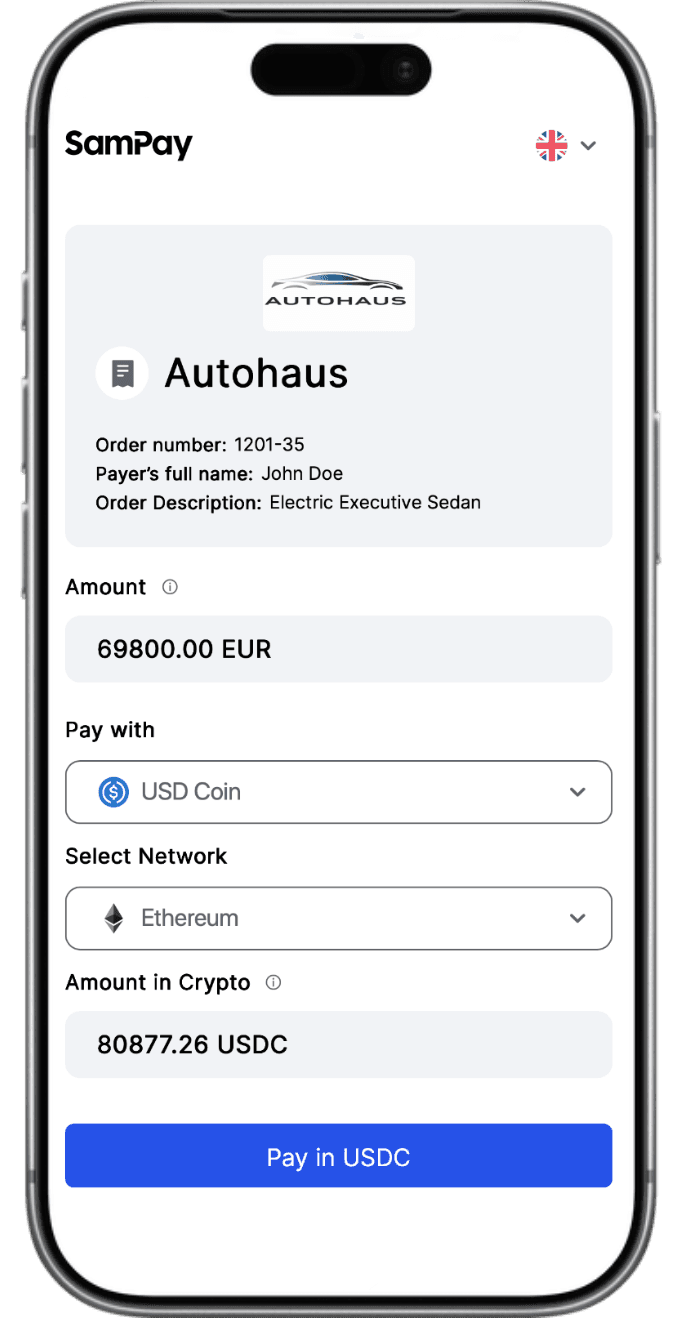
Before getting into the infrastructure behind that model, it helps to see how the merchant-side workflow should actually look. It should feel familiar, not like a separate crypto operation.
5. Do you have a process, or just a possibility?
This is one of the most practical questions in the whole checklist. Many businesses technically can accept crypto in some form. Very few have a process that makes it safe, repeatable, and easy for staff to follow.
A real process means your team knows what happens from the moment the invoice is issued to the moment EUR lands in your account. It means customer verification is built in, payment checks are automated, settlement is predictable, and records are available when needed. Without that, every transaction becomes a custom case, and custom cases are where mistakes happen.
That is why the risk is so high for companies that try to assemble this internally without expertise. You are not just adding a payment method. You are taking on compliance design, transaction monitoring, conversion logic, banking explainability, and operational controls. For most merchants, that is not a sensible use of internal resources.
What a compliant model should look like in practice
If you strip away the noise, the right model is straightforward. The customer chooses to pay in crypto. The payment is verified and screened. The crypto is converted into EUR. Your business receives EUR by bank transfer through SEPA or SWIFT. You do not hold crypto, you do not manage wallets as part of normal operations, and you do not carry exposure on your balance sheet.
That is the key difference between "accepting crypto directly" and using compliant crypto payments infrastructure. In the second model, crypto is simply the customer's payment rail. For your business, the result is still EUR.
This matters because it preserves how your company already works. Your pricing stays in EUR. Your accounting stays in EUR. Your treasury stays in EUR. The customer gets flexibility, but your internal model does not need to change.
For the customer side, the experience should also be clear and controlled. They need a professional payment flow, not an improvised wallet exchange over email or messaging apps. That reduces confusion and also supports trust during larger transactions.
Where SamPay fits into this model
This is exactly where a solution like SamPay becomes relevant. Not because it helps you "get into crypto" in an abstract sense, but because it removes the parts of crypto that traditional businesses should not have to manage themselves.
With SamPay, the flow is built around the business reality most merchants want. Your customer can pay in crypto. The payment goes through the required compliance checks, including KYC, AML, and KYT controls. The funds are converted from crypto to EUR. Your company receives EUR directly to its bank account. No crypto needs to sit on your balance sheet, and no separate internal crypto process needs to be created.
From an operational perspective, this matters just as much as the compliance layer. Your team can work with invoices and payment links in a familiar way instead of reinventing the process for each deal. The result is a model that is easier to explain internally, easier to reconcile, and easier to support over time.
SamPay is particularly relevant if you want to accept crypto payments in Europe without turning your finance team into a compliance desk. In sectors with high-value transactions, that distinction is crucial. The payment should support the sale, not introduce a second layer of risk around it.
The simplest way to stay compliant
If you are evaluating compliant crypto payments, the main decision is not whether clients are willing to pay this way. In many industries, they already are. The real decision is whether your business will try to carry the compliance and operational burden itself, or use infrastructure where those controls are already built in.
For most traditional businesses, the answer is clear. The simplest way to comply with EU expectations is to use a model where customer checks, transaction screening, crypto to EUR conversion, and bank settlement are handled inside one structured process. That is what removes the risk of ad hoc decisions, missing documentation, and unnecessary banking friction.
SamPay is built for exactly that. You keep running your business as you always have. You sell cars - you continue selling cars. You sell real estate - nothing changes. You receive EUR - always. That is why this approach feels less like adopting something new and more like removing a layer of avoidable complexity.
If you want to explore crypto payments for business without taking on crypto operations yourself, SamPay is the practical next step. It gives you a way to accept crypto payments in Europe while staying anchored in the model your business already understands: compliant process in, EUR settlement out. This is the obvious way to do it.
Book a demo
Let your clients pay in crypto while your business keeps operating in euro.
Book a demo to see how SamPay helps merchants accept crypto payments with compliant EUR settlement and a familiar operational flow.