Published April 5, 2026
How to reduce volatility risk in crypto payments
If you are looking into crypto payments for business, there is a good chance your first concern is not demand. It is control. You may already see that some clients want to pay in USDT, ETH, or other digital assets, especially in cross-border or high-ticket transactions. But the moment the conversation reaches internal finance, the same question usually appears: what happens if the value moves before the money reaches us?
That hesitation is justified. For a traditional business, volatility is not a side topic. It is the reason many companies decide not to accept crypto payments in Europe at all. You are not trying to become a trading desk. You are trying to sell a car, close a real estate deal, invoice for a premium service, and receive the amount you expected in EUR. That is the real business requirement.
Why volatility becomes a business problem so quickly
On paper, taking payment in crypto can sound simple. A client sends funds, you receive them, and the sale is complete. In practice, this is exactly where risk begins. If your company accepts crypto directly, even for a short period, you are exposed to price movement from the moment the client pays until the moment you convert those funds into euros.
That gap may be minutes, hours, or longer depending on your internal process. Someone has to monitor the payment, confirm receipt, decide when to convert, handle the transfer, and document what happened. During that time, the value can move against you. What looked like a profitable sale at the moment of invoicing can quietly turn into a lower-margin transaction by the time the money reaches your bank.
For businesses with high-ticket transactions, this is not a theoretical issue. A 2% or 3% move on a luxury car sale, property reservation, or premium service invoice is meaningful. It affects margin, reporting, and confidence in the payment method itself. What should have been a straightforward sale becomes a question mark for finance and management.
What volatility risk looks like in real operations
The easiest way to understand this risk is to look at how normal businesses actually work. Your prices are set in euros. Your accounting is in euros. Your suppliers, taxes, salaries, and reporting all depend on euro values being clear and stable. The moment payment enters in a volatile asset, you create a disconnect between how you sell and how you operate.
The sale is agreed, but the final amount becomes uncertain
Imagine you issue an invoice for €25,000. The client wants to pay in crypto. If you accept the asset directly, the transaction may still be worth €25,000 at the moment it is sent, but by the time your team verifies receipt and converts it, the value may be lower. Even if the change is small, the impact lands on your business, not on the client.
This creates an awkward internal reality. Sales believes the deal is done. Finance sees a shortfall. Accounting now has to explain why the expected euro amount and the actual euro proceeds do not match perfectly. What looked like a modern payment option becomes an administrative problem.
Your team starts managing market timing without wanting to
Most merchants do not notice this at first. They think they are simply adding another payment method. But if you handle crypto directly, your team ends up making market decisions, even if unintentionally. Do you convert immediately? Do you wait for a better rate? What if conversion is delayed because someone is unavailable? What if the payment arrives outside business hours?
This is where the core misunderstanding appears: you are no longer just accepting a payment, you are taking on exchange risk. And for most traditional businesses, that is not part of the job. You sell cars - you continue selling cars. You sell real estate - nothing changes. You receive EUR - always.
Volatility is only one part of the problem
Once a business looks closer, it becomes clear that price movement is tied to a bigger issue. Direct crypto acceptance does not only create rate risk. It also brings operational and compliance questions that most finance teams would rather avoid.
If funds arrive directly to your wallet, someone in your company becomes responsible for checking where they came from, whether the payment can be documented properly, and how your bank will view the converted funds later. Then there is treasury management: who holds access, how the transfer is approved, what happens if something is sent incorrectly, and how everything is recorded. Even if you solve the volatility problem manually, you are still left with extra risk that never existed in your normal EUR workflow.
That is why the real goal is not merely to accept crypto payments. The goal is to let crypto-paying customers buy from you without changing the way your business operates.
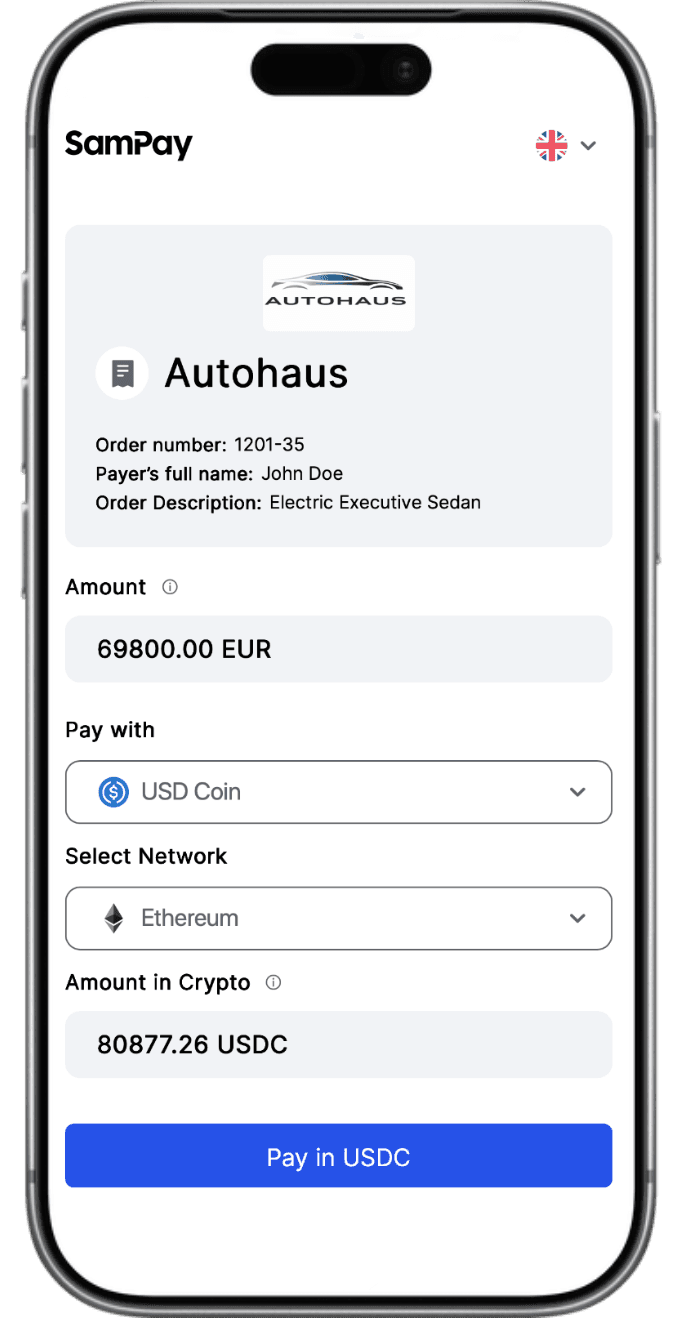
To make that possible, the payment flow has to begin in a familiar way. You should still create the amount in EUR, exactly as you would for any other sale.
When the process starts from a euro invoice, the logic stays clear for your sales team, finance team, and customer. The transaction is defined by the amount your business needs to receive, not by a token balance you then have to manage. That distinction matters because it removes uncertainty from the very beginning.
The model that removes volatility risk
The clean solution is not to hold crypto for less time. The clean solution is not to hold it at all. The correct model is straightforward: the client pays in crypto, the payment is checked automatically, it is converted into EUR immediately, and your business receives EUR by bank transfer.
That means your company never carries crypto on its balance sheet. You do not need to decide when to sell. You do not need to watch the market. You do not need internal policies for storage, custody, or liquidation. The crypto part exists for the customer, not for you.
This is also where compliant crypto payments become practical rather than theoretical. Every transaction should be checked before settlement, so your business is not left wondering how to explain incoming funds to a bank or auditor later. Instead of taking on technical and compliance work internally, you keep the outcome simple: a euro payout to your bank account.
That compliance layer should not create friction for your team either. It should happen inside the payment flow, not through manual back-and-forth after the fact.
For a merchant, the business value is clear. Every payment is screened automatically, so you do not have to investigate the source of funds yourself or worry that a legitimate sale will later create banking questions. The customer completes the required step, the transaction is reviewed, and the process moves forward in a controlled way.
Why instant conversion matters more than most businesses realize
When companies first discuss crypto to EUR settlement, they often focus on customer convenience. That matters, but internally the bigger advantage is predictability. If conversion happens immediately within the payment process, then volatility stops being your problem.
This has several practical effects. First, your revenue is protected because the amount is locked around the transaction rather than left exposed to market movement. Second, your finance team can reconcile the payment more easily because the settlement logic stays tied to the euro invoice. Third, management can approve crypto payments as a sales channel without feeling that they are opening a speculative risk.
For businesses that want to accept crypto payments in Europe, this is usually the turning point. The discussion changes from "Do we want to deal with crypto?" to "Can we let customers pay this way while we continue operating in EUR?" Those are two very different questions. The second one has a workable answer.
The customer side can also remain simple. Once the payment request is created, you can send a dedicated payment link instead of building a new manual process around every sale.
In practice, this matters because your staff should not need crypto expertise to complete a transaction. They send a link, the customer follows the payment steps, and your business waits for euro settlement. The workflow feels familiar because it is built around the sale, not around managing digital assets.
Where SamPay fits into this model
This is exactly the gap SamPay is designed to close. It allows your customer to pay in crypto while your business receives EUR directly to your bank account through SEPA or SWIFT. The conversion happens within the flow, and the required AML, KYC, and KYT checks are built in before settlement. Your company does not hold crypto, does not manage wallets as part of treasury, and does not need to create new internal routines for exchange timing.
That is the important distinction. SamPay is not just a tool to accept crypto. It is a way to remove the parts that make direct crypto acceptance risky for a traditional business. Volatility, compliance pressure, and banking friction are handled inside the infrastructure, so your operating model stays unchanged.
The final customer experience also reinforces trust. The payment process is guided, clear, and structured, which is especially important for high-value transactions where buyers want confidence and merchants want consistency.
When the payment is completed, the result for your business is simple: you receive euros, as expected. No token exposure. No waiting to decide when to convert. No balance-sheet complication. Just settlement in the currency your business already uses.
A safer way to accept crypto payments for business
If you have avoided crypto payments until now, that decision probably had less to do with customer demand and more to do with what came after the payment. And that instinct was correct. The problem was never the idea of letting a client pay in crypto. The problem was the volatility, compliance burden, banking uncertainty, and operational mess that came with handling it directly.
The better model is to remove that burden entirely. The client can pay in crypto. The system checks the transaction. The amount is converted into EUR. Your business receives the payout to its bank account. This is how crypto payments for business become usable in the real world.
Instant conversion removes the risk that most companies are actually worried about. SamPay makes that model practical. If you want to accept crypto payments in Europe without putting your revenue, reporting, or banking relationships under pressure, this is the obvious way to do it.
If you are exploring compliant crypto payments for your company, the next step is simple: look at whether your sales process can stay exactly as it is while the payment method expands behind the scenes. That is the benchmark that matters. If your business can continue selling normally and receive EUR only, then crypto stops being a risk and becomes just another way for clients to pay.
Book a demo
Let your clients pay in crypto while your business keeps operating in euro.
Book a demo to see how SamPay helps merchants accept crypto payments with compliant EUR settlement and a familiar operational flow.