Published April 5, 2026
How to declare crypto payments for a business in Europe
If you are looking into crypto payments for business, there is a good chance your first concern is not the payment itself. It is what happens after. Your sales team may be open to new payment methods, your clients may be asking for flexibility, and your business may see clear commercial value in accepting crypto payments in Europe. But then finance steps in with a very practical question: how do we declare this properly?
That is usually where enthusiasm slows down. Because the moment crypto touches your books directly, the discussion changes from "can we accept this payment?" to "how do we track it, value it, document it, and explain it later?" For a founder, an operator, or a finance team, this is the real issue. The problem is not accepting crypto. The problem is everything that comes with it.
Why declaring crypto payments becomes a business problem
In theory, receiving a payment in crypto can sound simple. A client sends funds, you confirm receipt, and the deal moves forward. In practice, this is where accounting and reporting become uncomfortable very quickly, especially if your business is built to operate in EUR and not as a crypto-native company.
The first issue is visibility. With traditional bank payments, your accounting team works with familiar bank statements, clear settlement dates, and transaction references that fit into existing workflows. With direct crypto payments, the trail often looks different. You may need to connect wallet activity to invoices manually, identify which incoming transfer belongs to which client, and make sure internal records actually match what happened on-chain. That is not just inconvenient. It creates risk when you later need to prepare reports, answer auditor questions, or justify how funds were received.
The second issue is valuation. Even if the client pays the exact expected amount in USDT, ETH, or another asset, your business still needs to determine how that payment is reflected in EUR terms for accounting and tax purposes. Which exchange rate do you use? At what exact moment? What if the asset moves before conversion? What if part of the amount arrives later or network conditions affect timing? These are not technical details. They become real reporting questions that your finance team has to resolve and defend.
What usually goes wrong when businesses handle crypto directly
Most traditional businesses do not struggle because they cannot generate a wallet address. They struggle because direct crypto handling introduces a layer of operational work they were never designed for. You sell cars - you continue selling cars. You sell real estate - nothing changes. You receive EUR - always. That is how the business wants to operate, and for good reason.
Tracking transactions is harder than it looks
Let us say your business receives several large payments over a week. One is a reservation fee, one is a full invoice payment, and one is a split transaction coming from a client using different wallets. Now someone inside the company has to reconcile those transfers with contracts, invoices, internal approvals, and expected settlement amounts. If that process depends on screenshots, wallet explorers, spreadsheets, and manual notes, it becomes fragile very fast.
Before showing how this can be simplified, it helps to see what a cleaner merchant workflow looks like when the payment starts from a standard business invoice in EUR.
That is the key difference many businesses are looking for. The commercial side of the transaction starts exactly as it already does today. The invoice is created in EUR, the amount is clear, and the business does not need to redesign its internal process around crypto.
Exchange rate questions create reporting uncertainty
The next problem appears when finance asks a basic question: what exactly did we receive? If your accounting currency is EUR, the answer cannot simply be "0.85 ETH" or "25,000 USDT." You need a defensible EUR value attached to the transaction, and you need consistency in how that value is determined.
This sounds manageable until transaction timing, asset price differences, and internal controls all enter the picture. If the value used for reporting differs from the value later recognized in bank settlement, someone has to explain the variance. If the payment stays in crypto for any period of time, then you are no longer dealing only with customer settlement. You may also be dealing with asset valuation, gain or loss treatment, and additional documentation requirements. For a business that never wanted crypto exposure in the first place, this is an unnecessary complication.
Documentation becomes harder to defend later
A business does not just need to receive money. It needs to prove what happened. That means invoice references, customer identity, payment origin checks, settlement records, and a reporting trail that makes sense to accountants, auditors, and banks. When crypto is handled directly, these records often come from different sources and formats. One part is in your ERP, another in an exchange account, another in wallet history, and another in internal email threads.
This is exactly where finance teams become cautious. Not because they reject innovation, but because they know that weak documentation creates expensive problems later. If a bank asks about incoming funds, or an auditor asks how certain payments were assessed, "we have the wallet history somewhere" is not a serious business answer.
The better model: crypto is used by the client, EUR is received by the business
This is where the structure matters more than the payment method itself. If you want compliant crypto payments without turning your finance team into crypto specialists, the cleanest model is straightforward: the customer pays in crypto, the transaction is screened, the amount is converted, and your business receives EUR by bank transfer.
In other words, the client can use crypto, but your business continues operating exactly as before. No crypto sits on your balance sheet. No internal treasury exposure is created. No one on your side needs to manage wallets, worry about volatility, or build reporting logic around digital assets. From an accounting perspective, you are working with EUR settlement into your bank account.
This is also the point where compliant crypto payments become practical for traditional businesses. The AML, KYC, and KYT checks happen as part of the payment flow, so the transaction is not just received - it is reviewed automatically. That matters because finance teams and company directors do not only care about revenue recognition. They also care about where the funds came from and whether the payment can create banking friction later.
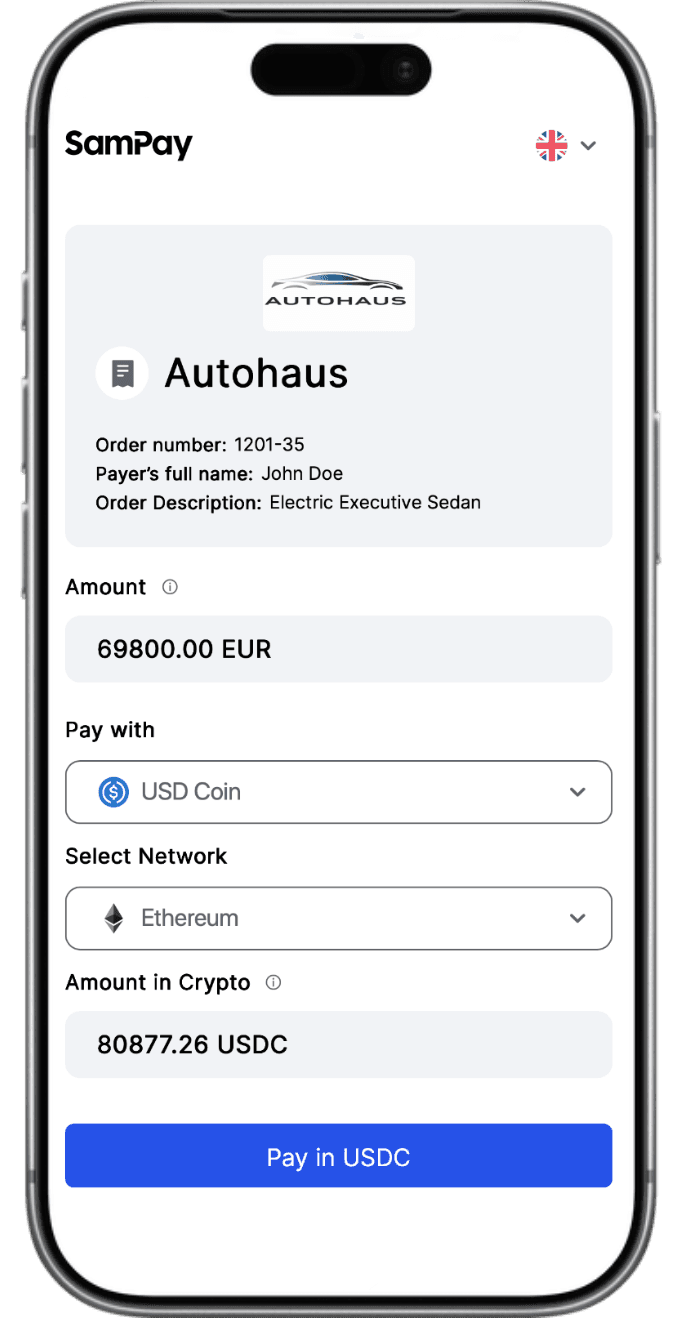
Before we go further, it is useful to see how the payment step can remain simple for the customer while staying controlled for the merchant.
From the client's side, the payment experience is clear and direct. From your side, the important part is not the wallet interaction itself. It is that the process is structured in a way that supports proper settlement and documentation without pushing crypto handling into your internal operations.
Why EUR settlement makes declaration and tax accounting easier
For most businesses in Europe, accounting becomes easier the moment the payment flow ends in fiat. That is because your reporting process can stay aligned with what your finance team already understands: invoice amount in EUR, settlement amount in EUR, bank transfer received, standard bookkeeping entry, normal reporting trail.
This does not mean compliance disappears. It means it is handled where it should be handled - inside the payment infrastructure, not inside your daily accounting routine. Every payment is checked automatically, so you do not have to worry about where the money came from or how to explain it to your bank. Instead of documenting a crypto asset movement, a rate conversion, and a later payout, your team works with a clean EUR settlement result.
That distinction is extremely important for decision-makers. When people talk about how to accept crypto payments in Europe, they often focus on the front end. But the real operational advantage appears in the back office. If finance can treat the incoming funds as an ordinary fiat operation, adoption becomes realistic.
Before that settlement reaches your books, strong compliance checks also need to happen in the background without slowing down the transaction unnecessarily.
This is where many businesses feel relief. The controls exist, but they do not become your internal burden. The payment is screened, the risk is managed, and your team is not left assembling evidence after the fact.
Where SamPay fits into this model
This is exactly the kind of structure SamPay is built for. Rather than asking your business to receive and manage crypto directly, SamPay lets the client pay in crypto while your company receives EUR to its bank account through SEPA or SWIFT. That means crypto to EUR happens within the payment flow, not on your balance sheet.
For a founder or operator, that changes the conversation internally. You are no longer asking finance to support a new asset class. You are giving them a controlled payment route that ends in the same currency your business already uses. For accounting, reporting, and internal approvals, this is a much cleaner model than direct wallet acceptance.
It also helps solve the practical problems that usually make businesses hesitate. Transaction tracking becomes clearer because payments are tied to a structured flow. Exchange rate uncertainty is reduced because conversion happens within the settlement process. Documentation is easier to organize because the transaction is not spread across disconnected tools and manual records. And from a banking perspective, the merchant receives EUR, not crypto.
You can see that same logic in the completion stage of the payment flow. What matters to the business is not that crypto was used somewhere in the background. What matters is that the payment is completed reliably and can be treated as a normal business transaction on the merchant side.
What this means for your finance team
If your team is evaluating crypto payments for business, the real benchmark is not whether a transaction can be technically accepted. It is whether the entire process can be declared, documented, and reported without introducing new accounting confusion or unnecessary risk.
That is why the direct-crypto model often feels wrong for traditional businesses. It asks your internal team to solve problems that should not exist in the first place: wallet reconciliation, exchange rate interpretation, asset treatment, fragmented records, and difficult audit trails. For luxury, real estate, automotive, jewelry, and other high-ticket sectors, those issues do not help the sale. They just complicate the back office.
With EUR settlement, the logic becomes much more natural. The customer gets the payment flexibility they want. Your business keeps its normal operational model. Finance receives familiar banking records. Accounting stays focused on fiat reporting. And the commercial benefit of accepting crypto payments in Europe no longer comes with unnecessary internal disruption.
The obvious way to handle crypto payments in Europe
If the goal is to grow without creating accounting headaches, the answer is not to make your company "more crypto." The answer is to keep your company exactly as it is, while giving clients an additional way to pay. That is the distinction that matters most.
When settlement happens in EUR, declaration and tax accounting become much closer to ordinary fiat operations. That is the model finance teams can work with, management can approve, and banks are far more comfortable with. SamPay makes this possible by turning a complex crypto payment into a predictable EUR settlement flow your business can actually use.
If you are exploring compliant crypto payments, this is the logical next step: look at a setup where the client pays in crypto, the checks happen automatically, the amount is converted to EUR, and your company receives funds in the bank as usual. No crypto on the balance sheet. No unnecessary operational burden. No reason for your team to change how the business already runs.
Book a demo
Let your clients pay in crypto while your business keeps operating in euro.
Book a demo to see how SamPay helps merchants accept crypto payments with compliant EUR settlement and a familiar operational flow.