Published April 5, 2026
How to accept crypto without holding crypto on balance sheet
If you are looking into crypto payments for business, there is a good chance your first concern is not the payment itself. It is what happens after the payment. Your finance team starts asking whether crypto would appear in accounting records, your accountant wonders how to classify it, and someone inevitably raises the banking question: how will this look when funds move through the company? That hesitation is not about being resistant to innovation. It is about protecting a business that already runs in a clear, familiar way.
This is especially true if you sell high-ticket products or services. In real estate, automotive, jewelry, luxury retail, or premium consulting, one payment can be large enough to trigger internal review on its own. The moment crypto is accepted directly, you are no longer just taking a payment - you are introducing a new asset class into the business. That changes accounting, reporting, audit preparation, and often the conversation with your bank as well.
Why businesses hesitate even when clients are ready to pay
At some point, a client may ask whether they can pay in USDT, ETH, or another cryptocurrency. Commercially, this can sound like a simple opportunity. You already have the client, the amount is agreed, and the only question seems to be the payment method. But in practice, this is where many businesses pause, because accepting crypto directly is not the same as receiving a normal EUR payment.
Once crypto lands in your wallet, it becomes your company's asset, at least for some period of time. From there, the questions begin. How should it be recorded in the books? At what valuation? What happens if the asset price moves before conversion? How should your auditor view it? And how do you explain these flows clearly to your bank if your business is otherwise entirely fiat-based?
These are not theoretical concerns. For a founder, it means introducing a process that did not exist before. For operations, it means new payment handling rules. For finance, it means extra accounting treatment, possible tax implications, reconciliation work, and a new dependency on external explanations. What looked like "just another way to get paid" becomes an operational layer that your business did not ask for.
What changes when crypto appears in your accounting
It is no longer just revenue collection
If your company accepts crypto directly, the transaction does not stop at "customer paid." You now need to reflect the receipt of a digital asset, track its conversion, document rates, and reconcile every step. Even if the intention is to convert it quickly, there is still a moment when the crypto belongs to your business. That is the moment accounting becomes more complicated.
For many traditional businesses in Europe, this is exactly what they want to avoid. You sell cars - you continue selling cars. You sell real estate - nothing changes. You receive EUR - always. The business model is already clear. Adding crypto assets to the balance sheet creates a mismatch between how the business operates commercially and how it starts to appear financially.
Audit and tax treatment become harder to manage
The more formal your internal controls are, the more direct crypto acceptance creates friction. Auditors will want a documented trail. Accountants will need consistency in recognition and valuation. Tax advisors may need to confirm how gains, losses, or conversion events are treated. Even when the final economic result is straightforward, the path to documenting it is often not.
That extra work rarely creates value for the merchant. It simply exists because the crypto entered the business first. The issue is not customer demand - the issue is the accounting burden created by receiving the asset directly.
Before going further, it helps to look at what the right workflow should actually feel like from the merchant side. The key is that your invoice remains in EUR from the start.
When the amount, currency, and payment terms are set in EUR, your commercial process stays exactly where it should be: inside your normal business logic. You are not pricing products in crypto, and you are not managing exchange exposure internally. You are simply offering the client an additional payment rail while keeping the transaction anchored in euros.
Why direct crypto acceptance also creates banking friction
Accounting is only one part of the problem. Banking is the other. Many companies are less worried about the payment itself than about how their bank will react to crypto-related flows. If funds come in from a wallet, move through exchanges, or are settled inconsistently, this can create questions that your finance team then has to answer repeatedly.
In practice, this usually looks like unnecessary back-and-forth. Your bank asks for proof of source of funds. Compliance teams want transaction explanations. Internal staff spend time collecting screenshots, wallet details, conversion records, and client documentation. None of this helps you close more deals or serve customers better. It is simply the cost of handling crypto in the wrong way.
This is why many businesses looking to accept crypto payments in Europe are not really searching for a "crypto solution." They are searching for a way to get paid without changing how the business is run. They want the client to pay in crypto if needed, but they want the company itself to remain in EUR, within normal bank settlement, and without crypto ever sitting on the books.
The model that avoids crypto on balance sheet
Crypto in, EUR out
The clean model is simple: the customer pays in crypto, the transaction is checked automatically, the amount is converted into EUR, and the merchant receives a bank transfer. No crypto is held by the business. No digital asset remains on the balance sheet. From your side, it is a EUR settlement process.
That is the distinction that matters. You are not building internal crypto operations. You are not opening new treasury processes. You are not turning your accounting department into a digital asset team. The payment starts as crypto on the customer side and ends as EUR in your bank account.
This is what "instant conversion" solves. Instead of receiving crypto first and figuring everything out later, the conversion happens as part of the payment flow itself. The merchant never meaningfully takes possession of a crypto asset as part of business operations. That is what removes the accounting layer.
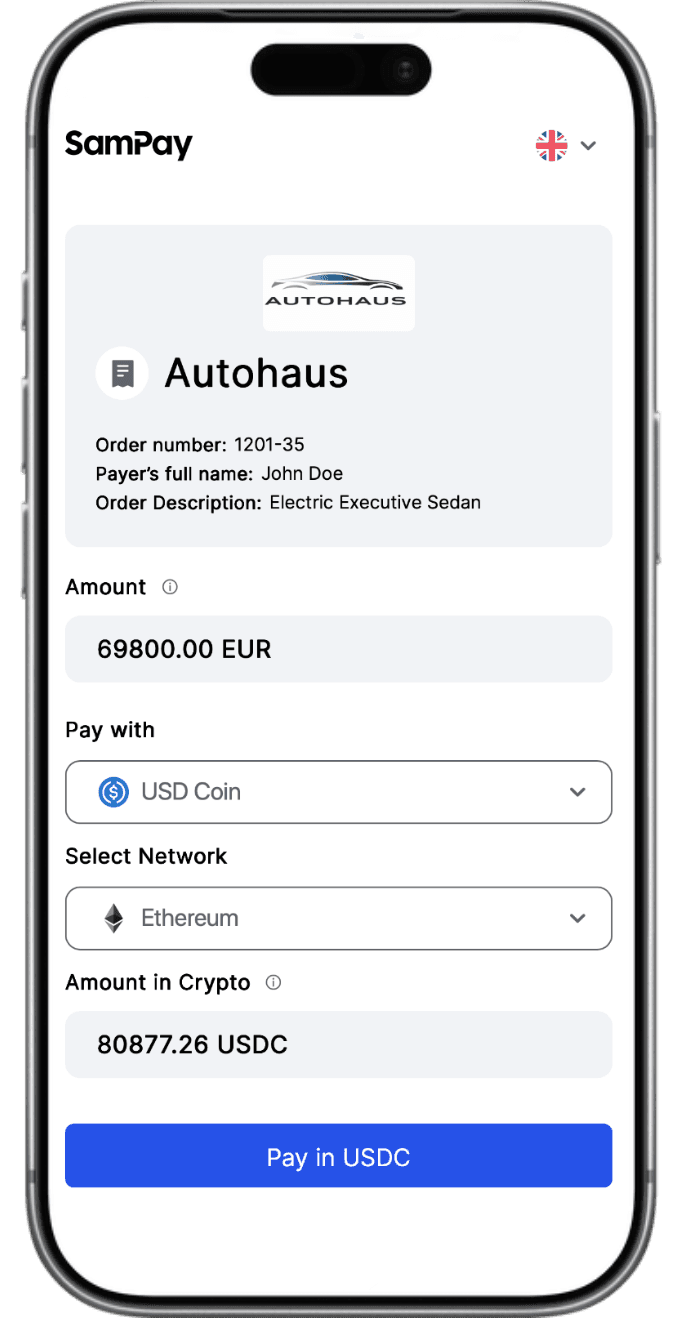
A practical flow should also be simple for your team to use. If the process requires training, manual intervention, or unusual payment handling, most businesses will avoid it. A better approach is one where sending the payment request feels familiar.
This matters because your sales or operations team should not need to understand crypto mechanics. They should be able to issue a payment request, share it with the client, and continue with the transaction as they normally would. The additional payment option exists for the customer, not as a new burden for your staff.
Compliance has to be built in, not added later
There is another reason the instant conversion model works better: compliance happens inside the flow. Every payment should be screened automatically, so you do not have to worry about where the funds came from or how to justify the transaction afterward. That means identity checks where needed, transaction monitoring, and risk filtering before settlement reaches your business.
For a traditional merchant, this is critical. You do not want to receive problematic funds and then discover the issue later, once it has already touched your company. You want the transaction to be checked before the payout reaches your bank account. That is the difference between "accepting crypto" and using a compliant crypto payments model designed for normal businesses.
The compliance layer should also be easy for the customer, because friction at the wrong moment can delay a deal. A well-designed flow keeps verification structured and proportionate, rather than pushing complexity onto your team.
For the merchant, the business impact is straightforward: checks happen automatically, risks are filtered early, and your company receives a cleaner EUR payout. You keep control over the commercial relationship without taking on the compliance mechanics yourself.
Where SamPay fits into this model
This is exactly where SamPay becomes relevant. It is not a tool for turning your business into a crypto operator. It is a payment layer that lets your customer pay in crypto while your company continues working in euros. The flow is simple: customer pays in crypto, checks are performed, funds are converted, and EUR is paid out to your bank account through SEPA or SWIFT.
That means no crypto on your balance sheet, no need to manage wallets internally, and no extra accounting treatment for held crypto assets. From a finance perspective, this is what makes the model workable. Your books stay euro-based. Your reconciliation stays closer to what your team already knows. Your bank receives a familiar settlement outcome rather than an unexplained crypto trail.
This is especially relevant for businesses with higher average transaction values. If you are selling a vehicle, a property reservation, jewelry, or a premium service package, you do not want every exceptional payment method to create exceptional back-office work. SamPay is designed so that the merchant receives EUR only, exactly as before.
The customer experience also remains clear. They are guided through a dedicated payment interface, while you remain outside the technical side of crypto processing.
That separation is important. The customer gets the payment option they want, and your business gets the outcome it wants: predictable euro settlement, reduced operational risk, and no crypto asset exposure internally.
What this means for founders, operators, and finance teams
For founders, this model removes a strategic objection. You do not have to choose between winning a client and introducing crypto risk into the company. For operators, it removes a workflow problem. The payment process stays manageable and does not require a new internal system around wallets and exchanges. For finance teams, it removes the most sensitive issue: crypto does not sit on the balance sheet in the first place.
And that is the real point. The goal is not to make your business more "crypto-friendly" in some abstract way. The goal is to let your business accept demand from crypto-paying customers without changing how the company functions at its core. You stay in EUR. Your internal processes remain familiar. The risky and technical layer is abstracted away.
The obvious way to accept crypto without holding it
If your business wants to accept crypto payments in Europe, but you do not want crypto assets appearing in accounting, there is a clear answer. Do not accept crypto directly into your business as an asset. Use a structure where the client pays in crypto and your company receives EUR only.
Through an instant conversion model, the business never holds cryptoassets. SamPay removes that layer completely. That means less accounting friction, fewer audit questions, less banking concern, and a much more realistic path to offering compliant crypto payments without disrupting your existing operations.
This is why, for most traditional merchants, this is the obvious way to do it. You keep the sale. The client gets flexibility. Your business keeps operating normally. If that is the outcome you want, the next step is simple: explore a setup where crypto to EUR happens in the background, not on your balance sheet.
Book a demo
Let your clients pay in crypto while your business keeps operating in euro.
Book a demo to see how SamPay helps merchants accept crypto payments with compliant EUR settlement and a familiar operational flow.