Published April 5, 2026
How to accept crypto payments as a business in Europe (2026)
If you are looking into crypto payments for business, the first thing to clarify is simple: the hard part is usually not the payment itself. The hard part begins right after that. Your finance team starts asking how the funds will be received, your accountant wants to know what lands on the balance sheet, and your bank will eventually care where the money came from and how it was processed.
That is why many European businesses are interested in crypto, but hesitate to move forward. On the sales side, the demand is real. Clients in high-ticket sectors such as cars, real estate, jewelry, and premium services increasingly want to pay in digital assets. But on the operational side, most companies do not want wallets, token decisions, volatility exposure, or uncomfortable conversations with their bank. They want the sale, not the extra layer of risk.
Why accepting crypto sounds easier than it is
At first glance, accepting crypto payments in Europe can look straightforward. A client wants to pay in USDT or ETH, so you assume you only need an address or a wallet and the issue is solved. In practice, this is where things become complicated. The moment your business starts accepting crypto directly, you are no longer just receiving money - you are taking on a new operational and compliance burden.
The first issue is workflow. Someone in your company suddenly needs to create and manage wallets, keep access secure, understand which network the client is using, and make sure funds do not get sent incorrectly. If a payment comes through on the wrong chain or in the wrong asset, the problem lands on your team. For a traditional business, this is not a normal payment operation. It is a distraction from the business you actually run.
If you sell cars, you should continue selling cars. If you sell real estate, nothing about your internal process should suddenly start revolving around blockchains, wallet custody, and token compatibility. You are not trying to become a crypto company. You are trying to accept a customer's preferred method of payment without changing how your business operates.
The real friction starts after the funds arrive
Direct crypto acceptance creates a second, more serious layer of problems: what happens after the payment is received. This is the part many businesses underestimate. The crypto may have arrived, but now your company has to decide what to do with it, how to record it, how to convert it, and how to explain it.
Volatility is not a side issue
If you accept crypto directly, your revenue may sit in a volatile asset even if only for a short period. For a treasury team or business owner, that is unnecessary exposure. You agreed to sell a product or service for a specific value. You did not agree to have that value move up or down while you are still figuring out settlement.
In most traditional businesses, predictability matters more than optional upside. You want to know how much you sold, how much you will receive, and what arrives in your bank account. That is especially important for high-ticket transactions where even small percentage changes can mean a meaningful difference in final revenue.
Compliance becomes your problem
The next issue is source of funds. Once your company touches crypto directly, questions begin immediately. Where did these funds come from? Has the payment been screened? Can you show that the transaction passed the right checks? If your internal team cannot answer these questions clearly, risk moves from "theoretical" to "very practical."
For businesses in Europe, this matters even more because expectations around AML, KYC, and transaction monitoring are getting stricter, not looser. You may not want to build an internal process for compliant crypto payments, but if you accept crypto directly, you are effectively forced into that responsibility. This is rarely what a founder, operator, or finance lead had in mind when they first thought about offering crypto payments for business.
A compliant setup should not feel like your team is improvising. It should feel structured, documented, and automatic.
This is why the right payment model includes identity and transaction checks as part of the flow, not as an afterthought your team has to manage manually. When this is built in properly, the customer can complete the necessary verification, and your business is not left wondering how to justify the payment later.
Why banks are often the hidden obstacle
Many articles about crypto payments focus on customer demand, but decision-makers usually worry about something else: banking. You may be open to accepting crypto, but you also know that your business still runs on bank accounts, EUR settlements, payroll, rent, suppliers, and reporting. If your bank relationship becomes unstable, the entire business feels it.
This is where direct crypto handling can create friction that has nothing to do with the sale itself. When funds move from wallets into your corporate environment, your bank may ask questions about origin, compliance, transaction history, and risk controls. If those answers are weak or inconsistent, you can face delays, additional scrutiny, or in some cases account restrictions. For a traditional business, this is often the real reason crypto adoption stalls internally.
The concern is valid. You are not being conservative for no reason. You are protecting the continuity of your operations. A payment method is only useful if it fits cleanly into the financial infrastructure you already rely on.
What the workable model looks like in Europe
So how do you accept crypto payments in Europe without dragging your company into crypto operations? The answer is to separate the customer's payment method from your business settlement method.
The customer can pay in crypto. The payment is then screened, verified, and converted. Your business receives EUR to its bank account through SEPA or SWIFT. That means your company continues operating in EUR, exactly as before, while the crypto part remains in the background.
This is the model more businesses are moving toward because it solves the real problem. It does not ask your team to hold crypto, manage wallets, guess at compliance, or explain token movements to your bank. It turns crypto into a front-end payment option for the customer, while keeping your back office and treasury logic unchanged.
Crypto → conversion → EUR → bank account
This sequence matters because it protects the merchant from the parts that create risk. The customer chooses to pay with crypto. The provider handles the compliance layer, including AML, KYC, and KYT checks. The crypto is converted into EUR. Then the settlement reaches your bank account like a normal business payout.
That means no crypto on your balance sheet, no need for your finance team to learn custody procedures, and no uncertainty about whether the final value will change before settlement. From your side, you are simply receiving EUR.
What this looks like in day-to-day operations
A good crypto-to-EUR flow should not feel exotic inside your company. It should feel familiar. You create an invoice in EUR or send a payment request. The customer gets a clear payment page and pays in crypto. The system processes the transaction, runs the required checks, converts the funds, and your payout arrives in EUR.
That is important because adoption inside the business depends on simplicity. If your sales team, finance team, or operations staff need separate training just to handle one payment method, rollout becomes difficult. But if the process starts with the same invoice logic you already use, then the new option can fit into your existing workflow without disruption.
For most businesses, this is the right starting point: the amount is set in EUR, the commercial agreement stays in EUR, and your team never has to think in tokens. The customer may pay in crypto, but from your side, the transaction is anchored to the currency you already use.
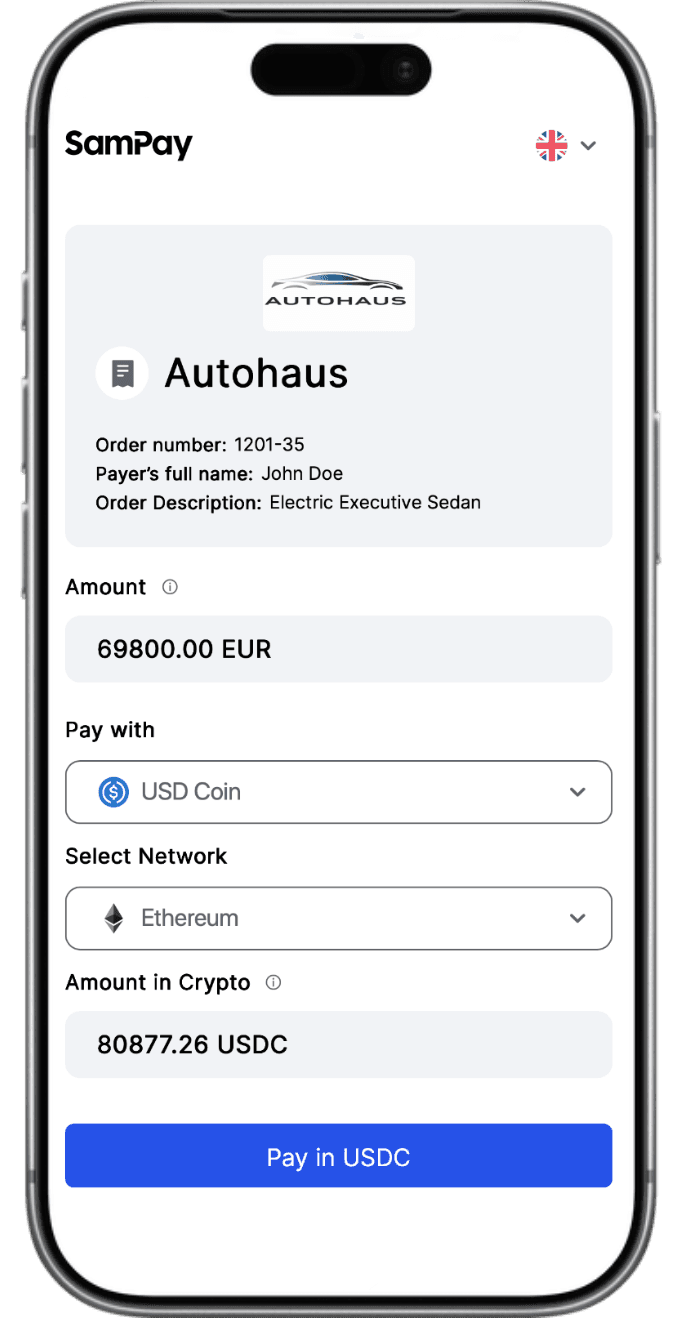
The payment step for the client should also be straightforward, especially in premium transactions where clarity matters. Confusion at the payment stage creates hesitation, and hesitation kills conversions.
When the payment page is structured clearly, the client sees what to pay and how to complete it, while your team avoids back-and-forth explanations. This is particularly useful when working with international buyers who are ready to pay quickly but do not want unnecessary friction.
Where SamPay fits into this model
This is exactly where a provider like SamPay becomes relevant. Not at the moment you first hear the word "crypto," but at the moment you decide your business should not carry the complexity around it. SamPay is built for companies that want to accept crypto payments in Europe while still receiving payouts directly in EUR to their bank account.
In practice, SamPay allows your customer to pay in crypto while the platform handles the difficult parts in the background. The payment is checked, converted, and settled to you in EUR. Your business does not hold crypto, does not need to manage wallets, and does not need to build a compliance process from scratch.
This matters because the value is not just technical connectivity. The value is that all the complexity becomes invisible to the merchant. You keep selling your product or service the same way you do now. Your accounting remains EUR-based. Your internal teams do not have to become crypto specialists.
That automation is a major part of what makes the model scalable. Instead of reviewing every incoming crypto payment manually or trying to document risk controls internally, you rely on a structured process designed for compliant crypto payments from the start.
Who this model is best for
This approach is especially relevant for businesses with high-ticket transactions and a traditional operating structure. If you are selling vehicles, property, luxury goods, concierge services, or other premium offers, you may already have clients who hold digital assets and want to use them. The opportunity is real, but so is the need to protect your business from avoidable risk.
A crypto-to-EUR model works because it respects both sides of the transaction. The client gets flexibility. Your business gets familiar settlement. That is what makes it commercially useful. It is not about becoming more "crypto-forward" for branding reasons. It is about removing payment friction without introducing operational friction.
You sell cars - you continue selling cars. You sell real estate - nothing changes. You receive EUR - always.
The safest way to accept crypto payments as a business in Europe
If you are evaluating how to accept crypto payments as a business in Europe in 2026, the decision should be based on business logic, not novelty. The most scalable option is not direct wallet acceptance. It is not asking your finance team to become a compliance department. And it is not exposing your bank relationships to unnecessary questions.
The safest and most practical model is to work with a provider that takes care of AML/KYC, conversion, and payout, while your company simply receives EUR in its bank account. That is what makes crypto usable for traditional businesses. It removes volatility, reduces banking friction, and keeps your operations aligned with how you already work.
SamPay closes that gap fully. It lets you offer crypto payments for business without actually operating in crypto yourself. For many companies, that is the point where the idea finally becomes workable. Not because crypto suddenly became simpler on its own, but because the complexity is handled where it should be handled: outside your business.
If you are exploring how to accept crypto payments in Europe without changing your finance model, this is the next step to look at. Review the workflow, test how it fits your sales process, and evaluate whether a compliant crypto-to-EUR setup can help you close more deals without taking on new operational risk. For most traditional merchants, this is the obvious way to do it.
Book a demo
Let your clients pay in crypto while your business keeps operating in euro.
Book a demo to see how SamPay helps merchants accept crypto payments with compliant EUR settlement and a familiar operational flow.