Published April 5, 2026
How exchange rates are calculated in crypto payments
When the payment amount looks clear, but the final EUR amount is not
If you are looking into crypto payments for business, you are probably not trying to become a crypto company. You are trying to solve a practical question: how can a client pay in crypto while your business continues working in EUR, with normal accounting, normal banking, and no surprises for your finance team. This is especially true if you sell cars, real estate, jewelry, or premium services, where transaction values are high and even a small pricing difference becomes a real loss.
This is where exchange rates stop being a technical detail and become a business issue. On paper, a client may agree to pay the equivalent of €25,000 in crypto. But between the moment the price is shown, the moment the payment is sent, and the moment the funds are converted, the actual rate can move. If that process is not controlled properly, your revenue is no longer predictable in EUR.
For a traditional business, that uncertainty is exactly what creates hesitation. You do not want your sales team discussing market timing. You do not want accounting asking why the invoice was for one amount but the settlement was different. And you definitely do not want to explain to your bank why crypto touched your balance sheet at all. The real question is simple: how is the rate calculated, when is it fixed, and who carries the risk if the market moves?
Why exchange rate formation matters more than most merchants expect
In practice, exchange rates in crypto payments are not just pulled from one universal source. They depend on liquidity, market movement, conversion timing, provider logic, and how long the customer takes to complete the payment. That may sound operational, but the business impact is immediate. If you invoice in EUR and the conversion happens later at a worse rate, your company absorbs the difference.
This is why many businesses initially think they want to accept crypto, but then stop at the operational review stage. The sales side sees opportunity. The finance side sees uncertainty. The compliance side sees questions. And once those three teams start looking at the details, the issue becomes clear: accepting crypto directly means taking on risks that have nothing to do with your core business.
What "the rate" actually means in a business transaction
When a customer pays in crypto, there are several moments where the exchange rate can matter. There is the rate shown when the payment request is created. There may be a tolerance window while the customer completes the payment. Then there is the rate used when the crypto is actually converted into EUR. If these are not aligned, the final payout can differ from the expected invoice amount.
For a merchant, this creates an uncomfortable situation. You may have agreed a clear commercial price with the client, but now the final result depends on market movement and on how the payment flow is managed. In a €2,000 purchase, that may be a nuisance. In a €50,000 or €200,000 payment, it becomes a real commercial problem.
Slippage is not a trading term here - it is your margin disappearing
Most merchants do not think in terms of slippage, but they feel its effect immediately. A client starts a payment at one rate, takes a few minutes to complete it, and during that time the market shifts. If no one has fixed the rate and guaranteed the settlement logic, the business may receive less EUR than expected after conversion.
That difference has to land somewhere. Either you ask the customer to top up, which creates friction and makes the transaction feel unreliable, or you absorb the loss yourself. Neither option is good for a serious business. If you sell high-ticket products or services, you need the payment side to feel stable and professional.
What usually goes wrong when businesses try to handle this directly
At first glance, direct crypto acceptance can look simple. You generate a wallet address, the customer sends funds, and then you convert them. But the moment you walk through the process carefully, several problems appear at once.
First, there is the timing issue. The crypto market moves continuously, and conversion rates are not fixed forever. If the customer delays the payment or sends an incorrect amount, someone has to decide how to reconcile the transaction. Your team is suddenly dealing with rate windows, confirmations, shortfalls, or overpayments instead of simply collecting money.
Second, there is the accounting issue. Your business invoices in EUR, but the incoming asset is crypto. That means you now need a policy for valuation, conversion timing, and reconciliation. Even if your intention was only to accept client demand, you have introduced a new financial workflow into the company.
Third, there is the banking and compliance issue. Once crypto enters your operational chain, questions follow naturally. Where did the funds come from? How were they checked? How do you document the conversion? How do you show that the final EUR settlement is clean and explainable? These are not abstract concerns. They affect whether your bank is comfortable with the transaction history attached to your company.
The better model: the customer pays in crypto, you receive EUR
The clean way to structure crypto to EUR payments is not to make your business handle crypto better. It is to make sure your business does not handle crypto at all. The customer can pay in crypto, but the merchant should stay in the same operating model as before: invoice in EUR, settle in EUR, account in EUR, and receive a bank transfer.
This is the difference between "accepting crypto" and accepting clients who want to pay with crypto. Those are not the same thing. In the second model, the complexity is moved away from your team and into the payment infrastructure, where it belongs.
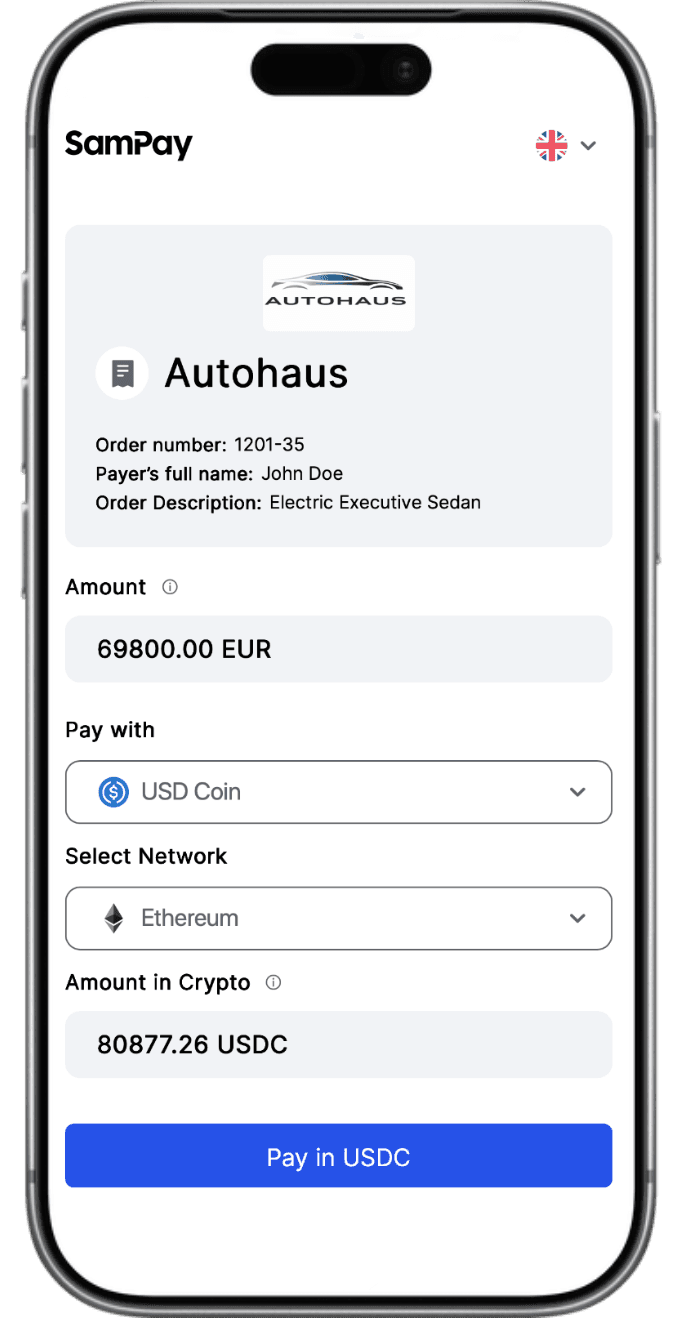
A practical workflow starts with a payment request created in EUR. Your side defines the amount exactly as you would in any regular sale. The provider then presents the crypto equivalent to the customer, manages the payment flow, performs the necessary checks, converts the funds, and sends EUR to your bank account.
Before that conversion even becomes relevant to the merchant, the payment flow should already be controlled and clear.
The important point here is not the interface itself. It is the operating logic behind it: your business starts from a EUR amount, not from a crypto amount. That keeps pricing, internal approvals, and accounting consistent from the beginning.
How compliant crypto payments should work in Europe
If you want to accept crypto payments in Europe, the payment process must do more than convert one asset into another. It has to protect the merchant from operational and compliance exposure. That means the transaction should be checked automatically, the customer should follow a clear payment flow, and the payout should end in EUR to a regular bank account.
From the customer's perspective, the process still needs to be simple. They receive a payment request, see what they need to send, and complete the transfer. They do not need a confusing process, and you do not need manual coordination from your staff.
That is why a guided payment page matters. It reduces payment errors, makes the amount and currency clear, and lowers the chance of back-and-forth during a high-value transaction.
But customer clarity is only half of the equation. On the merchant side, every payment also needs to be checked automatically so your company does not have to worry about the origin of funds or how to justify the transaction later. This is what compliant crypto payments should mean in business terms: the risk controls are built into the process, not left on your team's desk.
When this model is done properly, your finance team does not touch crypto, your accountants do not have to value digital assets, and your bank receives a normal EUR flow.
So how is the exchange rate actually handled in the right model?
This is the part that matters most for a business decision-maker. In a proper setup, the provider fixes the exchange rate for the transaction under defined conditions and takes responsibility for the conversion risk during that window. That means the customer knows what to send, and you know what EUR amount the payment is intended to settle.
Without that protection, every transaction becomes a small exposure to market movement. With it, the merchant has predictable commercial terms. The provider manages the conversion mechanics, liquidity sourcing, timing, and execution. Your business receives the agreed EUR settlement through the normal payout process.
This is exactly how the topic of exchange rate formation should be understood from a business perspective. You do not need to know how every market source is connected or how conversion is routed internally. You need to know whether the rate is fixed, whether the process is compliant, and whether your EUR outcome is protected. That is the level that matters.
Once the payment is completed and processed, the transaction should end cleanly and without uncertainty for the merchant.
Where SamPay fits in
This is where SamPay becomes relevant, not as a crypto tool, but as a way to let your business accept crypto payments in Europe without taking on crypto complexity. SamPay is built around the model that makes sense for traditional merchants: the customer pays in crypto, the transaction is checked, the funds are converted, and your company receives EUR by bank transfer.
That means no crypto on your balance sheet, no manual conversion decisions, and no need for your team to monitor exchange movement. If the client wants to pay in USDT or another supported cryptocurrency, the payment can still be processed in a way that feels familiar on your side. You continue selling cars. You continue selling real estate. You continue selling premium goods or services. You receive EUR, always.
Just as importantly, SamPay handles the part that usually creates fear inside the business. The rate is fixed within the payment process, and the provider takes on the conversion risk instead of pushing it onto the merchant. In other words, the uncertainty that would normally sit between payment receipt and final payout is absorbed by the infrastructure.
The obvious way to think about exchange rates in crypto payments
If you strip away the noise, the issue is straightforward. A business should never be forced to become a market participant just because a client wants to pay in crypto. You should not have to guess conversion timing, absorb slippage, build internal controls, or introduce banking risk into a normal sale.
The correct model is much simpler: the provider fixes the rate and takes the risk. The payment is screened, converted, and settled in EUR. SamPay does this automatically, which is why the process feels far more natural for traditional companies than direct crypto acceptance ever will.
If you are evaluating crypto payments for business, this is the point to focus on. Not whether crypto is possible in theory, but whether your company can accept it without changing how the business operates. That is the standard worth using.
Explore SamPay if you want a practical way to offer compliant crypto payments, protect your EUR pricing, and keep your business model exactly as it is today. Because in the end, this is the obvious way to do it: your client pays in crypto, and you receive EUR in your bank account as usual.
Book a demo
Let your clients pay in crypto while your business keeps operating in euro.
Book a demo to see how SamPay helps merchants accept crypto payments with compliant EUR settlement and a familiar operational flow.