Published April 5, 2026
How crypto-to-EUR payment processing works
If you are evaluating crypto payments for business, the first question is usually not whether a client wants to pay in crypto. The real question comes one step later: what actually happens between the moment the client pays and the moment your company receives money in the bank? That is where many finance teams, founders, and operators pause. Not because demand is unclear, but because the process itself feels legally, technically, and operationally uncertain.
This hesitation is completely reasonable. On paper, "accepting crypto" sounds simple. In practice, the moment you try to map the process internally, you run into uncomfortable questions. Who issues the invoice? Who receives the crypto? How is the payment checked? How is it converted? What exactly reaches your bank account, and how do you explain that flow to compliance, accounting, or your bank?
That is why the problem is usually not accepting crypto itself. The problem is everything that comes with it: verification, traceability, conversion, settlement, and banking comfort. For a traditional business, especially in luxury, real estate, automotive, or other high-ticket sectors, all of that extra complexity quickly becomes the reason to avoid the topic altogether.
Why businesses get stuck on the process
If you sell cars, property, jewelry, or premium services, your business already has a working financial routine. You issue invoices, collect payments, reconcile transactions, and receive EUR into your bank account. Your finance team knows how this works, your accountant knows how this works, and your bank is comfortable with this model. The last thing you want is to introduce a new payment method that changes everything around treasury, reporting, and compliance.
This is exactly where confusion starts. Many decision-makers assume that to accept crypto payments in Europe, they must open wallets, hold digital assets, monitor rates, and somehow manage legal exposure around incoming crypto. And once that assumption appears, the conversation often ends there. Not because the opportunity is bad, but because the operating model feels wrong for a normal business.
In practice, this usually looks like an internal discussion rather than a payment problem. Someone in sales says clients are asking for crypto. Someone in operations asks how the money flow works. Finance asks what lands on the balance sheet. Compliance asks how the funds are screened. Banking asks where the incoming money is coming from. Suddenly, what looked like a simple sales channel becomes a multi-department risk question.
What direct crypto handling actually creates
It is not just a payment method
The mistake many companies make is treating crypto like another checkout option. It is not that simple if you handle it directly. The moment your business receives crypto itself, you are no longer just taking a payment. You are taking custody of an asset, exposure to price volatility, and responsibility for proving where funds came from.
That creates a chain of practical issues. If a customer pays in USDT or ETH, your team needs to know whether that transaction is acceptable, whether the source of funds is clean, what exchange rate applies, and what happens if the asset price moves before conversion. Then comes the accounting question: are you booking crypto, EUR, or both? And if your bank later reviews the related payout activity, can you clearly document the flow?
Legal and banking uncertainty appears very quickly
This is why many businesses that initially consider direct crypto acceptance step back. The issue is not customer demand. The issue is that internal teams do not want to carry risk they do not fully control. Finance departments do not want crypto on the balance sheet. Accountants do not want unclear treatment. Banks do not like unexplained flows. Management does not want a payment method that adds operational friction to every large transaction.
For a traditional business, the right model is not "learn crypto and manage it safely." The right model is simpler: let the client pay in crypto while your business continues operating in EUR. That is the difference between adding a new customer payment option and accidentally redesigning your financial operations.
How the correct crypto-to-EUR flow works
Once you look at the process through a business lens, the right structure becomes very straightforward. The provider manages the crypto side, the checks, and the conversion. You continue to work as you always have, with EUR settlements to your bank account.
1. The invoice is created in EUR
Everything starts with a normal commercial step: your business creates an invoice or payment request in EUR. This is important because it keeps the transaction anchored in your usual operating currency from the very beginning. You are not pricing a product in crypto. You are not managing exchange exposure yourself. You are simply charging the same EUR amount you would charge in any other payment channel.
This is where many merchants realize the model is much simpler than expected. You do not need to restructure your commercial process. You continue selling what you sell, at your normal price, in your normal currency.
A provider-led flow usually begins with a familiar interface for invoice creation, which reinforces that nothing changes on your side operationally.
2. The customer receives a payment link or payment page
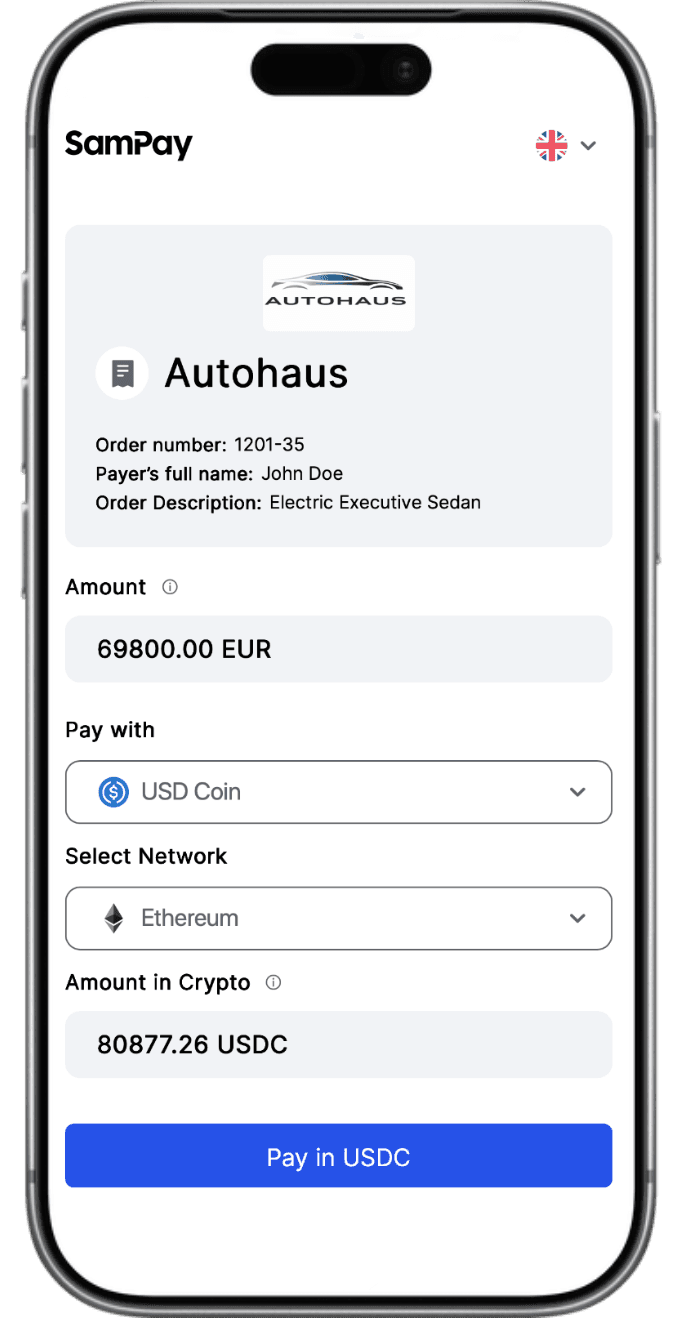
Once the invoice is prepared, the customer is sent a payment link or directed to a payment page. From your side, this is just a payment request. The complexity of how the client pays is abstracted away into a controlled interface. That matters because your team does not need to coordinate wallets manually, explain payment steps, or troubleshoot crypto transfers directly with the customer.
For businesses with high-ticket transactions, this step is more important than it may seem. A clean payment interface creates confidence on both sides. Your client sees a structured process, and your team sees a standardized workflow rather than an improvised one.
That is also why payment links are so useful in offline and premium sales environments. You are not building a crypto desk inside your company. You are simply sending a secure way to complete a payment.
3. The payment is checked before it becomes your payout
This is the part that is most often misunderstood, and also the part that matters most to finance and compliance teams. Before funds are processed into a merchant payout, the transaction goes through screening and verification steps. In plain business terms, that means the payment is checked automatically so you do not have to guess whether there is a compliance issue hiding inside the transaction.
Without that layer, your business would have to answer difficult questions later. Where did the funds come from? Was the transaction linked to risky activity? Why was this payment accepted? How do you justify it to a bank or auditor? These are exactly the questions traditional merchants do not want to handle internally.
A proper compliant crypto payments setup removes that burden from the merchant side. The checks happen inside the provider flow, not as an afterthought after money has already touched your business.
This is one of the most important points in the whole process. The client may be paying in crypto, but your company should not be left alone with compliance interpretation. The provider should handle identity checks, transaction monitoring, and risk controls as part of the payment flow itself.
4. The crypto is converted into EUR
After the payment is confirmed and the necessary checks are passed, the crypto is converted into EUR. This is the step that protects the merchant from volatility and keeps reporting predictable. You do not receive a digital asset and decide later what to do with it. You receive the economic result in euros.
That distinction is critical. If your business handles conversion itself, you carry timing risk and execution risk. If conversion is built into the process, the customer pays in crypto and your business receives EUR as the outcome. This is what "crypto to EUR" should mean in a serious business environment: not exposure, but abstraction.
This also makes internal reporting much easier. Sales, finance, and accounting can work with the same familiar settlement logic. The payment method changes for the customer, but the treasury reality for your company stays stable.
5. The payout arrives in your bank account
The final step is the one that matters most to the merchant: the EUR payout is sent to your bank account through standard banking rails such as SEPA or SWIFT. At this point, the process is complete. The customer used crypto, but your company did not need to hold crypto, convert crypto manually, or explain a crypto balance on the books.
This is the result most traditional businesses actually want. You sell cars - you continue selling cars. You sell real estate - nothing changes. You receive EUR - always. That is why the correct payment model is not about making your business "more crypto." It is about making crypto invisible where it should be invisible.
What this looks like in a real provider setup
When this flow is implemented properly, it feels much closer to a structured payment service than to anything experimental. You create the invoice, the client pays through a guided interface, the transaction is screened, the amount is converted, and the payout reaches your bank account. The provider manages the moving parts so your team does not have to build internal expertise around wallets, tracing, conversion, or crypto operations.
This is where SamPay fits naturally into the conversation. SamPay is designed around the model traditional businesses actually need: customer pays in crypto, checks are handled inside the flow, the amount is converted into EUR, and the merchant receives a bank payout. The merchant never holds crypto on the balance sheet, which removes one of the biggest barriers for finance teams and regulated businesses.
From a workflow perspective, this matters because you are not being asked to adapt your entire company to a new financial system. SamPay sits between customer preference and merchant settlement. That means you can accept crypto payments in Europe without operating like a crypto business yourself.
For many businesses, that is the missing piece. They do not need a lecture about blockchain. They need a provider that makes the process clear, controlled, and bank-friendly from end to end.
Why this model is the one that gets approved internally
In most companies, new payment methods are not blocked by customers. They are blocked by internal uncertainty. If finance cannot explain the flow, if accounting cannot book it comfortably, and if management sees banking risk, the project stops. That is why the structure matters more than the headline.
A provider-based invoice → payment → checks → conversion → payout flow solves exactly that problem. It gives each internal stakeholder a clear answer. Sales gets more flexibility. Operations gets a standard process. Finance gets EUR settlement. Compliance gets built-in controls. Management gets a model that does not create unnecessary risk.
This is also why "accept crypto payments for business" should not mean "start handling crypto directly." For most traditional merchants, the smarter model is to let a specialist provider absorb the difficult parts while the business keeps operating normally.
The obvious next step
If you have been evaluating crypto payments and the process still felt vague, this is the key takeaway: the correct model is structured, not improvised. The flow is invoice → payment → checks → conversion → payout. When this is handled through the right provider, your business does not need to take on custody, compliance interpretation, volatility exposure, or banking friction.
That is exactly why SamPay covers all stages of the process. It allows you to offer crypto payments for business while keeping your company on the familiar side of the transaction: priced in EUR, settled in EUR, received in your bank account. No crypto on the balance sheet, no operational detour, no need to turn your team into crypto specialists.
If you are exploring compliant crypto payments or want to understand how to accept crypto payments in Europe without changing how your business operates, this is the model worth testing. It is structured, predictable, and practical. In other words, this is the obvious way to do it.
Book a demo
Let your clients pay in crypto while your business keeps operating in euro.
Book a demo to see how SamPay helps merchants accept crypto payments with compliant EUR settlement and a familiar operational flow.