Published April 5, 2026
Do you need to account crypto on balance sheet?
If you are discussing crypto payments internally, the conversation usually becomes difficult long before the first payment arrives. Sales may see an opportunity. Management may want to avoid losing clients. But finance and accounting teams often ask the more important question: if we accept crypto, does it end up on our balance sheet?
That question is where the real issue starts. Not because accepting a client's preferred payment method is inherently complicated, but because the moment crypto becomes your asset, it brings valuation questions, reporting implications, audit pressure, and often uncomfortable conversations with your bank. For many traditional businesses, especially in automotive, real estate, jewelry, and premium services, that is exactly the kind of operational burden they do not want.
If you sell cars, you should continue selling cars. If you sell real estate, nothing about your business model should suddenly turn into a treasury management exercise. And if your company works in EUR, your payment flow should still end in EUR, not in a volatile digital asset that your team now has to classify, document, and explain.
Why the balance sheet question matters more than the payment itself
At first glance, accepting crypto payments for business can sound like a simple commercial decision. A client wants to pay in USDT or ETH, and you want to close the deal. But in practice, the payment itself is often the easiest part. The real complications begin the moment crypto lands with the merchant and becomes something the company legally controls.
Once that happens, your business is no longer just receiving money. It is holding a crypto asset that may need to be recognized, measured, reviewed, and reconciled. Your accountant will want to know how it should be recorded. Your auditor may ask how it was valued and whether controls were in place. Your finance team may need to explain why a company that invoices in EUR is suddenly exposed to crypto-related accounting treatment.
This is why many companies hesitate, even when customer demand is real. They are not rejecting new payment options. They are trying to avoid importing a new layer of financial complexity into a business that otherwise runs perfectly well in euros.
What happens when crypto sits on your books
Valuation becomes an ongoing issue
The moment crypto is recorded as a company asset, someone has to decide how it should be valued. That sounds technical, but the business impact is very practical. If the asset price moves, your reporting may be affected. If there is a time gap between receipt and conversion, your company may be exposed to gains, losses, or valuation adjustments that have nothing to do with your actual product or service.
For a luxury car dealer or real estate business, this creates a strange mismatch. You may have delivered a car, signed a property deal, or sold a high-value item at a fixed EUR price, yet your internal reporting now includes questions linked to crypto market movement. That is unnecessary noise in an otherwise straightforward transaction.
Reporting becomes harder than expected
Accounting teams generally want consistency. They want predictable inflows, clean records, and documentation that matches the way the business already operates. Directly accepting crypto often breaks that simplicity. Instead of a normal EUR settlement, there is now a different asset type entering the records, with additional support needed for timing, conversion, source of funds checks, and final reconciliation.
This is where the issue often becomes visible internally. The sales side may think, "We accepted a payment." Finance sees something else: a non-standard asset, extra documentation, and more work at month-end. Auditors may later see the same thing and ask for evidence that everything was handled properly.
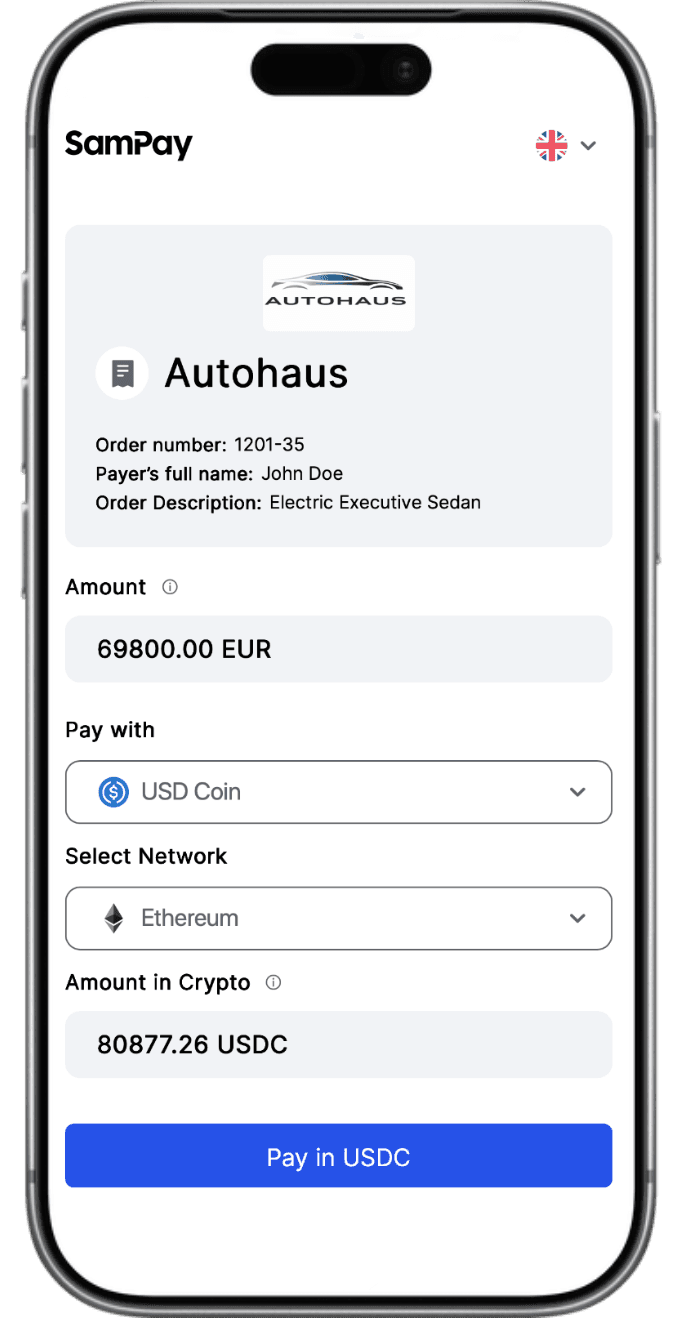
Before going further, it helps to see what the clean operational model should look like from the merchant side. The right setup starts with the invoice staying in euros.
When the invoice is created in EUR, the commercial logic remains exactly where it should be. Your business sets the EUR amount, your accounting remains EUR-based, and the client simply gets another way to settle it. This matters because it keeps crypto outside the financial identity of your company rather than turning it into an asset you have to manage.
Audit and compliance pressure increases
Even if your team is willing to deal with valuation and reporting, there is another layer that cannot be ignored: where the funds came from and how they were screened. If you accept crypto directly, you are responsible for being comfortable with the source of funds, the transaction trail, and the explanation you can provide later if your bank, auditor, or compliance partner asks questions.
In practice, this usually becomes a chain of internal friction. Someone needs to review the payment. Someone needs to document what checks were done. Someone needs to be able to answer why the company accepted that transaction and how risks were assessed. For businesses that are not crypto-native, this is rarely a capability they want to build in-house.
That is why compliant crypto payments matter so much more than the payment headline itself. The business risk is not that a client pays in crypto. The risk is receiving something you cannot comfortably account for, justify, or settle into your normal financial flow.
Why most traditional businesses do not want to "accept crypto" directly
This is worth saying clearly: most merchants exploring crypto to EUR solutions do not actually want to hold crypto. They do not want treasury exposure. They do not want accounting ambiguity. They do not want to spend time educating banks or auditors about why a one-off client payment turned into a balance sheet issue.
They simply do not want to lose a legitimate sale because the client prefers to pay differently.
That distinction is important. You are not trying to become a crypto business. You are trying to remain your current business while removing unnecessary payment friction. The best model is therefore not "receive crypto and figure it out later." The best model is one where the client can pay in crypto, while your company still receives EUR in its bank account, as usual.
This is also the point where operational simplicity matters. If the process is clumsy, finance teams will resist it and sales teams will avoid using it. The workflow has to feel familiar.
A practical setup should let your team send a payment link or issue an invoice without changing how deals are handled internally. The client gets a clear payment path, while your staff continues using a normal business process. That is how crypto payments for business become manageable: not by adding a parallel finance system, but by keeping everything merchant-facing simple.
The model that avoids balance sheet problems
Crypto is paid by the customer, not held by the merchant
The cleanest structure is simple. Your customer pays in crypto. The transaction is screened. The amount is converted into EUR. Your business receives EUR by bank transfer through SEPA or SWIFT. At no point do you need to hold crypto on your balance sheet.
That changes the discussion completely. Instead of debating how to classify or value a crypto asset, your team deals with what it already understands: EUR settlement to a bank account. No crypto wallet management, no asset recognition problem, no market exposure sitting in company records.
Compliance is built into the payment flow
A strong payment setup should also remove the compliance burden from your operations team. Every payment needs to be checked automatically so you do not have to wonder where the funds came from, whether the transaction is risky, or how to explain it to your bank later. This is one of the biggest practical benefits of using a proper provider instead of handling crypto directly.
This kind of built-in verification matters because it turns a difficult internal question into a managed process. Your business is not left manually reviewing wallets or trying to understand transaction histories. The checks happen within the flow, reducing risk without forcing your finance team to become crypto specialists.
Banking stays predictable
For most European businesses, banking comfort is non-negotiable. You may be open to new payment methods, but not at the cost of making your banking relationships harder to manage. If your company receives EUR into its bank account, with the right screening and documentation behind the transaction, the payment fits much more naturally into existing processes.
That is the real advantage when you want to accept crypto payments in Europe without changing your operating model. Your company continues to invoice in EUR, settle in EUR, and report in EUR. The customer may use crypto, but from the merchant's perspective, the transaction ends where it should: as normal fiat revenue.
Where SamPay fits in
This is exactly the model SamPay is built for. A client can pay in crypto, SamPay handles the required AML, KYC, and KYT checks, converts the payment into EUR, and sends the payout to your bank account. Your business never needs to hold crypto at all.
That matters because it removes the balance sheet issue at the source. There is no need to account for crypto as a company asset if crypto never becomes one. Instead of building internal processes around valuation, reporting, and audit concerns, you stay inside the framework your business already uses every day.
For traditional merchants, that is the real value. You sell cars - you continue selling cars. You sell real estate - nothing changes. You receive EUR - always.
To make the process even clearer, the payment flow should end with a visible, controlled completion stage rather than a vague manual handoff.
That finality is important for both operations and finance. Your team needs to know the payment was completed, checked, and settled properly. The less ambiguity there is around status, conversion, and payout, the easier it is to treat the transaction like any other completed business payment.
So, do you need to account crypto on balance sheet?
If you accept crypto directly and take possession of it, in many cases you may indeed create accounting, reporting, and audit questions that would not exist otherwise. That is why so many businesses hesitate. They are not afraid of customer demand. They are trying to avoid turning a payment method into an internal finance burden.
But if crypto never reaches your balance sheet, those problems largely disappear. The customer pays in crypto, the payment is screened and converted, and your business receives EUR into its bank account. From an accounting and operational perspective, that is a completely different scenario.
This is why SamPay is the practical answer for companies evaluating compliant crypto payments. It allows you to accept crypto payments for business without becoming a crypto holder, without introducing avoidable volatility, and without forcing finance teams to deal with assets they never wanted on the books.
If you are exploring how to accept crypto payments in Europe, the best next step is not to ask how your company can manage crypto internally. It is to ask how your company can avoid touching it altogether. That is the safer, cleaner, and more scalable approach.
In the end, the obvious model is also the right one: let the customer pay how they want, while your business continues operating exactly as before.
Book a demo
Let your clients pay in crypto while your business keeps operating in euro.
Book a demo to see how SamPay helps merchants accept crypto payments with compliant EUR settlement and a familiar operational flow.