Published April 5, 2026
Do businesses need a crypto license to accept payments?
If you are looking into crypto payments for business, there is a good chance your first concern is not the payment itself. It is what happens around it. You are not asking whether a client can send USDT or ETH. You are asking a more serious question: if your company starts accepting this type of payment, do you suddenly need a crypto license, new compliance procedures, or difficult conversations with your bank?
That concern is justified. In Europe, the answer depends less on the fact that a customer pays in crypto and more on how the transaction is structured. The same commercial intent can lead to very different regulatory outcomes depending on whether your business touches crypto directly, holds it, converts it, or simply receives EUR from a licensed provider.
Why this question matters more than most businesses expect
From the outside, accepting crypto can look simple. A customer wants to pay. You want to close the sale. So it may seem enough to add a wallet address, receive the funds, and sort out the rest later. In practice, this is exactly where many businesses step into risk without realizing it.
The issue is not that regulators are trying to stop normal companies from making sales. The issue is that once your business begins receiving, holding, or converting crypto directly, you may start performing activities that look much closer to a regulated crypto service than to a standard commercial transaction. That creates questions your finance team may not be ready to answer. Where did the funds come from? Who screened the transaction? Why did the company receive digital assets directly? Who converted them to EUR, and under what controls?
For a car dealer, a real estate agency, a jewelry business, or any premium service provider, this quickly becomes a distraction from the real business. You do not want to become a crypto operator just to accept one more payment method. You sell cars - you continue selling cars. You sell real estate - nothing changes. You receive EUR - always.
What creates licensing risk in the first place?
It is not the client's payment choice - it is your role in the flow
At some point, a customer may ask whether they can pay in crypto. That by itself does not mean your business needs a license. The real issue is whether your company starts acting as the party that receives crypto, stores it, manages it, exchanges it, or otherwise handles it operationally.
This is where many businesses get confused. They think, "We are not launching an exchange, we are just taking payment." But if the payment lands in your wallet, sits under your control, and then gets converted or transferred onward, the commercial simplicity disappears. From a regulatory and banking perspective, your company may look like it is doing much more than making a sale.
That is why this topic should be reviewed at the level of transaction design, not marketing. If your internal model is wrong, the problem is not only legal theory. It can show up in onboarding, accounting, audit review, and bank compliance checks months later.
What usually goes wrong when businesses try to handle crypto directly
The business accidentally takes on a role it never wanted
In practice, companies often start with good intentions. They want to expand payment options, serve international buyers, and avoid losing deals. So they test direct acceptance. A client sends crypto to a wallet. Someone internally tracks the payment. Then finance has to decide when and how to convert it. Compliance has to think about source-of-funds questions. Accounting has to work out how to record the asset, the conversion rate, and any gain or loss.
The original goal was simple: make it easier for the client to pay. But now your team is dealing with a digital asset, exchange exposure, potential volatility, and a paper trail that your bank may examine later. This is where the real burden appears. The merchant is no longer just receiving money. The merchant is managing a crypto process.
Banking risk appears even if the sale itself is legitimate
Many business owners focus only on regulation and forget the banking side. But your bank does not just look at what you sold. It also looks at how funds moved, who handled them, and whether your company touched anything that creates higher compliance exposure.
If payments arrive through direct crypto handling, your bank may ask for explanations that feel far outside normal trade activity. They may want to know how transactions were screened, whether the payer was identified, how wallet risk was assessed, and why your company dealt with crypto directly in the first place. Even if every deal is legitimate, the operational story can still look uncomfortable.
For traditional businesses, this is often the real reason crypto projects stall internally. The sales team may like the idea. Clients may ask for it. But finance and operations do not want uncertainty. They want a model that fits existing controls, existing accounting, and existing bank relationships.
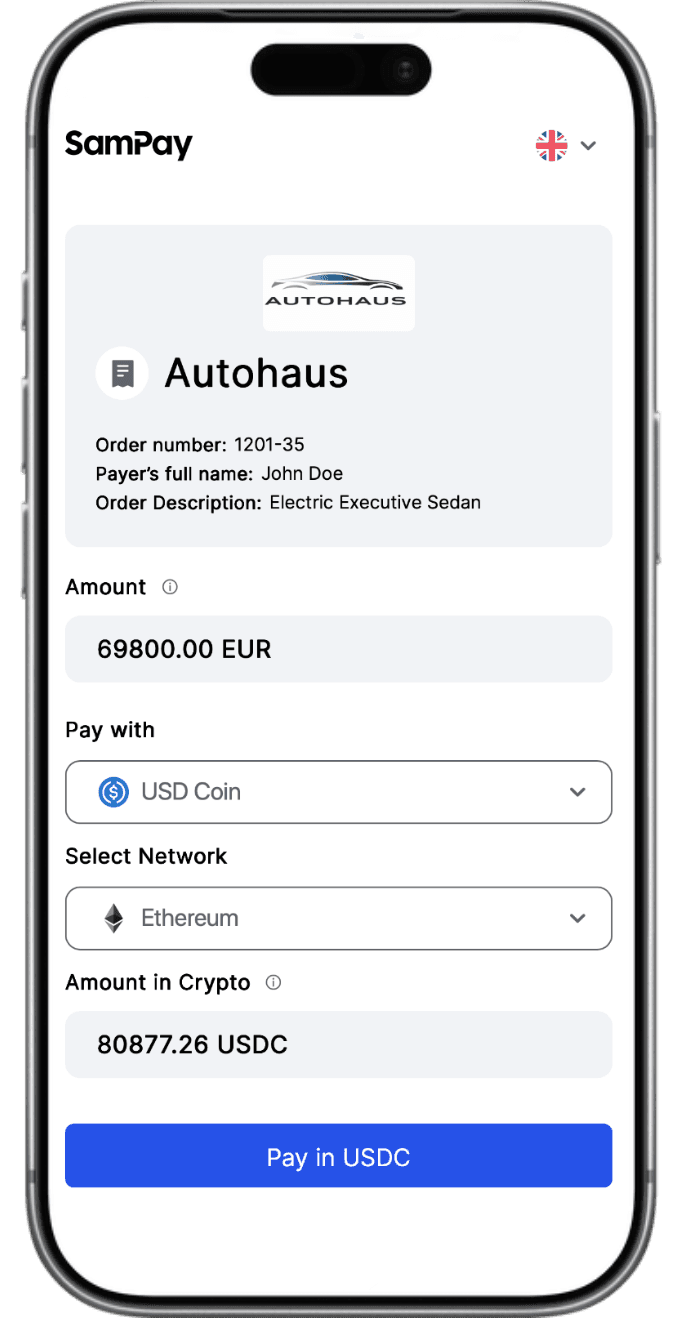
Before going further, it helps to look at what the right workflow should actually feel like from the merchant side. It should look familiar, structured, and based in EUR from the beginning.
When the payment request starts as a normal EUR invoice, the business logic stays where it should be. You define the sale amount in euros, just as you do today. The customer may choose to pay in crypto, but your company is still operating in EUR terms, with no need to price goods in digital assets or manage exchange exposure internally.
The model that avoids unnecessary licensing exposure
The safest structure is crypto → conversion → EUR → bank account
If you want to accept crypto payments in Europe without turning your business into a crypto operation, the key is to use the right architecture. The customer pays in crypto. The payment is checked. The funds are converted into EUR. Your business receives EUR to its bank account through the provider's settlement flow. You do not hold crypto, do not manage wallets on your balance sheet, and do not operate the conversion layer yourself.
This matters because the regulated activity, screening, and operational handling sit with the specialist provider, not with your company. Your role remains what it should be: you are the merchant selling a product or service and receiving euros. That is a very different position from directly receiving and processing crypto yourself.
Compliance should happen automatically, not inside your company
For most businesses, the real value is not the payment method itself. It is the fact that every sensitive part of the process is handled before the money reaches your account. That means identity checks where required, transaction screening, risk filtering, and a documented process your finance team can actually live with.
This is not about technical elegance. It is about removing operational pressure from the merchant. Every payment should be checked automatically, so you do not have to worry about where the money came from, whether the transaction creates questions later, or how to explain the flow to your bank.
The same principle applies to the customer side. The payment experience can be simple for the buyer without creating extra complexity for your team.
A structured payment link keeps the process professional and easy to control. Instead of giving out wallet details manually and hoping the right amount arrives, your business works through a clear commercial flow. That reduces mistakes, makes reconciliation easier, and keeps the transaction tied to a specific sale.
The merchant should never become the weak point in the chain
This is the part many providers fail to explain clearly. If your business still has to receive crypto first, hold it temporarily, or figure out how to off-ramp it later, the complexity has not been removed. It has only been delayed. And delayed complexity usually lands on the finance team, where it becomes slow, expensive, and risky.
The correct model removes that burden entirely. The customer can use crypto. The provider manages the regulated and technical side. Your company receives euros by SEPA or SWIFT like any other business payment. From the merchant's perspective, nothing essential changes in daily operations.
You still issue invoices in EUR. You still account in EUR. You still settle to your bank account in EUR. That is exactly why the model works for traditional sectors, especially those with high-ticket transactions and low tolerance for compliance surprises.
Before settlement happens, there also needs to be control over who is paying and whether the transaction passes the required checks.
This is where the difference between "accepting crypto" and "building a compliant crypto payment flow" becomes very clear. The merchant should not have to collect and interpret crypto risk data manually. The process needs to be built in, so the transaction can move forward only when it meets the right compliance conditions.
So, does your business need a crypto license?
In many cases, no - if the structure is correct
This is the practical answer most businesses are looking for. If your company is simply selling its normal goods or services and receiving EUR, while a specialized provider handles the crypto payment side, conversion, and compliance layer, then your business is generally not stepping into the role of a crypto service provider.
That distinction is critical. The risk usually appears when the merchant starts doing too much directly: receiving crypto to its own wallet, holding it, converting it independently, or building internal processes around transaction handling. That is where legal and banking questions become much harder.
So the question is not, "Do businesses need a crypto license to accept payments?" The better question is, "Is the payment flow designed so that the merchant stays a normal merchant?" If the answer is yes, the licensing burden does not need to move onto your business.
Where SamPay fits into this picture
SamPay is built around exactly this principle. The customer pays in crypto, the transaction goes through the necessary checks, the funds are converted, and your business receives EUR directly to its bank account. There is no need for your company to hold crypto, manage wallets internally, or build a compliance structure around digital assets.
That is why the model makes sense for traditional businesses, especially in luxury and high-value sectors. You can offer modern payment flexibility without changing your operating model. Your team keeps working in euros. Your accounting remains familiar. Your bank settlement stays predictable.
This is what businesses actually need from compliant crypto payments: not more infrastructure to manage, but less. The right provider should remove friction, not introduce it. The moment your team has to think like a crypto company, the model is already wrong.
The practical conclusion for decision-makers
If you are evaluating whether to accept crypto payments in Europe, do not start with the wallet, the token, or the customer's preferred asset. Start with the transaction structure. Ask one simple question: after everything is done, does my business still look and operate like a normal EUR-based merchant?
If the answer is yes, you are on the right path. If the answer is no, you may be introducing regulatory, banking, and operational exposure that your business never intended to take on. That is why direct handling is usually the wrong route for traditional companies.
The practical conclusion is straightforward: with the right architecture through a provider, your business does not need to take on the licensing burden itself. SamPay is designed around exactly that model. You keep selling what you sell. Your clients can pay in crypto. You receive EUR, always.
If you want to explore compliant crypto payments without changing how your business operates, SamPay is the logical next step. You do not need to become a crypto expert. You just need a payment structure that keeps crypto in the background and your business exactly where it belongs: in EUR, under control, and ready to close more deals.
Book a demo
Let your clients pay in crypto while your business keeps operating in euro.
Book a demo to see how SamPay helps merchants accept crypto payments with compliant EUR settlement and a familiar operational flow.