Published April 5, 2026
DAC8 explained for businesses using crypto payments
If you are looking at crypto payments for your business, the first question is usually not technical. It is financial. You are thinking about what your accountant will say, what your bank will ask, and whether the tax side will become harder than the sale itself. That concern is becoming even more relevant in Europe, because DAC8 pushes tax transparency around crypto much further than before.
For many businesses, this is the point where interest in crypto payments starts to slow down. Not because clients do not want to pay this way, and not because the commercial opportunity is unclear, but because internally the whole thing begins to feel messy. The sale may be simple, but the reporting trail behind it often is not. When finance teams cannot clearly explain where funds came from, how they were converted, and what exactly hit the company account, risk grows very quickly.
What DAC8 changes for businesses
DAC8 is part of a broader European push toward tax transparency. In plain business terms, it means authorities are moving toward better visibility over crypto-related activity, especially where transactions, service providers, and users can be identified and reported more systematically. You do not need to become a regulatory expert to understand the practical consequence: if your business touches crypto payments, the expectation for clear records is increasing.
That matters most for businesses that are not crypto-native. If you sell cars, real estate, jewelry, or premium services, your company is not built around wallets, tokens, and blockchain records. Your business is built around invoices, contracts, customer files, bank transfers, VAT treatment, and clean accounting. The moment crypto enters the process directly, your finance workflow can stop looking familiar.
This is why DAC8 is not just a legal topic. It is an operational one. If a tax authority, auditor, or bank asks how a payment moved from a crypto wallet to your revenue line, your answer needs to be simple, documented, and consistent. If it is not, what looked like a new payment option can turn into an accounting and compliance problem.
Why direct crypto acceptance becomes complicated fast
At first glance, accepting crypto can seem straightforward. A customer sends funds, you receive them, and the deal is done. In practice, that is usually where the real complexity begins. Your team then has to work out how to value that payment in EUR, how to record it properly, how to document the source of funds, and how to explain the transaction if your bank or accountant asks questions later.
If this happens once in a while, people often try to manage it manually. Someone saves screenshots. Someone notes the exchange rate. Someone forwards wallet details to accounting. Someone tries to match a transaction hash to an invoice. This may look manageable in the moment, but over time it creates gaps. And tax risk usually does not come from one dramatic mistake. It comes from small inconsistencies that add up.
For example, if your customer pays in crypto and you hold that crypto even temporarily, you are no longer dealing with a simple payment event. You are dealing with an asset that may change in value, require separate accounting treatment, and raise questions about gains, losses, and valuation timing. The commercial transaction becomes mixed with treasury, reporting, and compliance exposure.
Why finance teams worry about transparency
Your finance team does not want a payment method that creates unclear records. They want to know what was sold, who paid, how much was received, when it was settled, and what amount entered the bank account in EUR. They also want supporting documentation that makes sense to an auditor or tax authority without needing a long technical explanation.
That is exactly where many direct crypto setups fall apart. Even if the customer is legitimate and the transaction is real, the documentation chain may still be weak. The wallet belongs to whom? Was the identity verified? Was the payment screened? Which EUR conversion rate was used? Why does the invoice show one amount while the incoming value appears differently elsewhere? These are not abstract issues. They are the kind of questions that cause friction during reporting reviews and banking checks.
Before looking at the payment flow itself, it helps to understand what businesses actually need on their side: a normal commercial process. You create an invoice, you charge in EUR, and your accounting stays aligned with the way your company already operates.
That is the point many businesses miss. You do not need a "crypto business" workflow. You need a normal business workflow with an additional payment option for the customer. Your internal process should remain in EUR from start to finish.
The business risk behind poor transparency
Lack of transparency does not stay theoretical for long. It can lead to delayed bookkeeping, difficult VAT reconciliation, awkward discussions with your bank, and unnecessary exposure during audits or tax reviews. Even if everything was done in good faith, unclear crypto-related records can make your business look harder to understand than it should be.
This is especially important in high-ticket sectors. If you sell a vehicle, a property-related service, luxury goods, or another premium product, the amounts are large enough that every payment attracts more attention. A poorly documented card payment is one thing. A poorly documented crypto payment can trigger much more scrutiny, simply because more questions naturally follow.
And this is where many businesses realize the core issue: they do not actually want to "handle crypto." They just do not want to lose a sale because a client prefers to pay that way. Those are two very different things. One creates operational burden. The other should be solved by infrastructure.
What the right model looks like
The clean model is simple: the customer pays in crypto, the transaction is checked automatically, the funds are converted into EUR, and your business receives EUR to its bank account via SEPA or SWIFT. You do not hold crypto. You do not manage wallets internally. You do not put volatile assets on your balance sheet. You continue operating exactly as before.
This matters for tax transparency because the record becomes much easier to follow. There is a clear invoice amount in EUR, a controlled payment flow, compliance checks around the transaction, and a final EUR payout to your bank account. Instead of trying to explain a chain of wallet movements to finance, you can show a structured payment process with predictable settlement.
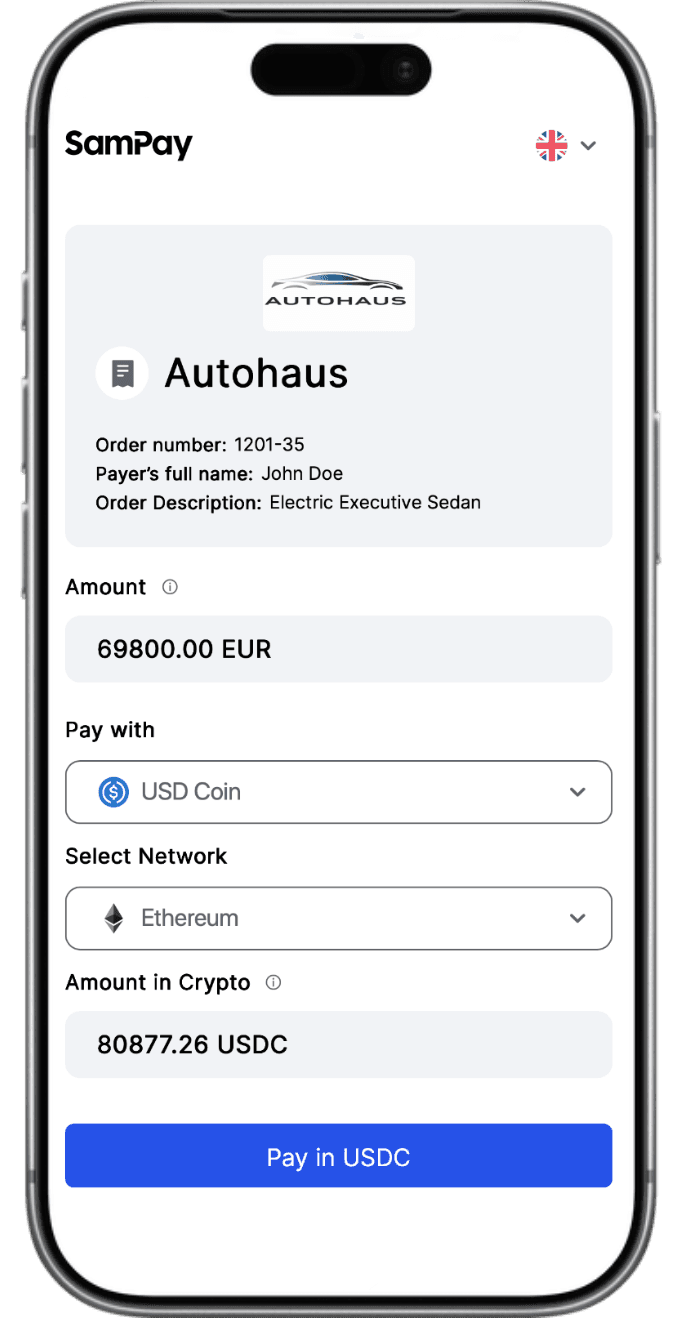
The customer experience can also stay clear and professional without making your internal team take on extra complexity. The payment request is sent in a familiar business format, and the crypto-specific part is handled on the customer side, not inside your accounting department.
What happens in the middle is exactly what matters most from a compliance and transparency perspective. The payment is not just "received." It is monitored, verified, and processed through a structured flow. That is what makes compliant crypto payments workable for normal businesses rather than just for crypto specialists.
To make that possible, checks cannot be optional or manual. Identity and transaction screening need to be part of the infrastructure, so your business is not left explaining later why a payment was accepted without proper controls.
Why this model fits DAC8-era expectations
DAC8 increases the importance of traceability, reporting discipline, and clear counterpart information. Businesses do not need more moving parts in response to that. They need fewer. The safer route is not to build an internal crypto handling process and hope finance can document it later. The safer route is to use a regulated structure that already turns crypto into something your business can process normally: EUR in the bank, with a clean operational trail.
This is the real difference between "accepting crypto" and using crypto payments as a business tool. In one model, your company starts carrying the compliance burden itself. In the other, the infrastructure absorbs the technical and regulatory complexity so that your business can stay focused on sales, service, and accounting discipline.
That distinction is especially important if you want to accept crypto payments in Europe without confusing your finance or compliance teams. Europe is moving toward more transparency, not less. So the right question is no longer "Can we take crypto?" The better question is "Can we do it in a way that still looks clean to accounting, tax, and banking?"
Where SamPay fits
This is where a provider like SamPay becomes practical. SamPay is not about turning your company into a crypto operator. It is about letting your customers pay in crypto while your business receives EUR directly to its bank account. The crypto part is handled in the background, with compliance controls built into the flow.
In practice, that means your customer can pay in crypto, the transaction goes through AML, KYC, and KYT checks, the amount is converted from crypto to EUR, and the final payout arrives through standard banking rails. You continue working in EUR, exactly as before. There is no need to hold crypto on your balance sheet, no need to build internal wallet procedures, and no need to ask your finance team to invent a new accounting process.
The final result is what most businesses wanted from the start: more flexibility for the client, without more complexity for the merchant. The deal remains your deal. The invoice remains in EUR. The reporting trail is far easier to understand.
To the customer, the payment still feels modern and convenient. To your business, it ends where it should end: with a completed payment and predictable bank settlement.
Conclusion: transparency is no longer optional
If you are evaluating crypto payments today, DAC8 should not scare you away from the opportunity. But it should change how you approach it. Tax transparency is no longer something to "sort out later" after the payment comes in. It has to be built into the payment process from the beginning.
That is why using regulated infrastructure reduces risk. It gives your business a cleaner reporting trail, fewer compliance gaps, and far less friction with accounting and banking. SamPay does exactly that by making crypto invisible where it should be invisible: inside the operational layer, not on your balance sheet or inside your finance team's workload.
You sell cars - you continue selling cars. You sell real estate - nothing changes. You receive EUR - always. This is the model that makes crypto payments for business realistic in Europe, especially for companies that want growth without operational confusion.
If you want to explore how to accept crypto payments in Europe without taking on the reporting burden yourself, SamPay is the obvious next step. It lets you offer a modern payment option while keeping your business transparent, compliant, and fully centered on EUR settlement.
Book a demo
Let your clients pay in crypto while your business keeps operating in euro.
Book a demo to see how SamPay helps merchants accept crypto payments with compliant EUR settlement and a familiar operational flow.