If you sell luxury goods, you already know that the payment itself is rarely the difficult part. The difficult part is everything around it: trust, documentation, source of funds, internal approvals, banking comfort, and making sure a high-value sale does not create a problem for finance after the deal is closed. That is exactly why many premium merchants hesitate when crypto comes into the conversation. It is not because they do not want new clients. It is because they do not want new risk attached to a perfectly normal sale.
In luxury retail, one unusual payment can trigger a chain of uncomfortable questions. Your sales team may be ready to close, but finance starts asking where the funds came from, whether the transaction can be justified to the bank, how the accounting will work, and what happens if the value changes before settlement. At that point, the issue becomes clear: the problem is not accepting crypto. The problem is everything that comes with it.
Why luxury businesses hesitate, even when demand is real
If you sell watches, jewelry, art, designer items, or other premium goods, you are not looking for novelty in payments. You are looking for a reliable way to complete high-ticket transactions without introducing friction into a business that already works. Your team knows how to invoice in EUR, reconcile settlements, deal with accountants, and keep the bank comfortable. The moment crypto enters directly into that process, the familiar workflow starts to break.
This usually does not happen in theory. It happens in practice, in small but important moments. A serious buyer wants to move quickly, but your team does not know whether taking crypto directly will create compliance exposure. Your finance department worries about whether holding digital assets, even briefly, will create reporting issues. Your bank may not be enthusiastic if crypto starts appearing in your operating flows. What looked like a simple sales opportunity suddenly becomes an internal risk discussion.
That hesitation is especially strong in the luxury segment because transaction sizes are higher and scrutiny is stronger. A €15,000 accessory, a €40,000 watch, or a €120,000 jewelry sale does not get treated like an ordinary online checkout. The larger the ticket, the more important it becomes to know that every payment is clean, every step is documented, and the settlement lands in a form your business already understands.
The real issue is not payment acceptance - it is what you inherit with it
When merchants first think about crypto payments for business, they often focus on the front-end question: can the customer pay this way or not? But for a luxury business, that is only the surface. The real question is what your company inherits the moment it accepts crypto directly.
If you receive crypto yourself, you are no longer just selling a product. You are taking on a chain of responsibilities that most traditional merchants never wanted in the first place. You need to think about where the funds came from, whether the wallet has a problematic history, how to document the transaction, how to convert it, what exchange rate applies, how to explain the movement of funds to your bank, and whether your accounting team is prepared to deal with any of it. That is where direct crypto acceptance becomes a business risk, not just a payment method.
Risks and checks become your problem very quickly
In the luxury segment, source-of-funds concerns are not optional. They are part of doing business responsibly. If you accept crypto directly, you cannot simply assume that a transaction is fine because the customer seems legitimate. You need confidence that the funds are not linked to sanctioned activity, fraud, or other problematic sources. Without the right screening, that responsibility lands on your business.
For many merchants, this is where the idea stops making sense. Your company may be excellent at selling premium goods, serving high-net-worth clients, and managing branded customer experience. But that does not mean your team should suddenly become an expert in wallet screening, transaction tracing, AML review, and regulatory interpretation.
Even if the transaction is clean, another issue appears immediately after: banking. Many businesses underestimate this part until it becomes uncomfortable. A bank may ask why crypto-related funds are moving through the business, what controls were applied, and how the company ensures compliant handling. If the answers are vague, or if the process looks improvised, the merchant carries that friction. In a premium business, where banking stability matters, that is not a minor concern.
Luxury clients expect smooth payments, not internal uncertainty
The customer experience matters just as much as the back office. A luxury buyer expects the transaction to feel premium from beginning to end. If your team hesitates, asks for manual workarounds, or cannot clearly explain how the payment will be processed, confidence drops immediately. The client may still want to buy, but the experience no longer feels aligned with the brand.
That is why the workflow matters. The best model is not one where you improvise around crypto. It is one where the customer gets a clear payment path while your business continues to operate in EUR, exactly as before. The payment experience can be modern on the client side without becoming complicated on the merchant side.
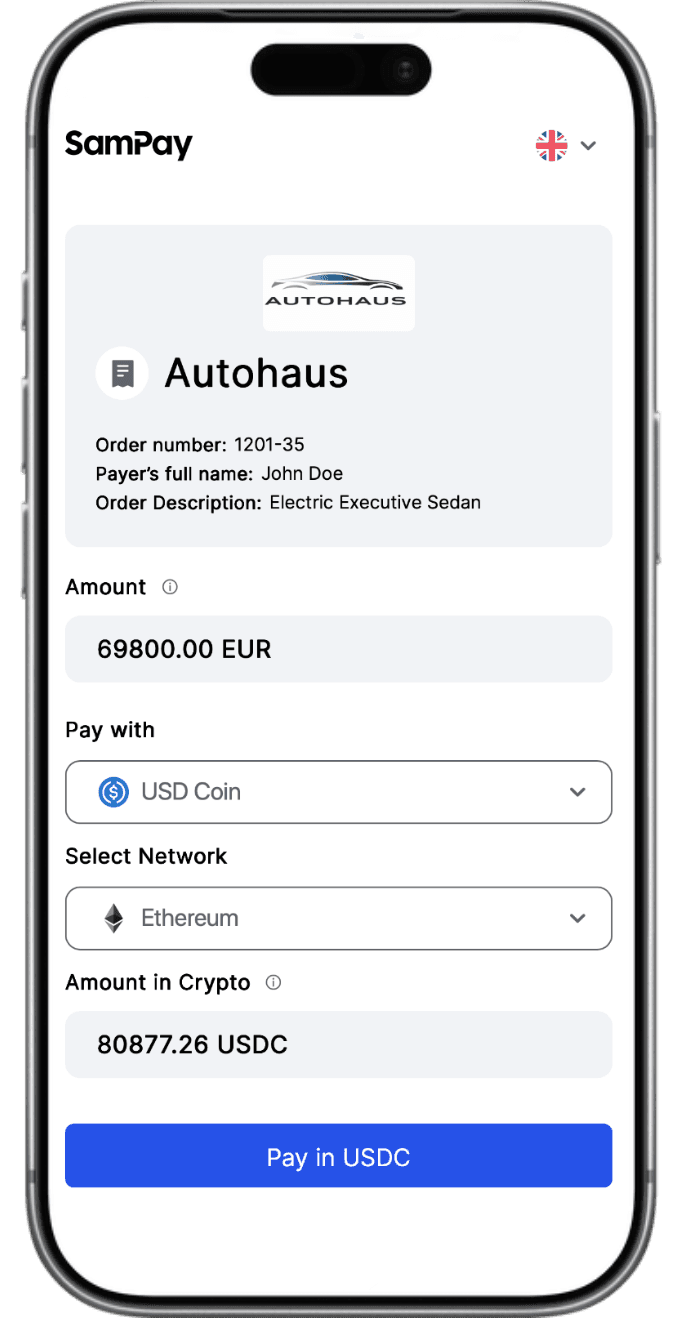
A practical flow starts with something your team already understands: an invoice in euros. The sale is priced in EUR, approved in EUR, and documented in EUR. That keeps pricing, accounting, and internal controls familiar from the start.
When the process begins this way, the logic is already right for a traditional business. You are not redesigning your operation around crypto. You are simply giving the client another way to complete a euro-denominated purchase.
What the right model looks like for luxury goods
The correct approach is simple in concept, even if the provider handles a lot in the background. The customer pays in crypto. The payment is checked automatically. The crypto is converted into euros. Your business receives EUR by bank transfer. That is the model luxury merchants actually need.
This matters because it removes the part that creates fear internally. There is no crypto sitting on your balance sheet. There is no need for your finance team to manage wallets. There is no guessing about whether exchange rate volatility will affect the value of the sale before funds arrive. You receive EUR only, in a way your business already knows how to handle.
The customer can still enjoy the flexibility of paying with crypto, but for your company, the result is straightforward: a compliant euro settlement to the bank account you already use. That is the difference between offering crypto payments in Europe as a business decision and accepting crypto directly as an operational gamble.
Compliance should be built in, not added later
In luxury transactions, compliance cannot be an afterthought. It has to be part of the payment flow from the start. That means every transaction needs proper checks before it becomes your problem. If those checks happen automatically inside the process, your team can focus on the sale. If they do not, someone inside your company is left trying to interpret risk manually.
That built-in control is what makes compliant crypto payments viable for traditional merchants. Identity review, transaction screening, and risk monitoring should happen in the background so that you are not left asking basic questions after the payment arrives. In business terms, this means you do not need to worry about where the money came from or how to justify the transaction to your bank later.
The customer journey can remain smooth while the controls run behind the scenes. That balance matters in luxury sales, where neither compliance friction nor customer confusion is acceptable.
This is the kind of structure that gives both sides confidence. The buyer sees a clear process. Your business sees a controlled one.
The payment should feel simple, even if the control layer is serious
One of the biggest misconceptions around crypto to EUR solutions is that security and simplicity are opposites. In reality, the best systems combine both. Your client should not face a chaotic process, and your team should not need to manually coordinate every step. In practice, that means a straightforward payment page, a clear amount, a visible payment method, and automatic confirmation once the transfer is detected.
For luxury businesses, this is not just operationally useful. It is part of brand protection. The payment process should feel clean and intentional, not improvised. That is especially important when the customer is making a high-value purchase and expects the same level of professionalism at payment as in the rest of the sales journey.
Once the transaction is initiated, automation becomes even more important. Your team should not be chasing blockchain confirmations, checking wallets manually, or wondering whether the transfer arrived. The system should detect the payment, verify it, and move it through the process toward settlement.
That is how crypto payments for business become manageable for non-crypto businesses. The complexity exists, but it stays behind the curtain where it belongs.
Where SamPay fits in
This is exactly where a provider like SamPay makes sense for the luxury segment. SamPay is not designed to turn your business into a crypto operator. It is designed to let your client pay in crypto while your company receives euros directly in its bank account. The checks happen within the flow. The conversion happens before settlement. Your business does not hold crypto and does not need to build internal expertise around it.
For a luxury merchant, that changes the conversation completely. Instead of asking whether your team can safely handle crypto, the question becomes much simpler: do you want to accept more clients without changing how your business operates? If the answer is yes, the right setup is one where the crypto layer is abstracted away from you.
You sell watches - you continue selling watches. You sell jewelry - nothing changes. You receive EUR - always. That is the reason this model works for premium merchants who care about reputation, control, and smooth internal processes as much as they care about closing the sale.
Why this is the right approach for high-ticket sales
High-ticket transactions are where every weakness in a payment process becomes visible. If compliance is unclear, the deal feels risky. If settlement is unpredictable, finance gets nervous. If banking questions appear later, the cost of that "new payment method" suddenly looks much higher than the sale justified. That is why direct crypto handling is rarely the right answer for premium merchants.
A provider removes those risks by structuring the transaction correctly from the start. The client pays in crypto, the payment is screened, the value is converted, and the merchant receives euros in the bank. That keeps the sale aligned with the way your company already works. You gain access to demand without absorbing the burden behind it.
SamPay is particularly well suited to high-ticket sales because that is where clean controls and predictable settlement matter most. If your average transaction size is significant, you do not want a workaround. You want a process that satisfies sales, operations, finance, and banking expectations at the same time.
The obvious next step
If your business is exploring how to accept crypto payments in Europe, the goal should not be to "start handling crypto." The goal should be to let customers use crypto while your company continues operating as usual. That means pricing in EUR, settling in EUR, keeping compliance built in, and avoiding unnecessary banking friction.
For luxury goods merchants, this is the obvious way to do it. The provider takes on the complexity, the checks, and the conversion layer, while you keep control over the sale and receive predictable euro settlement. That is what removes hesitation internally and makes crypto payments commercially useful instead of operationally risky.
If you are evaluating options now, SamPay is worth exploring because it fits the reality of premium, high-ticket business. It does not ask you to become crypto-native. It lets you stay what you already are: a traditional merchant selling valuable goods with a professional, low-risk payment process.
Book a demo
Let your clients pay in crypto while your business keeps operating in euro.
Book a demo to see how SamPay helps merchants accept crypto payments with compliant EUR settlement and a familiar operational flow.