Published April 5, 2026
Crypto payments for consulting and services
If you run a consulting firm, advisory business, agency, legal practice, premium design studio, or another service business with international clients, you have probably noticed that the work itself is often not the hard part. The real friction starts when it is time to get paid. A project is approved, the invoice is ready, the client is willing to move fast, and then the process slows down because the payment route is inconvenient, expensive, or simply not aligned with how that client operates.
This is especially common when you work across borders. A client in one country wants to pay immediately, but bank transfers take time, card limits get in the way, and internal compliance checks on the client side can delay a straightforward transaction. In some cases, the client is perfectly able to pay in crypto, but your team hesitates because accepting crypto directly sounds like opening a completely different business model, not just adding another payment option.
That hesitation is valid. The problem is not accepting crypto. The problem is everything that comes with it: compliance, volatility, banking questions, accounting confusion, and the operational burden of handling something your service business was never built to manage. If you provide consulting or services, you should be focused on delivery, retainers, project margins, and client relationships, not on wallets, risk checks, and explaining incoming digital assets to your bank.
Why service businesses feel payment friction first
Service businesses are often among the first to feel international payment pressure because there is no physical shipment to delay the transaction and no inventory cycle to absorb payment issues. You finish a milestone, send an invoice, and expect the process to be simple. But in practice, cross-border service payments can turn into a chain of small frictions: the client asks for a different currency, your bank takes longer than expected, fees reduce the final amount, or the transfer gets reviewed because something about the payment route looks unusual.
For high-value consulting and premium services, this becomes even more visible. If you bill for strategy, legal support, executive advisory, architectural work, private brokerage, or bespoke business services, clients are often international and time-sensitive. They are not always asking for something exotic; they are usually asking for speed and convenience. Sometimes crypto is simply the payment method they can use fastest. The issue for you is not whether they can pay - it is whether your business can accept that payment without taking on unnecessary risk.
This is where many companies pause. The founder may be open to the idea, but the finance team asks reasonable questions. How do we account for this? Who verifies the source of funds? What happens if the bank asks why crypto-related money is reaching the company? Do we need internal procedures? Does this affect tax treatment? Suddenly, what looked like a payment option starts to feel like an operational problem.
The real issue with direct crypto acceptance
At first glance, direct crypto acceptance can look simple. A client sends funds, you receive them, and the invoice is paid. But for a consulting or service business, that is usually where complexity begins, not where it ends. Once crypto lands on your side, your company has to deal with all the consequences of holding it, even if only briefly.
Compliance does not disappear just because the payment was successful
A completed payment does not mean the compliance question is solved. Your finance team still needs confidence about where the money came from and whether the payment can be comfortably documented. If the transaction later raises questions, it is your business that has to explain it. That is not a good position for a company whose core expertise is consulting, legal support, creative services, or advisory work.
When this process is handled manually, it creates stress around every large payment. Someone has to review details, someone has to store records, and someone has to be ready if your bank or accounting team asks for justification. What looked like flexibility for the client becomes extra work for your internal team.
Before going further, it helps to picture the business model that most service companies actually want: your invoice stays in EUR, your workflow stays familiar, and the payment complexity sits in the background rather than on your balance sheet.
That is the key distinction. You are not trying to become a crypto business. You are trying to get paid for your services in a way that does not disrupt accounting, reporting, or banking. You still want to invoice and settle in EUR, because that is how your company already runs.
Volatility and treasury risk make no sense for service companies
A consulting or service business prices expertise, time, and outcomes. Your margins depend on planning, not speculation. If you accept crypto directly and hold it even for a short period, you introduce a variable your business does not need. The value can move before conversion, the accounting treatment becomes more complicated, and you may end up discussing market fluctuations when the only thing that should matter is whether the invoice was paid.
For a service business, this is unnecessary exposure. You are not investing treasury capital. You are collecting payment for completed work. The sensible setup is one where the client can pay in crypto, but your business receives EUR in the bank account, with a clear amount and a clear record.
Banking friction is often the hidden reason companies say no
Many business owners assume the main barrier is technical. In reality, the bigger concern is often banking. Traditional banks are comfortable when they see normal EUR business activity supported by standard documentation. They are much less comfortable when a company starts directly interacting with crypto flows without a clear compliance framework and conversion process.
This is why many firms avoid the issue entirely. They are not against winning international clients. They are against creating a payment trail that could become difficult to explain later. That is a rational concern, especially for established service businesses that value stable banking relationships.
What a workable model looks like in practice
The right model for crypto payments for business is not "receive crypto and figure it out." The right model is much simpler: the client pays in crypto, the payment is checked, the amount is converted, and your company receives EUR to its bank account. That is the structure that makes crypto useful for a traditional business without turning the business into a crypto operator.
In practice, this means your workflow can remain as close as possible to the one you already use today. You create an invoice or payment request in EUR, send it to the client, and they choose crypto on their side. Behind the scenes, the payment goes through the necessary checks, conversion happens automatically, and settlement arrives in EUR through standard banking rails.
For service businesses, this matters because it protects the internal operating model. You sell consulting - you continue selling consulting. You provide premium services - nothing changes in how you run the company. You receive EUR - always.
A simple payment flow also matters because service businesses are often moving quickly between proposals, milestones, and retainers. The easier it is for your team to send a payment request, the less payment administration interrupts delivery.
That is why a payment link or invoice-based process is often the most natural fit. It does not force your team to learn crypto tools or build new routines. It simply gives the client a modern way to pay while your side remains familiar and controlled.
Why compliant crypto payments matter more in services
When you sell products, people often focus on logistics. When you sell services, trust is the product environment. Your reputation, documentation, and financial discipline matter. That is why compliant crypto payments are not a luxury feature - they are the foundation of whether this payment option is usable at all.
If a client pays in crypto, you need confidence that the payment is screened automatically and that questionable activity is filtered before it becomes your problem. In business terms, this means you should not be the one wondering how to justify the origin of funds or how to respond if your bank asks questions later. The payment setup should already include those safeguards.
This compliance layer is what separates a usable business solution from an improvised workaround. Without it, your operations team carries the burden. With it, the process becomes manageable and documentable, which is exactly what finance teams need.
That is why the compliance step should happen in the flow, not after the fact.
For your business, the practical meaning is straightforward: every payment is checked automatically, so you do not have to worry about where the money came from or how to explain it to your bank. That is what makes it possible to accept crypto payments in Europe without importing crypto risk into a traditional service company.
Where SamPay fits into this model
This is exactly where SamPay becomes relevant. Not as a tool for "getting into crypto," but as a way to remove the reasons traditional businesses hesitate in the first place. SamPay allows your client to pay in crypto while your company receives EUR directly to its bank account through SEPA or SWIFT. The crypto is converted before it becomes your operational problem, so in practical terms, it never does.
That distinction matters. Your accounting stays EUR-based. Your treasury stays EUR-based. Your team does not manage wallets, does not hold crypto on the balance sheet, and does not build internal crypto procedures just to collect payment for services already delivered. The entire point is that your business continues operating exactly as before.
For founders and operators, this means fewer blocked deals and faster international settlements. For finance teams, it means a structure that is easier to understand, document, and reconcile. For the client, it means flexibility. For your company, it means familiarity.
And because the process includes AML, KYC, and transaction checks in the background, the payment route is not just convenient - it is built to reduce the exact risks that make businesses avoid direct crypto acceptance.
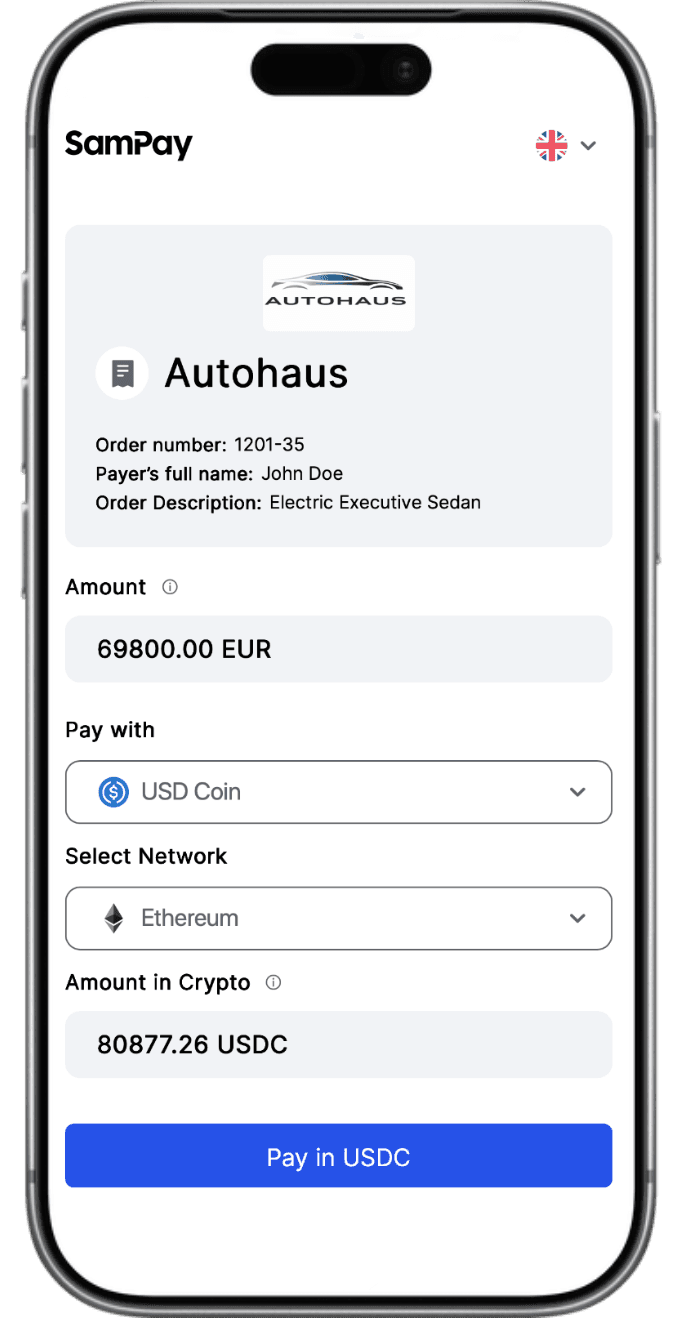
To the client, the payment experience is clear and straightforward, which also helps reduce back-and-forth at the moment when you are trying to close the transaction, not educate someone on process.
That is why this model works so well for consulting and services. It respects both sides of the transaction. The client gets a payment method they can use. You get a clean EUR outcome that fits your normal business operations.
A practical way to accept crypto payments in Europe
If your business is evaluating how to accept crypto payments in Europe, the decision should not be framed as "Should we become crypto-friendly?" The better question is: can we remove payment friction for international clients without adding risk, operational complexity, or banking issues to our business?
For consulting and services, the answer should be yes - but only with the right structure. Direct crypto handling usually creates more internal questions than it solves. Crypto to EUR settlement, with compliance built in and bank payout as the final step, is the model that makes business sense.
That is why the conclusion is simple. Crypto + EUR payout simplifies settlements. SamPay solves exactly that. It gives your business a way to say yes to international clients who want to pay in crypto, while keeping your own side of the business stable, familiar, and fully EUR-based.
If you want to expand payment flexibility without changing how your company operates, this is the obvious way to do it. Explore how SamPay can fit into your invoicing flow, test the payment journey, and see how compliant crypto payments can work for your business without turning your finance team into crypto specialists.
Book a demo
Let your clients pay in crypto while your business keeps operating in euro.
Book a demo to see how SamPay helps merchants accept crypto payments with compliant EUR settlement and a familiar operational flow.