If you run a car dealership, you already know that closing the sale is only half the job. The other half is getting paid in a way that is fast, documented, acceptable to your finance team, and unlikely to create problems with your bank. That becomes even more important when you sell to international buyers, where traditional transfers can be slow, inconvenient, or hard to coordinate across borders.
This is usually the point where crypto enters the conversation. Not because your dealership wants to become a crypto business, but because some buyers already hold part of their wealth in crypto and want to use it for large purchases. On paper, that sounds like an opportunity. In practice, most dealers hesitate for one simple reason: the issue is not the payment itself, but everything attached to it afterward.
Why car dealerships feel this pressure first
Car dealerships sit in a category where international demand is normal, transaction values are high, and payment friction can cost you a real sale. A buyer may be ready to reserve a premium vehicle, complete paperwork quickly, and arrange transport, but the payment method becomes the bottleneck. One client wants to pay from abroad, another wants to avoid delays with a large bank transfer, and another asks whether you can accept crypto payments for business because that is how they hold liquidity.
What makes this difficult is that car dealers are not trying to build a new financial infrastructure. You sell cars. Your team is built to source inventory, manage negotiations, process contracts, coordinate handover, and keep accounting clean. The moment you try to accept crypto directly, you suddenly step into a different world: wallet handling, transaction verification, source-of-funds concerns, compliance checks, accounting treatment, and possible bank questions later.
You can see why most dealers stop there. The opportunity is real, but the operational burden feels completely unrelated to the core business.
The real problem with international car payments
It is not just about convenience
For high-ticket vehicle sales, payment complexity is rarely a minor admin issue. It affects delivery timing, trust, and whether the transaction closes at all. If a buyer is abroad and wants to move funds quickly, traditional payment rails may not always fit the situation. Delays in international transfers, intermediary bank checks, cut-off times, and documentation back-and-forth can all slow the deal down.
That is why some dealerships start looking at compliant crypto payments. They are not chasing a trend. They are trying to remove friction for legitimate buyers without creating new risks internally. But this is where many businesses make the wrong assumption: that accepting crypto is simply another payment option, like card or bank transfer. It is not, at least not if you handle it directly.
Direct crypto acceptance creates problems your dealership does not want
The moment crypto lands in your company wallet, the nature of the transaction changes. Your finance team now has to think about valuation, volatility, accounting treatment, reconciliation, and what exactly sits on the company balance sheet. Your bank may ask where incoming funds came from or how your business is handling digital assets. If anything about the flow looks unclear, the discussion becomes difficult very quickly.
That is the real reason dealerships hesitate. You are not just receiving money, you are taking on compliance and banking exposure. A vehicle sale is already a transaction that attracts scrutiny because of its value. If crypto is introduced without the right controls, every unanswered question becomes your problem to solve.
What this looks like in real dealership operations
Imagine a foreign buyer wants to purchase a premium SUV and says they can pay immediately in USDT. If you do not have a proper structure, your team has to decide how to receive the payment, who checks the transaction, how you confirm the amount in EUR, whether the funds are safe to accept, and how accounting records the whole process. Then comes the next layer: can you comfortably show this to your auditor or bank if asked?
Or take a luxury dealership selling sports cars and imported vehicles to clients across Europe and beyond. The commercial side of the business may already be prepared for cross-border sales, but the payments side often is not. One unclear transaction can delay release of the car, create internal uncertainty, and lead to extra legal or banking review. Instead of making the sale easier, crypto becomes the reason everyone gets nervous.
This is why the right approach is so important. The dealership should not be exposed to token prices, wallet management, or the origin analysis of digital assets. Those are necessary checks, but all of that complexity should be invisible to the merchant.
The model that actually works for car dealerships
The practical solution is not "hold crypto better." It is to remove crypto from your dealership's side of the process altogether. The buyer pays in crypto, the transaction is checked automatically, the amount is converted, and your business receives EUR to its bank account. From your side, the transaction finishes in the currency you already use.
That distinction matters more than anything else. You are not changing your business model. You are not turning your dealership into a crypto company. You are simply allowing a client to pay with crypto while your business continues operating in EUR, exactly as before. This is the model that makes crypto payments for business relevant to traditional merchants.
Before the buyer pays, the amount can be set in EUR so your dealership keeps full pricing control. Your sales team knows the vehicle price, your finance team knows what should arrive, and your accounting remains predictable. The customer may choose crypto, but your internal workflow stays familiar.
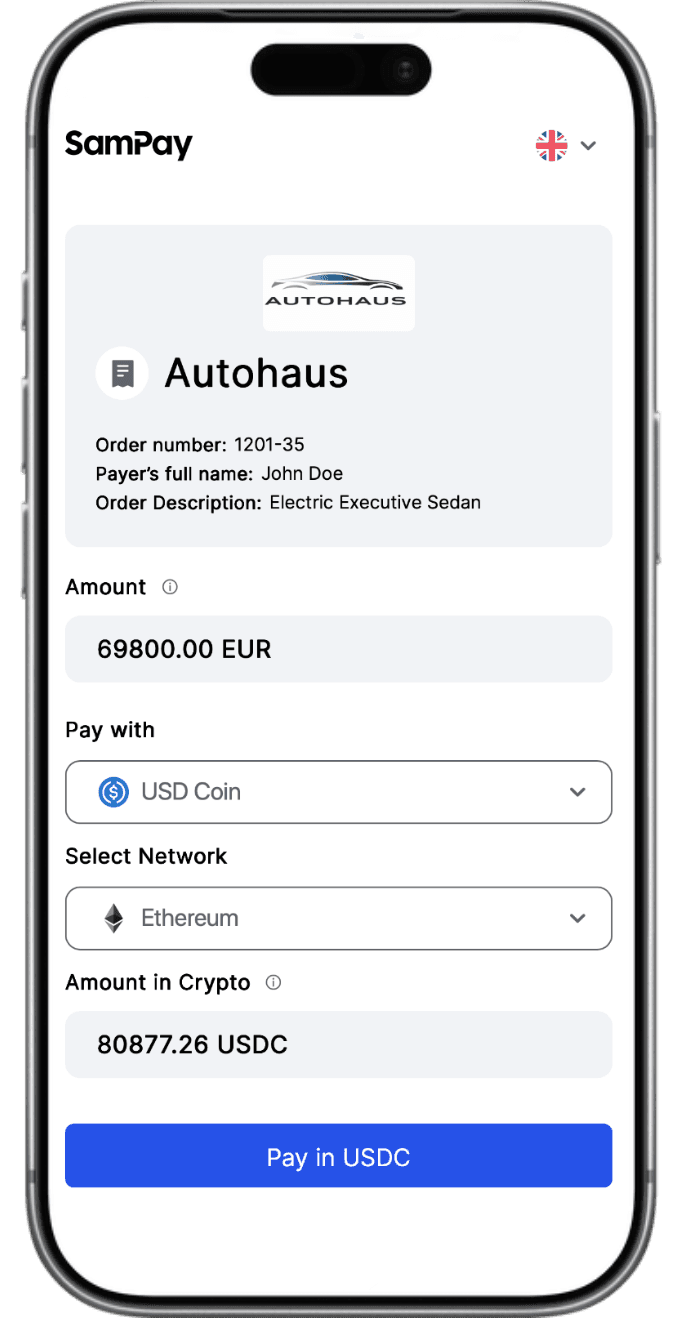
A simple invoice flow is a good example of how this should feel on the merchant side. Your team creates the payment request in EUR, not in tokens or wallet balances, so the transaction starts in the same commercial logic you already use for any vehicle sale.
From there, the buyer receives a clear payment path. This matters in car sales because high-value transactions should not feel improvised. The client needs to understand what to pay, where to pay, and when the payment is considered complete, without endless manual coordination between your salesperson and the buyer.
Why compliance matters more in automotive sales
The bigger the ticket, the less room for ambiguity
In lower-value retail, small operational mistakes may be annoying. In automotive sales, they can be serious. Vehicles are expensive, often resold internationally, and often purchased by clients your team may not know personally. That means payment compliance is not a nice extra. It is part of protecting the business.
When people talk about compliant crypto payments, what really matters to a dealership is simple: every transaction should be checked automatically, the payer should be verified when needed, and there should be a clear process behind the payment before the money reaches you. In business terms, that means you do not have to personally investigate wallets, explain questionable flows, or defend a transaction structure your team does not fully control.
This is exactly where direct crypto acceptance breaks down for most merchants. If your staff has to decide whether a transaction looks safe, the process is already wrong. Those checks should happen in the background, systematically, before settlement. Your dealership should only care that the payment passed the required controls and that EUR is arriving to the company account.
A compliance step should reduce friction, not create it. Done properly, it protects the dealership while keeping the transaction moving.
And once the payment is in motion, monitoring should not depend on screenshots, manual confirmations, or waiting for someone to "check the wallet." For a business selling cars, reliability matters. The transaction should be detected, reviewed, and advanced through the process with as little manual intervention as possible.
Where SamPay fits into this process
This is the point where a platform like SamPay becomes useful, because it is built around the business reality dealerships actually care about. The buyer pays in crypto. The system handles the necessary AML, KYC, and transaction screening. The funds are converted from crypto to EUR. Your dealership receives EUR by bank transfer through SEPA or SWIFT. You do not hold crypto, and you do not need to operate around it.
That is the difference between "accepting crypto" in theory and accepting it in a way that works for a traditional European business. SamPay is not asking your finance team to learn digital asset operations. It is giving your business a controlled payment channel that fits your existing accounting, banking, and internal approval structure.
For a dealership, this changes the conversation completely. Instead of saying no to buyers who want to pay in crypto, or saying yes and taking on unnecessary risk, you can offer a third option: the client pays how they prefer, while your business receives EUR only. The sale can move forward without dragging your accounting department into unfamiliar territory.
This is especially valuable if you want to accept crypto payments in Europe while keeping banking relationships stable. Banks do not want unclear stories. Finance teams do not want volatile assets on the books. Operators do not want manual exceptions in every high-value sale. SamPay solves that by making the crypto side invisible to the merchant and preserving the normal EUR-based workflow.
What this means for growth
For many dealerships, the upside is not about marketing yourself as "crypto-friendly." It is about removing a reason for good buyers to walk away. International clients, mobile high-net-worth buyers, and customers who move capital digitally are already part of the market. The question is whether your dealership can serve them without introducing internal risk.
If the answer is yes, your reachable market expands. More importantly, it expands in a controlled way. You are not loosening standards. You are not bypassing compliance. You are simply making it easier for legitimate clients to complete a purchase while your business remains protected.
That is why this model works so well for luxury and high-ticket sectors. The merchant does not need a new operating logic. You sell cars - you continue selling cars. Your contracts stay in EUR. Your accounting stays in EUR. Your bank settlement stays in EUR. The customer may use crypto, but from your side, nothing important changes.
The practical next step
Crypto payments can absolutely help car dealerships reach more international buyers, especially when traditional payment methods create delays or friction. But that only makes sense if the process is compliant, bank-safe, and operationally simple. Otherwise, you are solving one problem by creating three more.
The obvious model is crypto to EUR with proper checks built in and bank settlement at the end. That is what turns crypto from a risky distraction into a useful sales tool. SamPay makes that possible in a way that fits how dealerships already work: clear pricing, automated compliance, conversion before settlement, and EUR paid out to your account.
If you are exploring crypto payments for business, this is the standard to look for. Not more exposure to crypto, but less. Not more operational effort, but less. Not a new financial system inside your dealership, but a payment layer that lets you keep doing what you already do well.
Crypto payments expand your market when compliance is built into the process. SamPay makes that safe. If you want to test whether this model fits your dealership, the next step is simple: explore the workflow, see how crypto to EUR settlement works in practice, and evaluate it as a normal business payment process - because that is exactly what it should be.
Book a demo
Let your clients pay in crypto while your business keeps operating in euro.
Book a demo to see how SamPay helps merchants accept crypto payments with compliant EUR settlement and a familiar operational flow.