Published April 5, 2026
Crypto payments for businesses: complete guide (EU edition)
If you are looking into crypto payments for business in Europe, you are probably not trying to become a crypto company. You are trying to solve a practical business question: how do you let a client pay the way they want, without creating new risks for finance, compliance, accounting, and banking? That is usually where the confusion starts. The market offers many ways to "accept crypto," but from a business perspective, these models are not equal at all.
For most traditional businesses, especially in luxury, real estate, automotive, jewelry, and premium services, the issue is not the payment itself. The issue is everything that comes after it. The moment crypto enters your process directly, you are no longer just taking money from a client. You are taking on a chain of responsibilities your business was never built to manage.
If you sell cars, you should continue selling cars. If you sell property, nothing about your internal process should suddenly become more complicated. If you invoice in EUR, reconcile in EUR, and report in EUR, that should remain true. The right model for compliant crypto payments in Europe is the one that keeps your business operating exactly as before, while the crypto part stays invisible in the background.
The European market is growing, but the business question is still unresolved
Across Europe, more clients now hold part of their wealth in crypto and want to use it for legitimate purchases. This is especially visible in high-ticket categories, where buyers are international, mobile, and often expect more flexibility in how they settle payments. At some point, this becomes less of a trend question and more of an operational one: if a serious client wants to pay in crypto, what is the right way to say yes without creating a problem internally?
This is where many businesses get stuck. They see demand, but they do not have a clear framework for evaluating the available options. One provider offers wallet payments. Another offers OTC conversion. Another says they can help you "accept crypto payments in Europe," but it is not immediately clear what that means for your bank, your accountant, your compliance team, or your cash flow. In practice, the market looks crowded, but the number of models that actually work safely for a traditional European business is much smaller.
The main models businesses encounter
Direct wallet acceptance
The first model is the most obvious one: the customer sends crypto directly to your wallet. On the surface, it sounds simple. You provide an address, the client pays, and the funds arrive. For someone outside finance or compliance, that can look like the easiest route.
But this is usually the point where the real problems begin. If the funds land in your wallet, your business is now handling crypto directly. That creates immediate questions. Where did the funds come from? How do you screen the transaction? How do you explain the source of funds to your bank later when you want to convert or move the money? What happens if the value changes before conversion? And who inside your company is now responsible for holding and controlling those assets?
What looked like a payment method turns into a treasury, compliance, and banking issue. The business is no longer just receiving payment - it is effectively stepping into crypto operations.
OTC or manual conversion setups
The second model is more structured, but still problematic for many merchants. In this setup, crypto is received first and converted later through a broker, exchange, or manual OTC process. This can work in isolated cases, especially for one-off transactions, but it is rarely a scalable system for a business that wants predictable operations.
The issue here is fragmentation. Payment comes in one place, checks happen elsewhere, conversion happens separately, and settlement to the business account may depend on multiple parties. Finance teams do not want to chase transaction records across providers. Accountants do not want to rebuild the payment trail after the fact. Banks do not like unclear payment histories, especially when the business itself had direct exposure to crypto before conversion.
The result is friction at exactly the level where serious businesses need clarity.
Regulated processing with fiat settlement
The third model is the one that makes the most business sense in Europe: the customer pays in crypto, the payment is checked automatically, the amount is converted, and the merchant receives EUR directly to a bank account. In this structure, the company does not hold crypto on its balance sheet and does not have to build internal crypto expertise just to accept a client's money.
This is the difference that matters. The customer can pay with crypto, but your business continues operating in EUR. That means familiar accounting, predictable settlement, and a much easier conversation with internal finance and external banking partners.
Why businesses struggle to evaluate what is legal, safe, and bank-friendly
When decision-makers first review the market, they often ask three questions at once: is this legal, is this safe, and will our bank accept it? Those are the right questions, because the risk is not usually in the customer-facing payment page. The risk appears later, when the payment has to fit into the rest of the business.
Legality is not just about "can we do it?"
In Europe, the answer is not as simple as yes or no. A payment setup may be technically possible, but that does not make it operationally appropriate for a regulated business environment. The important question is whether the model includes proper screening, documented payment flows, and a compliant settlement structure that your business can actually support over time.
If you accept crypto directly and then try to sort everything out afterward, you are putting the burden on your own team. You are asking finance to interpret the flow, compliance to justify it, and banking partners to trust it. That is not a strong operating model for a company that wants stability.
Safety is not only about fraud
Many businesses hear "safe crypto payments" and think first about technical security. But for a merchant, safety is much broader. It includes payment traceability, AML controls, counterparty clarity, and protection from volatility. A payment can be technically successful and still create a serious business problem if it later raises questions about origin, screening, or documentation.
This is why built-in compliance matters so much. Every payment should be checked automatically, so you do not have to worry about where the funds came from or how to explain the transaction to your bank later. What your business needs is not a wallet tool. It needs a payment process that removes uncertainty.
Before going further, it helps to see what a business-friendly workflow actually looks like when crypto is fully abstracted away from the merchant side.
In the right setup, you create an invoice in EUR, exactly as you would for any other transaction. You are not pricing in tokens, managing exchange rates manually, or changing how your team works. The client may choose crypto on their side, but on your side the process remains familiar and controlled.
Banking risk is often underestimated
This is the part many merchants only understand after the fact. Banks do not just care that a payment happened. They care about how it happened, where the funds originated, and whether the flow is understandable and documented. If your company directly receives crypto and then later converts it, you may be introducing a type of payment activity your bank views as higher risk than your actual core business.
That creates unnecessary exposure. You sell cars - you should continue selling cars. You sell real estate - nothing changes. You receive EUR - always. That is the model banks understand best, and it is the model your internal reporting can support without strain.
What the right model looks like in practice
The strongest model for crypto to EUR payments is simple from the merchant's point of view. The customer chooses to pay in crypto. The transaction is screened. The crypto is converted into EUR. The business receives EUR by bank transfer through SEPA or SWIFT. The merchant never needs to hold or manage crypto directly.
That sounds straightforward because it should be. The complexity exists in the background, where it belongs. Compliance checks, transaction monitoring, and conversion should happen inside the payment infrastructure, not inside your operating team. Your business should not have to become a crypto expert just to close a sale.
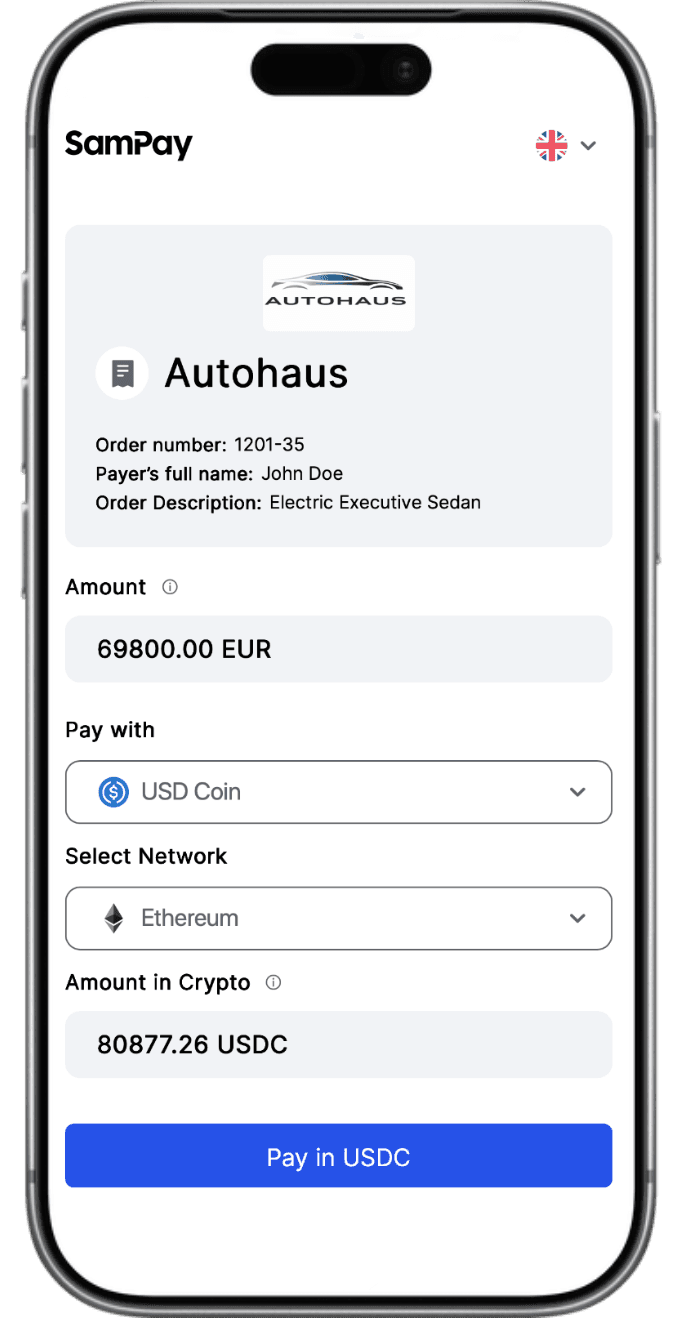
A clear customer flow also matters. The payment experience should feel structured and professional, especially for high-value transactions where trust is essential.
When the payment interface is clean and guided, the client knows what to do without back-and-forth. That reduces friction on both sides. More importantly, it keeps the transaction inside a controlled process instead of relying on manual wallet sharing, screenshots, and ad hoc confirmation messages.
On the compliance side, automation is what makes this workable for serious businesses. You do not want someone on your team checking every payment manually or trying to interpret risk signals without the right tools. The correct system verifies the transaction flow as part of the payment process itself.
This is the difference between simply "taking crypto" and using compliant crypto payments designed for business. One creates new responsibilities for your team. The other removes them.
Where SamPay fits in
This is exactly the type of model SamPay represents. The customer pays in crypto, SamPay handles the required checks, the funds are converted, and your business receives EUR directly to its bank account. No crypto sits on your balance sheet. No separate wallet operations are pushed onto your finance team. No unnecessary banking friction is created by asking your company to handle an asset class it never wanted to manage in the first place.
For a traditional business, that distinction is critical. SamPay is not about turning your company into a crypto business. It is about allowing you to accept crypto payments for business in a way that keeps your accounting, treasury, and settlement process normal.
The workflow itself should also be practical. A business does not need something exotic; it needs something that fits existing sales operations and can be used by non-technical teams.
That is why this model works particularly well for offline and high-ticket transactions. Your team can send a payment request, the client completes the crypto side, and the business receives EUR. The commercial process remains yours. The crypto complexity stays out of sight.
Which model actually scales in Europe
If you step back and look at the European market clearly, the answer becomes much simpler than it first appears. Direct wallet acceptance may look easy, but it pushes compliance, volatility, and banking risk onto the merchant. Manual conversion models may work occasionally, but they are too fragmented to support stable internal operations. Only the regulated processing model with fiat settlement is aligned with how traditional businesses actually function.
That is why, among all the available options, only one model truly supports growth without unnecessary risk: customer pays in crypto, provider handles screening and conversion, merchant receives EUR in the bank. It is the only structure that lets you say yes to demand without redesigning your company around crypto.
If your business is evaluating how to accept crypto payments in Europe, that should be the filter for every provider you review. Do they leave you holding crypto? Do they shift compliance burdens onto your team? Do they create questions for your bank? Or do they let you continue operating normally, with predictable EUR settlement and a clean payment trail?
That is also why SamPay stands out as the practical option. It follows the model that makes sense for real businesses, not for crypto-native operators. It gives you a way to accept crypto to EUR payments without changing what your company is or how it runs.
In the end, this is the obvious way to do it. If you want to explore crypto payments for business, start with the model that removes risk instead of adding it. Look at how regulated processing and fiat settlement would fit your current workflow, test the process, and evaluate it the same way you would any serious payment infrastructure. For most European merchants, that is the point where the decision becomes clear.
Book a demo
Let your clients pay in crypto while your business keeps operating in euro.
Book a demo to see how SamPay helps merchants accept crypto payments with compliant EUR settlement and a familiar operational flow.