If you are currently comparing a crypto payment gateway with a direct wallet, you are probably not trying to become a crypto company. You are trying to solve a very ordinary business question: how do you let a client pay the way they want, without creating a new set of problems for finance, compliance, and banking? That is the real decision here. Not whether crypto exists, but whether your business should carry the burden that comes with it.
For many companies, especially in luxury, automotive, real estate, private services, and other high-ticket sectors, this question appears quietly at first. A client from abroad wants to move quickly. A traditional bank transfer is slow, inconvenient, or blocked by timing. Someone internally says, "Why don't we just give them a wallet address?" On the surface, that sounds simple. In practice, that is exactly where complexity begins.
What looks simple is often the riskier option
A direct wallet feels easy because it removes the need to choose a provider. You create a wallet, share the address, receive funds, and assume the payment problem is solved. But from a business perspective, that is not a payment system. It is just money arriving in a format your company does not normally use, with no clear framework for how to process it safely.
The moment funds land in your own wallet, the questions start. Who checks where the money came from? Who confirms whether the transaction creates an AML concern? Who converts it to EUR, at what rate, and through which channel? How do you explain the source of funds to your bank when the money eventually needs to be settled into your regular account? And if something goes wrong, who inside your team owns that problem?
This is why comparing a crypto payment gateway vs direct wallet should not be framed as convenience versus inconvenience. It is better understood as unmanaged exposure versus managed process. One puts risk on your business. The other is designed to keep that risk away from your business.
What actually happens when you accept crypto directly
A wallet address is not a business process
Let's say you sell cars. A client wants to reserve or fully pay for a vehicle using USDT. If you give them a direct wallet address, the payment may arrive quickly, but your operational work starts only after that moment. Someone has to verify that the amount is correct, that the funds are usable, that the transfer is not tied to suspicious activity, and that the conversion into EUR can happen without delay or unexpected loss.
You are no longer just selling a car. You are now dealing with payment screening, treasury decisions, and banking exposure. That is not where most merchants want to spend time, and it is certainly not what finance teams want added to their monthly process.
Compliance becomes your problem immediately
This is where many businesses underestimate the issue. When crypto is received directly, the company is much closer to the compliance burden than it first appears. Even if the transaction itself was legitimate, your business may still need to answer difficult questions later: where did the funds come from, were they screened properly, and what controls were in place when the payment was accepted?
In other words, the risk is not theoretical. It shows up when you try to account for the transaction, when your bank reviews incoming funds, or when your team is asked to document how the payment was handled. The issue is not that crypto payments for business are impossible. The issue is that direct acceptance often pushes responsibilities onto a merchant that is not built to carry them.
Before a transaction is approved, proper checks should happen automatically, not manually through your staff. That is exactly why a structured gateway model matters.
A good payment flow does not ask your team to become investigators. It checks the transaction and the customer as part of the process, so your business is not left holding unanswered compliance questions later.
Volatility and conversion are not side issues
Even businesses that are open to crypto often draw a hard line here: they do not want crypto on the balance sheet. That is a very sensible position. The sale is priced in EUR, your accounting is in EUR, your suppliers are paid in EUR, and your reporting is in EUR. Bringing crypto into that chain creates a mismatch that serves no real business purpose.
If you accept funds into a direct wallet, somebody still has to convert them. That means choosing timing, execution, counterparties, and banking routes. It also means exposure to market movement during the gap between receipt and settlement. What looked like a simple payment option can quickly become a treasury issue.
Banking risk is often the hidden issue
Many merchants focus on the payment itself and ignore the final step: getting money into the bank account they actually use. But this is often where the real friction appears. A bank may not object to your business category at all, yet still become uncomfortable if the payment trail is unclear or if crypto touched your operations directly.
This matters because the merchant does not need crypto for its own sake. You need clean, explainable settlement into your existing financial workflow. That is why the real comparison in "accept crypto payments in Europe" is not wallet versus gateway as a technical preference. It is wallet versus a system that protects banking continuity.
Why the gateway model works better
The right model is crypto → conversion → EUR → bank account
For a traditional business, the correct model is straightforward. The customer pays in crypto. The transaction is checked. The funds are converted. Your business receives EUR by bank transfer. No crypto sits on your balance sheet, no treasury decision is pushed onto your staff, and no one internally has to figure out how to handle wallets, exchanges, or compliance workflows.
That is what a real gateway should do. It should not merely help you receive crypto. It should remove everything around crypto that your business does not want to own.
This model is especially important for high-value sectors. If you sell real estate, nothing about your core business should change. If you sell jewelry, you should still invoice and reconcile as usual. If you provide premium services, your team should not be pulled into payment risk simply because a client prefers to pay differently. You continue operating exactly as before, and you receive EUR only.
A proper gateway keeps the workflow familiar
The reason gateway models scale better is simple: they fit into how your business already works. You issue an invoice or payment request in EUR. The client gets a clear payment experience. The system handles the crypto side. You receive settlement in the currency your business already uses.
That is what makes the process realistic for non-crypto-native teams. The workflow stays commercial and administrative, not technical.
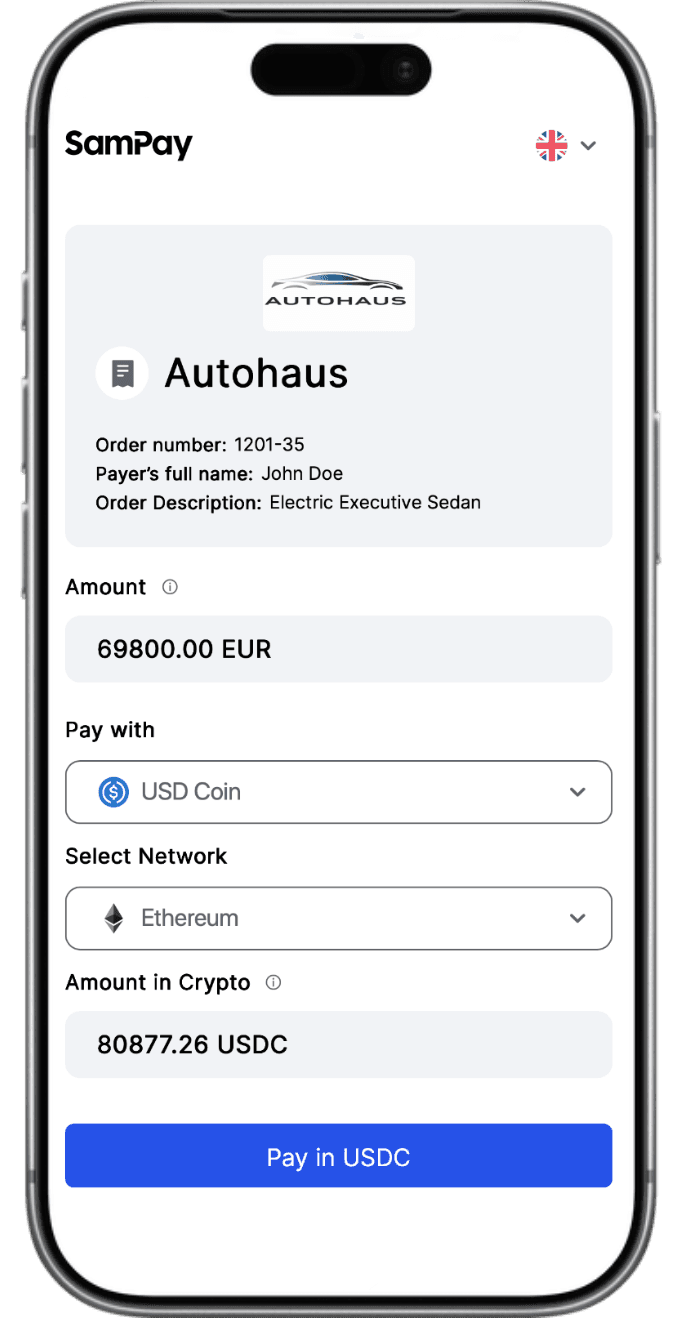
For example, the payment can start from a EUR invoice rather than from a wallet operation. That keeps your internal process consistent from the first step.
This matters more than it may seem. When your team creates a payment request in EUR, they are still operating inside a normal sales and accounting flow. The client may pay in crypto, but your business does not need to reorganize itself around that fact.
The customer experience improves too
A direct wallet often creates uncertainty for the buyer as well. They must trust that the address is correct, understand what amount to send, and hope someone on your side is manually tracking the payment. For premium transactions, that kind of ambiguity is not helpful. Clients expect a payment experience that looks deliberate and professional.
A gateway makes the payment clearer. The customer sees a proper payment page, the amount is structured, and the transaction can be monitored automatically. That reduces friction for both sides and makes crypto to EUR settlement feel like a controlled commercial process, not an improvised workaround.
And once the payment is sent, the system should detect and process it without your team watching wallets in real time.
This is the practical difference between "we can technically receive crypto" and "we have a compliant crypto payments process." One is fragile. The other is scalable.
Where SamPay fits in
This is exactly the role SamPay is built for. Instead of asking your company to accept and manage crypto directly, SamPay lets your customer pay in crypto while your business receives EUR to its bank account through SEPA or SWIFT. The checks happen as part of the flow. Conversion happens before settlement. The merchant does not hold crypto and does not need to build internal procedures around it.
From a business perspective, that changes the conversation completely. You are no longer evaluating whether your team can manage wallets, volatility, and compliance. You are simply adding a payment option while keeping your operating model intact.
The safer and more scalable choice
When decision-makers compare a crypto payment gateway vs direct wallet, the direct wallet often wins the first five minutes of the discussion. It feels immediate and low-effort. But once you look at what happens after the payment arrives, that impression usually disappears. Compliance, conversion, banking risk, reconciliation, and internal responsibility do not go away. They simply move onto your side.
That is why the gateway model is safer and more scalable. It separates customer payment preference from merchant operational burden. Your client can pay in crypto, but your business continues in EUR, with a clearer process and far less exposure. That is the model most traditional companies actually need.
SamPay is designed around exactly that logic. It gives you a way to offer compliant crypto payments without becoming a crypto operator yourself. If you are evaluating how to accept crypto payments in Europe, this is the practical path: keep the customer experience flexible, keep the merchant side simple, and keep settlement where it belongs - in your bank account, in EUR.
If you are exploring crypto payments for business, the next step is not to open a wallet and hope it works. The better next step is to look at a model that removes the risk from day one. With SamPay, you can test that model in a way that fits your current operations, your finance process, and your bank-facing reality. That is what makes it the smarter choice for businesses that want growth without unnecessary complexity.
Book a demo
Let your clients pay in crypto while your business keeps operating in euro.
Book a demo to see how SamPay helps merchants accept crypto payments with compliant EUR settlement and a familiar operational flow.