Published April 5, 2026
Can a business accept USDT and receive EUR in a bank account?
If you are looking into this question, you are probably not trying to become a crypto company. You are trying to solve a very practical business issue: a client wants to pay in USDT, but your company operates in EUR, your accounting is in EUR, and your bank account is in EUR. That is the real starting point for most businesses in Europe.
This is why the question is not really whether you can accept USDT. Technically, you can. The more important question is what happens after the payment arrives. Because the moment USDT touches your business directly, you are no longer just receiving money from a client. You are taking on conversion work, compliance exposure, banking questions, and operational risk that most traditional businesses do not want anywhere near their daily workflow.
If you sell cars, you should continue selling cars. If you sell real estate, nothing about your internal process should suddenly turn into exchange management and crypto reconciliation. If you run a premium service business, you should still invoice, settle, and report in EUR as usual. All of this complexity should not exist for the merchant.
Why this question matters more than it seems
At first glance, USDT sounds simple. A client pays, you receive funds, deal completed. In practice, that is rarely how it feels inside the business. The finance team immediately starts asking reasonable questions: how do we convert it, where do we convert it, what documents do we keep, what does the bank say when EUR comes in from an exchange, and how do we prove the source of funds if somebody asks later?
That is where many companies realize they are not evaluating a payment method. They are evaluating a new operational model. And for a traditional business, especially in luxury retail, automotive, real estate, jewelry, or other high-ticket sectors, that model often creates more friction than value if it is handled directly.
What direct USDT acceptance usually looks like
Let us say you decide to accept USDT directly. The customer sends the funds to a wallet your business controls. On paper, that sounds manageable. But now your company is holding a digital asset, and someone on your side has to decide what happens next.
Usually, that means sending the USDT to an exchange or arranging an OTC conversion, waiting for settlement, transferring EUR onward, and documenting every step. None of this is part of your normal sales or finance process. It becomes a separate workflow that depends on third parties, internal judgment calls, and manual handling at exactly the point where you want payment to be predictable.
Before getting into the risks, it helps to understand what businesses actually want instead: a familiar payment flow where the customer can pay in USDT, but your company still works in EUR from start to finish.
A practical setup starts with a EUR-denominated invoice, not a crypto treasury decision.
This matters because it keeps your commercial logic unchanged. You set the price in EUR, your client sees what needs to be paid, and your business does not start thinking in token balances or exchange rates.
The real problems begin after the wallet receives funds
Conversion is not just a technical step
The first issue is conversion. If USDT lands in your own wallet, someone has to turn it into EUR. That means choosing an exchange or OTC desk, managing accounts, monitoring rates, and making sure the EUR actually reaches your company bank account without delays or questions.
In practice, this becomes an internal burden very quickly. Someone has to own the process, someone has to reconcile the amounts, and someone has to explain why a transaction that started as client payment now passed through one or more crypto-related intermediaries before becoming EUR. What looked like a payment method now starts to resemble treasury management.
Platform and account restrictions are a real business risk
Many decision-makers underestimate this part. Even if you find a way to convert USDT regularly, you are still dependent on platforms that can ask for additional documents, pause transactions, limit activity, or review your account at the worst possible moment. For a private individual this is frustrating. For a business with high-ticket payments, it can become a serious operational problem.
A delayed payment in retail is inconvenient. A delayed payment in automotive or real estate can affect delivery timelines, reservations, internal approvals, and client trust. When large sums are involved, unpredictability is not a small issue. It directly impacts operations.
Your bank may not see it the way you do
Even if the funds are legitimate, banks do not look only at outcomes. They also look at the payment path. If EUR arrives after crypto conversion through external platforms, your bank may ask where the money came from, what the underlying transaction was, and how the source of funds was checked.
This is where many businesses get uncomfortable. You may know it was a valid client payment, but proving that clearly and consistently is a different matter. Without a transparent audit trail, you are left stitching together screenshots, wallet records, exchange confirmations, and invoices to explain one payment that should have been simple in the first place.
Why audit trail and compliance matter so much
For many merchants, compliance sounds like something legal teams worry about later. In reality, it matters at the moment the payment is received. If a client pays in USDT and your company handles the funds directly, you need to be comfortable answering basic but critical questions: who paid, where did the funds come from, how was the transaction checked, and how do you document the conversion into EUR?
This is not about crypto theory. It is about whether your finance team can close the transaction cleanly, whether your accountant can book it without guesswork, and whether your bank relationship remains stable. The bigger the ticket size, the more important this becomes.
A proper payment flow should include automatic checks before settlement, not manual problem-solving afterward.
When this part is built into the process, the business does not need to investigate every transaction on its own. That is the difference between compliant crypto payments and improvised crypto handling. One supports normal operations. The other creates new responsibilities your team never wanted.
The correct model: client pays USDT, business receives EUR
This is the model most businesses are actually looking for, even if they do not phrase it that way. The customer pays in USDT. The payment provider performs the necessary checks, converts the funds into EUR, and settles EUR to your bank account through normal banking rails such as SEPA or SWIFT. Your company does not hold crypto on its balance sheet, does not manage exchange accounts, and does not build internal procedures around wallets and conversions.
That changes the entire conversation. Instead of asking, "How do we handle USDT?" the business can ask, "How do we let the client pay the way they prefer while we continue operating exactly as before?" That is the useful question.
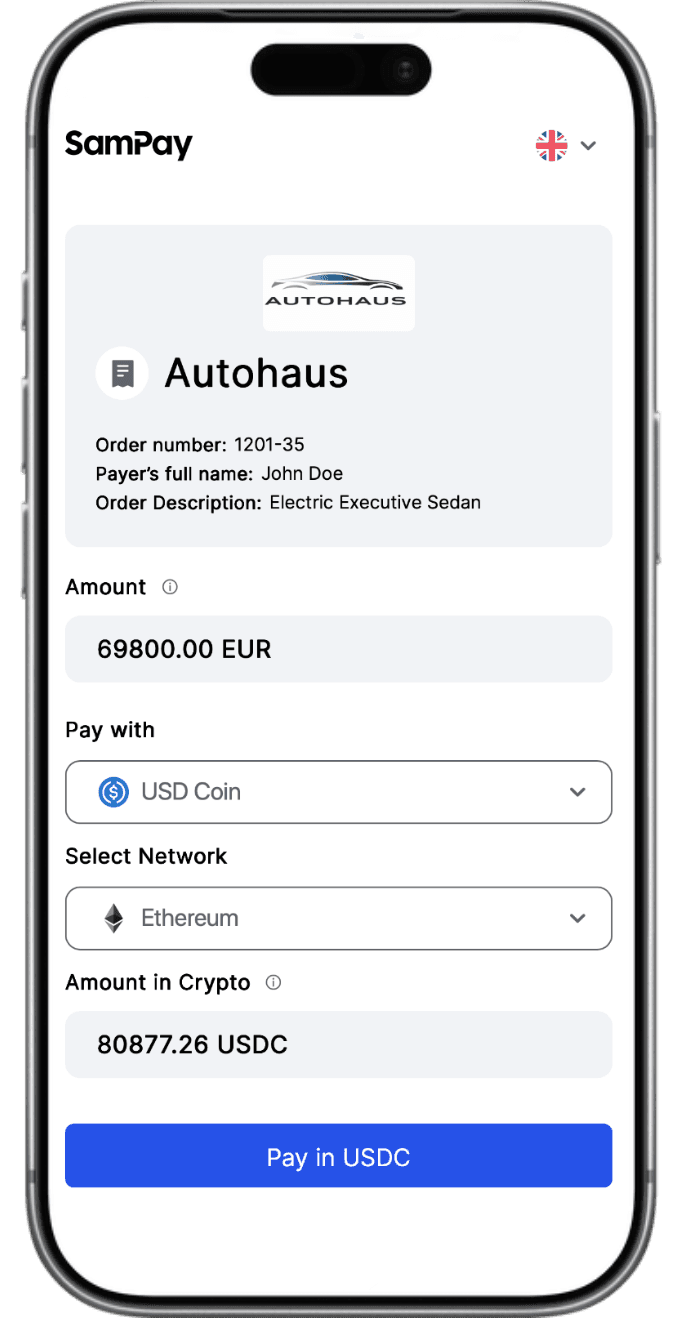
The customer experience can still be straightforward. They receive a clear payment page and complete the transaction in a format they understand, while your side remains focused on the commercial transaction, not the crypto mechanics.
From the merchant perspective, this is what makes crypto payments for business workable in Europe. Not because the business becomes crypto-native, but because crypto is abstracted away. You still receive EUR, exactly as before.
What this means for finance and operations
Once the model is structured correctly, several business problems disappear at the same time. Your accounting remains EUR-based. Your team reconciles bank transfers instead of token balances. Your internal approvals stay familiar. And your bank sees a clearer, more structured settlement flow rather than ad hoc conversion activity.
This is especially important if you want to accept crypto payments in Europe without creating side processes for finance, legal, and operations. The value is not only in accepting an additional payment option. The value is in doing it without disturbing the rest of the business.
A well-designed flow also removes uncertainty at the transaction level. The payment is detected, checked, and processed automatically instead of depending on manual follow-up.
That automation matters because high-value transactions should not rely on someone noticing a wallet transfer and then figuring out what to do next. The cleaner the process, the easier it is to scale safely.
Where SamPay fits into this model
This is exactly where a provider like SamPay becomes useful. SamPay is not about turning your company into a crypto operator. It is about allowing your customer to pay in crypto while your business receives EUR in a normal bank account. The flow is simple: the client pays in USDT or another supported asset, the transaction goes through compliance checks, the amount is converted, and your company receives EUR through bank transfer.
That means no crypto on your balance sheet, no need to manage exchange or OTC relationships, and no need to create internal procedures around custody, conversion, or transaction screening. For founders, operators, and finance teams, this is the practical difference between a risky workaround and a business-ready payment process.
If you are evaluating crypto to EUR solutions, this is the distinction that matters most. The goal is not merely to accept crypto payments. The goal is to accept them without inheriting the risk profile of crypto handling.
So can a business accept USDT and receive EUR in a bank account?
Yes, and for most traditional businesses, this is the only model that really makes sense. The client can pay in USDT, but your company should receive EUR directly to its bank account, with conversion and compliance handled in the background by a specialized provider. That removes the operational burden of exchanges and OTC desks, reduces banking friction, and gives you a cleaner audit trail around every transaction.
This is why the better approach is not direct acceptance of USDT into your own workflow. The better approach is a compliant crypto payments model where crypto is simply the client's payment rail, not your business asset. You continue selling what you sell. You continue invoicing in EUR. You continue running the company the same way.
For a car dealer, that means selling cars. For a real estate business, that means closing property deals. For luxury retail, that means serving the client without introducing treasury risk into the transaction.
If you are exploring how to accept crypto payments in Europe, start with the model, not the wallet. Look for a setup where your customer can pay in USDT and your business receives predictable EUR settlement with compliance built in from the start. That is exactly the scheme SamPay provides, and that is why it is the practical choice for businesses that want access to crypto-paying clients without taking on crypto complexity.
In other words, this is the obvious way to do it: let the client pay in USDT, let the provider manage the checks and conversion, and let your business receive EUR safely in the bank account it already uses.
Book a demo
Let your clients pay in crypto while your business keeps operating in euro.
Book a demo to see how SamPay helps merchants accept crypto payments with compliant EUR settlement and a familiar operational flow.