Published April 5, 2026
AML, KYC and KYT in crypto payments: practical guide
If you are looking into crypto payments for business, there is a good chance the first internal objection was not about demand. It was about risk. Your sales team may see opportunity, your clients may be asking for more flexible payment options, but finance and operations usually stop at the same point: who is going to verify the customer, check the source of funds, and make sure the bank will not have questions later.
That hesitation is reasonable. The difficult part is not the payment itself. The difficult part is everything around it: compliance, documentation, internal processes, and the possibility of making a mistake in an area where mistakes are expensive. When you hear terms like AML, KYC, and KYT, what you are really hearing is: more responsibility, more operational burden, and more exposure if something goes wrong.
Why compliance becomes the real issue
At first glance, accepting crypto payments in Europe can sound simple. A customer wants to pay in USDT or ETH, you provide payment details, and the funds arrive. But in practice, that is exactly where the easy part ends. The moment your business starts touching crypto directly, you also take on the obligation to understand who is paying, where the funds came from, whether the transaction creates a compliance issue, and how that activity will look to your bank and auditors.
For a traditional business, this is where the idea often starts to fall apart. You are not trying to become a crypto company. You are trying to sell a car, close a real estate deal, invoice for premium services, or complete a high-ticket transaction without creating unnecessary risk. If your team now has to build a compliance workflow around every incoming payment, then the payment method has started to distort the business instead of supporting it.
What AML, KYC, and KYT actually mean in business terms
AML: checking for money laundering risk
AML stands for anti-money laundering. In plain business language, it means every payment needs to be assessed for risk. If suspicious funds pass through your business, the consequences do not stay theoretical. You may face account reviews, frozen transfers, requests from banking partners, or regulatory questions that consume time and damage trust.
This is why AML is not just a legal checkbox. It is a business protection layer. If you accept crypto directly, someone has to be responsible for making sure the payment does not expose your company to sanctions risk, illicit funds, or reporting issues later.
KYC: knowing who the client is
KYC means know your customer. Again, the practical meaning is straightforward: if a payment comes in, you need to know who is behind it. In some cases that means identity verification. In others, it means collecting and storing supporting information that can justify the transaction if your bank, compliance officer, or accountant asks questions.
For businesses in luxury, automotive, real estate, or premium services, this matters even more because transaction sizes are larger. The higher the ticket, the less room there is for ambiguity. A payment is not just a payment. It becomes part of a file that may need to stand up to internal and external review.
KYT: understanding the transaction itself
KYT means know your transaction. This is the layer that checks the payment flow itself, including whether the wallet activity or origin of funds raises concerns. You do not need to understand the technical side in detail. What matters is the outcome: every payment should be screened automatically so you are not left wondering whether a transaction could create problems with your bank or compliance team.
If this sounds like a lot, that is because it is. And this is exactly why so many businesses hesitate. The checks are necessary, but they should not become your company's new operational burden.
What happens when a business tries to handle this alone
Many companies start with the same idea: perhaps we can set this up internally. On paper, it may look manageable. You choose a wallet, create a payment process, write an internal policy, and assume the team will review transactions when needed. But the reality is usually very different.
The first problem is expertise. AML, KYC, and KYT are not things you improvise safely. You need tools, policies, documentation standards, escalation logic, and people who know how to interpret risk signals correctly. If your team gets it wrong, the downside is not just inefficiency. It can mean rejected banking relationships, compliance failures, delayed settlements, and exposure to sanctions issues.
The second problem is cost. Once you try to implement compliant crypto payments internally, you quickly discover that the real expense is not the wallet or the payment button. It is the ongoing process around it. You need screening tools, identity verification flows, transaction monitoring, recordkeeping, and a reliable operational owner. For most traditional businesses, that is far too much infrastructure to build just to accept an alternative payment method.
The third problem is inconsistency. Internal checks tend to depend on people, and people make judgment calls under time pressure. One payment gets reviewed thoroughly, another gets rushed, a third sits waiting because no one is sure what to do next. That is how risk enters the system. Not because the company intended to be careless, but because manual compliance is difficult to scale and easy to mismanage.
What a workable model looks like instead
A practical model for accept crypto payments in Europe should protect your business, not transform it. That means the correct setup is not "your company starts receiving and managing crypto." The correct setup is much simpler: the customer pays in crypto, the transaction is checked automatically, the funds are converted, and your business receives EUR by bank transfer.
In other words, the flow should look like this: crypto → conversion → EUR → your bank account. You continue working in euros. Your accounting remains euro-based. Your treasury remains predictable. Your internal team does not need to manage wallets, price volatility, or transaction screening manually.
That is the difference between offering a modern payment option and taking on a new category of financial and compliance risk. If the system is designed correctly, crypto is simply the customer's way to pay. It does not become your company's balance-sheet problem.
How the process should look for your team
From the merchant side, the workflow should feel familiar. You create an invoice in EUR or send a payment request as part of your usual sales process. Your client sees a clear payment flow, pays in crypto, and the backend handles the rest.
A good compliance-enabled flow starts with a simple merchant action, not a technical setup. Your team should be able to define the amount in euros and proceed from there without dealing with crypto mechanics.
That matters because it keeps the business model intact. You sell cars - you continue selling cars. You sell real estate - nothing changes. You issue an invoice in EUR, as you always do, and the customer chooses how to settle it on their side.
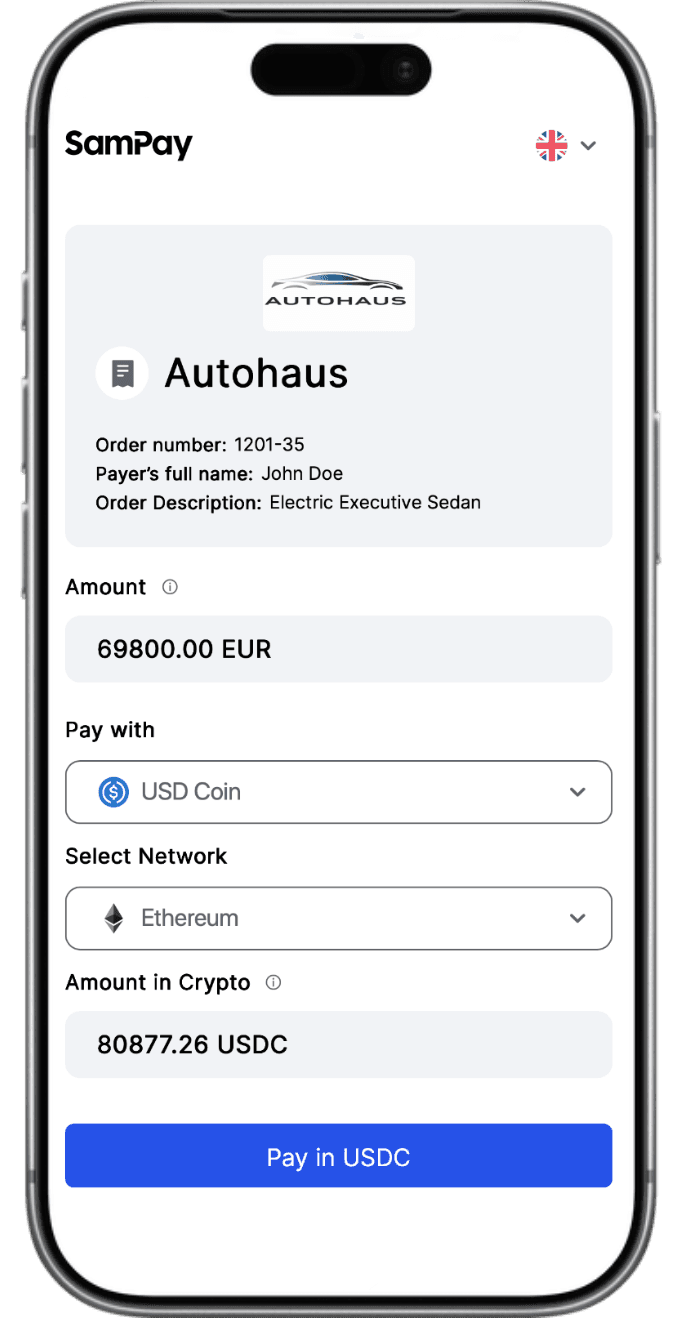
The customer experience should also be clear and structured, especially in high-ticket transactions where trust matters. The payment page should show exactly what the client needs to do, while your team stays focused on the sale rather than explaining wallets or exchange rates.
From there, the important part happens in the background. The transaction is detected, checked, and processed automatically. This is where compliant crypto payments become realistic for traditional businesses, because the risk review is not left to your internal staff to interpret manually.
And when identity verification is needed, it should happen within the payment process itself, not as a disconnected manual task your team has to organize through emails and documents. That reduces friction while still making sure the payment can be justified if questions arise later.
Why this matters for banking, accounting, and internal control
When founders first evaluate crypto to EUR solutions, they often focus on conversion speed or customer demand. Those are important, but they are not the main decision point for a serious business. The real question is whether the model fits your existing financial structure.
Your finance team wants predictable settlement. Your accountant wants clear records. Your bank wants to understand the flow of funds. If your business receives EUR directly into the bank account, after automated compliance checks and conversion, the situation becomes much easier to explain and manage. You are not holding crypto. You are not speculating. You are not asking the finance team to create a separate operating logic for one payment method.
This is where the strongest distinction appears: there is a major difference between accepting clients who pay in crypto and running your business in crypto. Traditional merchants usually need the first, not the second. And once you see that clearly, the right structure becomes obvious.
Where SamPay fits in
This is the point where a provider matters. Not because you need another tool, but because you need a compliance layer that already exists, already works, and already fits the way your business operates. SamPay is built around exactly that model.
With SamPay, the client pays in crypto, the required AML/KYC/KYT checks are handled within the flow, the funds are converted into EUR, and your business receives payout by bank transfer through SEPA or SWIFT. You do not hold crypto on your balance sheet. You do not build your own screening process. You do not ask your internal team to become compliance specialists in digital assets.
For a traditional merchant, that is the key advantage. SamPay does not ask you to adapt your business to crypto. It abstracts crypto away so your business can continue operating normally. This is especially important for companies handling high-value payments, where every transaction needs to be clear, defensible, and operationally simple.
If you have been researching crypto payments for business, this is the practical answer to the compliance question. The system does the checks. The conversion happens automatically. The payout arrives in EUR. Your team stays inside the workflow it already understands.
The practical conclusion for decision-makers
If you are deciding whether to accept crypto payments in Europe, AML, KYC, and KYT should not be treated as minor details to solve later. They are the core of the decision. Trying to assemble this internally is expensive, difficult to manage, and risky in ways that most traditional businesses simply do not need to take on. A single weak point in the process can create far more trouble than the payment itself is worth.
That is why the better model is not direct handling. It is delegated infrastructure. An automated compliance layer from a provider solves the real problem: not just taking the payment, but making sure the payment can pass through your business safely, cleanly, and in a form your finance team can actually work with.
SamPay already integrates these processes into one flow. Your customer pays in crypto. The checks happen automatically. The amount is converted from crypto to EUR. You receive euros in your bank account and continue operating exactly as before. For most businesses, this is not just a convenient option. This is the obvious way to do it.
If you want to explore compliant crypto payments without taking on the compliance burden yourself, the next step is simple: review the workflow, test how it fits your sales process, and see how crypto to EUR settlement can work inside your business without changing how your business runs.
Book a demo
Let your clients pay in crypto while your business keeps operating in euro.
Book a demo to see how SamPay helps merchants accept crypto payments with compliant EUR settlement and a familiar operational flow.