Published April 5, 2026
Accounting for crypto payments (EUR settlement model)
If you are looking at crypto payments for business, there is a good chance your first concern is not sales. It is accounting. You may already see the commercial upside, especially if you work with international clients, high-ticket transactions, or premium services. But then the practical question appears: how exactly should these payments be reflected in finance, reporting, and bank-facing documentation if the customer pays in crypto?
That is the point where many businesses stop. Not because demand is not there, and not because accepting a new payment method is impossible, but because the accounting logic starts to look unclear. If the client sends USDT or ETH, do you book crypto? Do you hold it on balance sheet? Do you recognize an exchange result? What does your accountant do with that transaction, and how do you explain it to your bank later? In practice, this is where the real hesitation begins.
Why accounting becomes the real barrier
For a traditional business, the issue is rarely technical. You do not need to understand wallets, chains, or token standards in detail. What you need is a clean, defensible financial flow. If you sell a car, a property, jewelry, or another high-value service, your finance team wants one thing above all: a payment model that can be recorded clearly, reconciled quickly, and explained without stress.
The problem with direct crypto acceptance is that it changes more than the payment method. It can change what appears on your books. The moment you receive crypto directly, you are no longer just collecting revenue. You may also be taking on questions around valuation, conversion timing, asset recognition, source-of-funds review, and banking explanations. That is too much operational complexity for what should be a simple sale.
A lot of businesses realize this only after looking closer. At first, accepting crypto payments in Europe can sound like a straightforward commercial decision. Then the finance side gets involved, and the conversation becomes much more cautious. Not because finance teams are against growth, but because they understand what happens when payment flows are not structured properly.
What makes direct crypto accounting so awkward
It is not obvious what exactly you received
If a customer pays you directly in crypto, the first accounting question is basic but important: what have you actually received? From a commercial perspective, you sold goods or services. But from an accounting perspective, the incoming asset may not look like cash in EUR. It may look like a digital asset that needs separate treatment before it ever becomes usable money for your business.
That creates friction immediately. Your sales team sees a completed deal, but your finance team sees a transaction that may require extra interpretation. There is no comfort in a payment method that forces internal debate each time a transaction arrives, especially when the amounts are large and the documentation needs to be clean.
Timing creates confusion
Even if you plan to convert the crypto quickly, direct handling introduces another layer of uncertainty. At what point do you recognize revenue? At what rate? What happens if the value changes before conversion? If there is a difference between the amount at invoice issuance and the amount at settlement, who accounts for that movement?
These are not theoretical questions. They affect reconciliation, reporting, and audit readiness. In many companies, the real issue is not whether crypto can be accepted, but whether the transaction logic will remain stable enough for accounting to treat it as routine. When that stability is missing, the whole process starts to feel like an exception.
Banks and compliance teams do not like ambiguity
The accounting treatment is not isolated from banking. If incoming funds are connected to crypto activity, your bank may ask for supporting documents, explanations, or transaction history. If your internal records are based on a direct crypto receipt followed by later conversion, the story becomes more complicated than it needs to be.
This is why so many businesses hesitate even when clients are willing to pay. The operational burden is not in the payment itself, but in everything that follows it. You are not just processing a sale. You are creating more work for accounting, more questions from compliance, and more room for misunderstandings with financial partners.
What the right model looks like
The cleanest structure is not "merchant receives crypto and figures it out later." The cleanest structure is this: the customer pays in crypto, the payment is checked, the amount is converted, and your business receives EUR to its bank account. From your side, the economic result is familiar. You invoiced in EUR, and you settled in EUR.
This matters because it changes the accounting logic completely. Instead of recognizing a crypto asset on your balance sheet, you operate as you always do: sale, invoice, EUR receipt, bank reconciliation. The crypto element exists only on the customer side and within the payment infrastructure. It does not become part of your operational burden.
Before looking at the compliance side, it helps to understand how simple the merchant workflow can be when the structure is built correctly.
In practice, this is the key accounting advantage. You create the invoice in EUR, using the same commercial logic you already use today. The client may choose to pay in crypto, but your internal transaction starts from a EUR amount, not from a crypto asset you need to interpret later.
How the EUR settlement model simplifies accounting
Revenue stays tied to your normal invoice flow
When the transaction starts with a EUR invoice and ends with a EUR bank payout, the accounting treatment becomes far more straightforward. Your revenue recognition follows the same business logic as any other sale. Your finance team does not need to create a separate framework for handling tokens, valuation swings, or temporary crypto holdings.
That is the real benefit of a proper crypto to EUR model. It is not about making crypto look attractive. It is about making the merchant side boring, predictable, and easy to document. You sell cars - you continue selling cars. You sell real estate - nothing changes. You receive EUR - always.
Reconciliation becomes manageable
Finance teams do not want mystery. They want invoice amount, settlement amount, supporting records, and a bank entry they can match without building a manual workaround. With a structured model, the payment provider handles the crypto side, and your business receives an ordinary EUR transfer through the banking system.
That means less time spent explaining unusual flows and less risk of inconsistent bookkeeping between sales, treasury, and accounting. For businesses evaluating compliant crypto payments, this is often the turning point. The right solution is not one that gives you access to crypto. It is one that keeps crypto away from your books.
A simple payment flow also matters operationally, especially when teams need a process they can use without training themselves on new financial mechanics.
The merchant-side experience can stay as simple as sending a payment request. That is important because if your process becomes difficult for staff to use, accounting problems tend to follow. The fewer special-case workflows you create, the cleaner your records remain.
Why compliance matters for accounting too
A common mistake is to think of compliance and accounting as separate topics. In reality, they are connected. If a payment later raises source-of-funds questions, your finance team is the one that often has to help answer them. If your bank asks where the money came from, accounting documentation must support that explanation.
That is why direct crypto acceptance creates so much tension. It is not only about how to post the transaction. It is about whether every transaction can be defended later if someone asks for detail. Where did the funds come from? Was the payer checked? Was the transaction screened? Was conversion documented properly? These are business questions, not crypto questions.
With the right payment structure, those checks happen automatically before the payout reaches you. The payment flow is reviewed, filtered, and documented as part of the service itself, which removes a large part of the hidden burden from your internal team.
This is where compliant crypto payments become workable for traditional businesses. You do not want your accountant, CFO, or operations manager to manually investigate each incoming transaction. You want a system where every payment is checked automatically, so your business only receives settlements that fit a proper financial process.
Where SamPay fits into this model
This is exactly why businesses use a provider like SamPay. Not because they want to become crypto companies, but because they want to accept crypto payments in Europe without changing how their business operates internally. SamPay handles the flow from crypto payment to verified conversion to EUR payout, while the merchant remains in a familiar EUR-based model.
The logic is simple. Your customer pays in crypto. SamPay performs the necessary AML, KYC, and transaction checks. The crypto is converted into EUR. Your business receives EUR by bank transfer through SEPA or SWIFT. You do not hold crypto on balance sheet, and your accounting process stays much closer to an ordinary EUR settlement.
For finance teams, this changes the conversation completely. Instead of discussing how to book digital assets, they can focus on standard revenue and bank receipt logic. Instead of building internal policies around volatility and crypto custody, they can work with a payment structure that was designed to keep those issues outside the merchant perimeter.
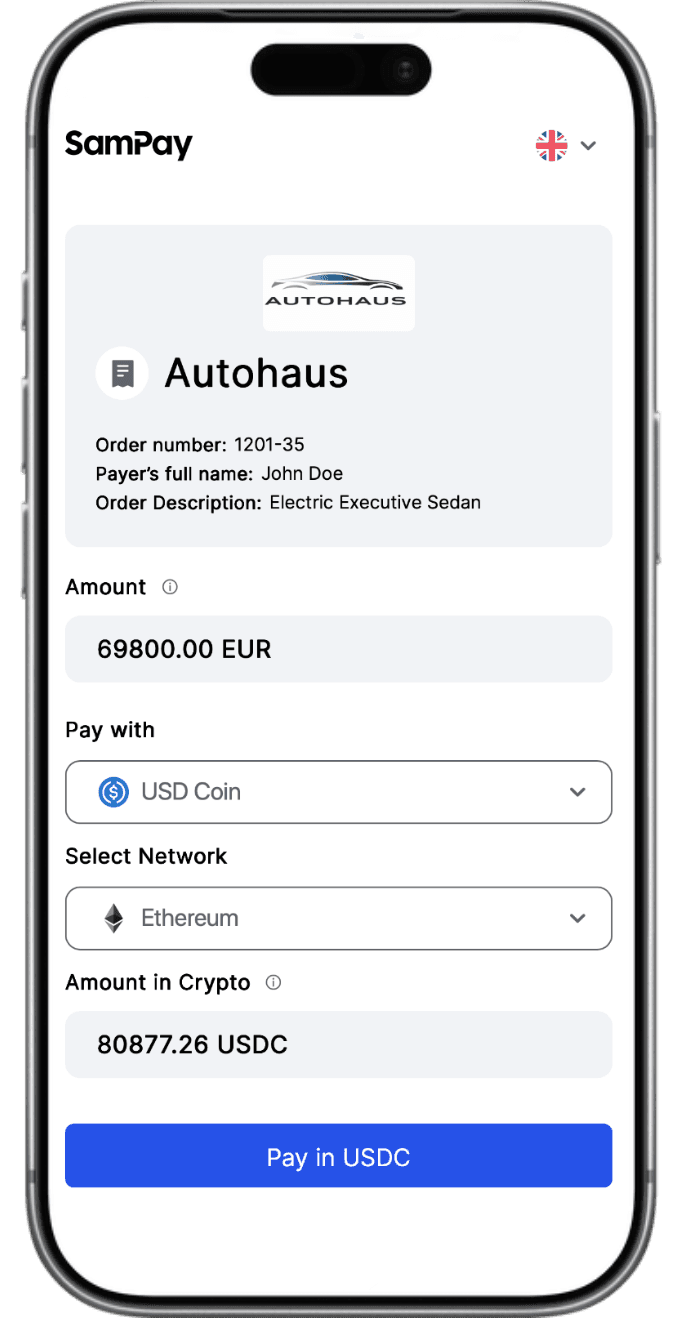
The payment experience for the client can still be clear and professional, which matters when large transactions depend on trust and simplicity.
That customer-facing clarity supports the back-office result. When the front end is organized and the settlement model is controlled, the merchant can offer a modern payment option without taking on modern payment chaos.
So how should you account for these payments?
If the structure is correct, you should not be thinking in terms of "how do we account for crypto on our books?" In most cases, the better question is: how do we ensure the merchant never has to account for crypto in the first place? That is the difference between a risky payment setup and a practical one.
The right model is not merchant receives crypto, merchant converts crypto, merchant explains crypto. The right model is customer pays in crypto, provider converts it, merchant receives EUR. Once you look at it this way, the accounting logic becomes much more natural. What seemed unusual at first starts to look like a standard EUR receipt supported by a specialized payment infrastructure.
Conclusion: treat it as a business payment, not a crypto operation
If your concern is how to account for crypto payments, that is actually a healthy sign. It means you are looking at the issue from the right side: business reality, not novelty. For most traditional merchants, the goal is not to touch crypto directly. The goal is to remove payment friction for the client while keeping internal finance, compliance, and banking as normal as possible.
With the proper structure, these transactions are simply ordinary EUR inflows from the merchant's point of view. That is why the EUR settlement model works so well. It removes the non-obvious accounting logic that appears when businesses try to accept crypto directly, and replaces it with something your finance team can actually live with.
SamPay simplifies that model in the most practical way. You keep selling what you sell. Your customer can pay in crypto. The checks happen automatically. The conversion happens in the background. And your business receives EUR to the bank account, as usual. If you are evaluating crypto payments for business, this is the obvious way to do it: explore a structure where the customer gets flexibility, while your company keeps operating exactly as before.
Book a demo
Let your clients pay in crypto while your business keeps operating in euro.
Book a demo to see how SamPay helps merchants accept crypto payments with compliant EUR settlement and a familiar operational flow.