Published April 5, 2026
Accepting stablecoin payments (USDT/USDC) for business
If you are looking at stablecoin payments for your business, you are probably not trying to become a crypto company. You are trying to solve a very practical problem: some clients want to pay in USDT or USDC, and you want to know whether you can accept that money without creating accounting, compliance, or banking issues for yourself. That is the real business question.
On the surface, stablecoins look like the easy version of crypto. They are less volatile, they are widely used, and many international clients already hold them. So it is understandable why founders, operators, and finance teams start here when thinking about crypto payments for business. But in practice, stablecoins only look simple from the outside. The moment you try to accept them directly, the same uncomfortable questions appear: where did these funds come from, how do you convert them cleanly into EUR, and what does your bank think when crypto-related money starts touching your operations?
Why stablecoins appeal to businesses in the first place
The business logic is easy to understand. Stablecoins such as USDT and USDC are designed to avoid the dramatic price swings most people associate with crypto. For a merchant, that makes them feel closer to a payment instrument than a speculative asset. If you sell cars, real estate, jewelry, premium services, or other high-ticket products, you may already be hearing from international clients who prefer to move value this way.
That interest is not really about technology. It is about convenience, speed, and accessibility. A client may be ready to pay from another country, outside normal banking hours, or from funds they already keep in stablecoins. From their perspective, this can feel easier than coordinating a traditional bank transfer. For you, though, the question is not whether the client can send USDT or USDC. The question is whether your business can receive payment in a way that remains clean, explainable, and operationally normal.
This is where many companies make an important discovery: stablecoins reduce volatility, but they do not remove business risk. They do not automatically solve compliance. They do not automatically solve banking transparency. They do not automatically solve finance-team concerns around reporting, reconciliation, and settlement in EUR.
The real issues start after the payment arrives
At first, accepting USDT or USDC directly can sound manageable. Someone on the team creates a wallet, the customer sends funds, and then you convert them. In theory, it seems straightforward. In reality, this is exactly where operational complexity begins.
A stablecoin payment still needs to be explainable
From a business perspective, a payment is not complete just because funds arrived somewhere. Your finance team needs to know what was received, from whom, for which invoice, under which legal entity, and with what proof of origin. If the payment later needs to be reviewed internally, by auditors, or by your bank, that explanation must be immediate and consistent.
With stablecoins, the source of funds still matters. Even if the asset itself is designed to be stable, the transaction history behind it may raise questions. If you accept funds directly into a wallet without proper screening, you may later find yourself trying to explain a payment trail you never checked in the first place. That is not where most traditional businesses want to spend time.
This is why compliant crypto payments matter much more than the asset name. USDT and USDC may feel familiar in the market, but for your business, what matters is whether every transaction is reviewed automatically so you do not have to worry about how to justify it later.
Before a client ever sends payment, the process should already feel familiar from a merchant perspective: you issue an amount in EUR and keep the commercial side exactly as it is.
That point matters more than it may seem. If you invoice in EUR, your business logic stays unchanged. You are not repricing goods in crypto, not monitoring market moves, and not teaching your team a new treasury process.
Manual conversion creates friction fast
The next issue is conversion. Even with stablecoins, you usually do not want to hold crypto on your balance sheet. Your suppliers, employees, taxes, rent, and everyday obligations are still in EUR. So if you accept USDT or USDC directly, someone has to convert it.
This often becomes a manual, messy step. A member of your team has to move funds, use an exchange or OTC desk, monitor rates, confirm settlement, and then arrange the transfer onward. Now your payment flow depends on operational handling that has nothing to do with your core business. If you are selling a car, closing a property transaction, or delivering a premium service, this extra layer adds work exactly where you want certainty.
And manual conversion is not just inefficient. It can also create reporting gaps. The more steps involved between receiving stablecoins and seeing EUR in your bank account, the harder it becomes to keep everything transparent and clean. That is where finance teams start asking the right question: why are we building a crypto operations process just to receive a payment?
Banks do not look only at outcomes - they look at process
A common misunderstanding is that if stablecoins are converted quickly, the banking side should not care. In practice, banks care about how money enters your business, how it is documented, and whether the source and flow are understandable. If crypto-related activity appears inconsistent, opaque, or poorly explained, that can create unnecessary friction.
For a traditional company, banking stability is not a side issue. It is central. You do not want your account team answering uncomfortable questions because a client paid in USDT and the path from wallet to bank account looks improvised. You also do not want to discover that what seemed like a simple payment method has introduced a new category of internal risk.
This is exactly why the direct acceptance model is usually the wrong model for non-crypto-native businesses. You are not just accepting payment. You are taking on compliance, treasury, and banking exposure that should not sit with the merchant in the first place.
What the right model looks like
If you want to accept crypto payments in Europe without changing how your business operates, the structure has to be different. The correct model is simple from your side:
The client pays in stablecoins, your business receives EUR
The customer chooses to pay in USDT or USDC. The payment is checked. The crypto is converted. Your company receives EUR by bank transfer. From your perspective, the process ends where your normal finance workflow begins: money arrives in euros, reconciliation remains clear, and your business continues as usual.
That is the key distinction. You are not becoming a holder of crypto. You are not exposing your balance sheet to digital assets. You are not asking accounting to adapt to a completely different operating model. The crypto element exists for the client, while your business remains euro-based.
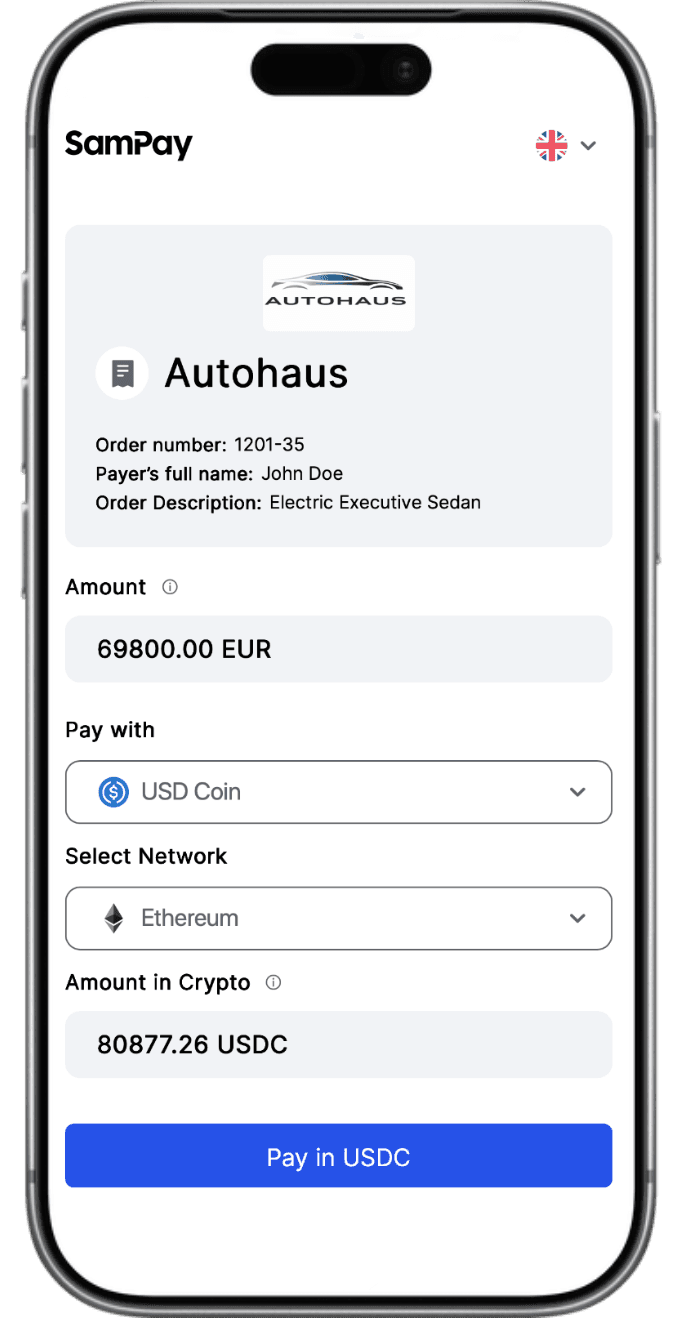
The customer-facing flow can also be straightforward. A payment request is created, shared, and completed without forcing your team to coordinate wallet details manually over messages or calls.
That simplicity matters in real life. High-ticket transactions already involve approvals, documents, and timing. The payment step should reduce friction, not add a new operational puzzle.
Compliance should be built in, not added later
This is the part many merchants underestimate. Compliance is not something to check after the money arrives. It has to be part of the payment flow itself. Every transaction should be screened automatically so your business does not have to investigate where the funds came from or whether they may trigger issues later.
For a finance team, this is not a technical detail. It is what makes the difference between a usable payment method and a risky one. If the checks are built into the process, your internal team can treat the outcome as controlled and documented. If the checks are not built in, the burden moves back onto you.
That is why infrastructure matters more than the stablecoin brand. USDT and USDC are payment instruments here, but the real value comes from the system around them: verification, monitoring, conversion, and clear EUR settlement.
A compliant flow should make those controls invisible to the merchant while still keeping the process smooth for the client.
This is the practical version of compliant crypto payments: the client can pay the way they want, while your business gets a payment flow that is easier to defend internally and externally.
Where SamPay fits into this model
This is the role SamPay is designed to play. Not as a tool that turns your company into a crypto operator, but as infrastructure that allows your clients to pay in stablecoins while your business continues receiving EUR through normal banking rails.
In practice, SamPay handles the part you do not want to build yourself. The client pays in crypto, including stablecoins such as USDT or USDC. The transaction goes through the necessary checks. The amount is converted from crypto to EUR. Then your business receives euros to its bank account through SEPA or SWIFT. You keep operating in fiat, as you already do today.
That is an important business distinction. You sell cars - you continue selling cars. You sell real estate - nothing changes. You provide premium services - your commercial process stays the same. You receive EUR, always, while the crypto side is abstracted away in the background.
And because the payment process is structured, it becomes easier to manage commercially as well. The client sees a clear payment page, follows a defined flow, and completes the transfer with less back-and-forth.
For businesses evaluating how to accept crypto payments in Europe, this is usually the point where the decision becomes clearer. The objective is not to "start doing crypto." The objective is to remove payment friction for clients without importing crypto complexity into the business.
Why this matters especially for high-ticket and traditional businesses
If your transactions are large, infrequent, relationship-driven, or involve extra scrutiny, the wrong payment setup creates more risk than benefit. A boutique real estate agency, luxury car dealer, jewelry business, or premium service provider does not need another complicated backend process. It needs a reliable way to close deals while preserving internal control.
That is why stablecoins are only useful in a business context when they sit inside the right infrastructure. On their own, they do not solve the merchant problem. They simply move the problem from price volatility to compliance, conversion, and banking explainability. For a traditional business, that is not a real improvement.
The better approach is to let clients use the payment method they prefer while your side remains unchanged. No crypto custody. No manual exchange steps. No unclear source-of-funds questions landing on your team after the fact. No awkward gap between "we received payment" and "we can safely book this in EUR."
A practical way to move forward
Stablecoins can absolutely be a useful payment instrument for business. They can help you serve international clients, reduce payment friction, and make certain transactions easier to close. But that only works if the infrastructure behind them converts crypto to EUR and handles compliance properly.
That is exactly why direct wallet acceptance is usually the wrong path for traditional merchants. The issue is not whether USDT or USDC can be sent. The issue is whether your company can accept that payment without taking on risks that do not belong to you.
SamPay solves that by turning a crypto-origin payment into a familiar business outcome: checked, converted, and settled in EUR to your bank account. No crypto on your balance sheet. No need to build internal crypto operations. No reason to change how your business already runs.
If you are exploring crypto payments for business, this is the sensible next step: look at a model where your customer can pay in stablecoins, and you still receive EUR as usual. That is what makes stablecoin acceptance practical, compliant, and scalable for a real business in Europe.
Book a demo
Let your clients pay in crypto while your business keeps operating in euro.
Book a demo to see how SamPay helps merchants accept crypto payments with compliant EUR settlement and a familiar operational flow.