Published April 5, 2026
Accepting crypto via exchange vs payment provider
If you are comparing an exchange with a payment provider, you are probably already past the first question. You are not asking whether crypto exists or whether clients use it. You are asking something much more practical: what is the right tool for a real business that wants to get paid without creating accounting, compliance, and banking problems afterward.
That is exactly where many merchants get stuck. On paper, using an exchange can seem simple. You open an account, generate a wallet, receive crypto, convert it, and withdraw funds. But once you look at how your business actually operates - invoices, finance approvals, reconciliations, bank transfers, compliance checks, customer communication - it becomes clear that an exchange and a payment provider solve very different problems.
Why this comparison matters for a business
When people say, "Why not just use an exchange?", they usually look at the transaction itself, not the full merchant workflow. And that is the mistake. For a private user or a trader, an exchange may be enough. For a company selling cars, real estate, jewelry, or premium services, the payment is only one part of a larger business process.
You do not just need a wallet address. You need a way to issue a payment request, know who is paying, confirm that the funds are clean, convert the amount into EUR, send it to your bank account, and document the transaction in a way your finance team can actually work with. If any of that is missing, your business is the one absorbing the complexity.
This is especially true for high-ticket transactions. A €15,000 payment or a €150,000 payment is not something you want to "figure out manually" after the client sends funds. In practice, that is where direct exchange-based handling starts to show its limits.
What an exchange is actually built for
An exchange is designed for buying, selling, holding, and managing crypto assets. That is its core job. It is built for trading activity, asset conversion, balances, and withdrawals. It is not primarily built around merchant operations, invoice-based settlement, or smooth payment collection for traditional businesses.
That distinction matters more than it may seem at first. If you use an exchange to accept crypto payments for business, you are taking a tool designed for asset management and trying to turn it into a checkout and settlement system. Sometimes that works for one-off cases. It usually becomes messy as soon as payments become regular, customer-facing, or operationally sensitive.
Where exchange-based crypto acceptance starts to break down
No real payment workflow
The first issue is often surprisingly simple: there is no proper merchant payment flow. Your team still needs to tell the client how much to send, in which asset, to which address, and by when. Then someone needs to check whether the payment arrived, whether the amount was correct, and whether it matches the invoice.
That might sound manageable in a small test case. But if you are running a real business, you do not want your sales or finance team manually coordinating wallet details and verifying incoming transfers. You want a payment process that feels structured and predictable, not improvised.
A proper merchant flow starts with the business side, not the crypto side. You create an invoice in EUR, send a payment request, and let the system handle the crypto part in the background.
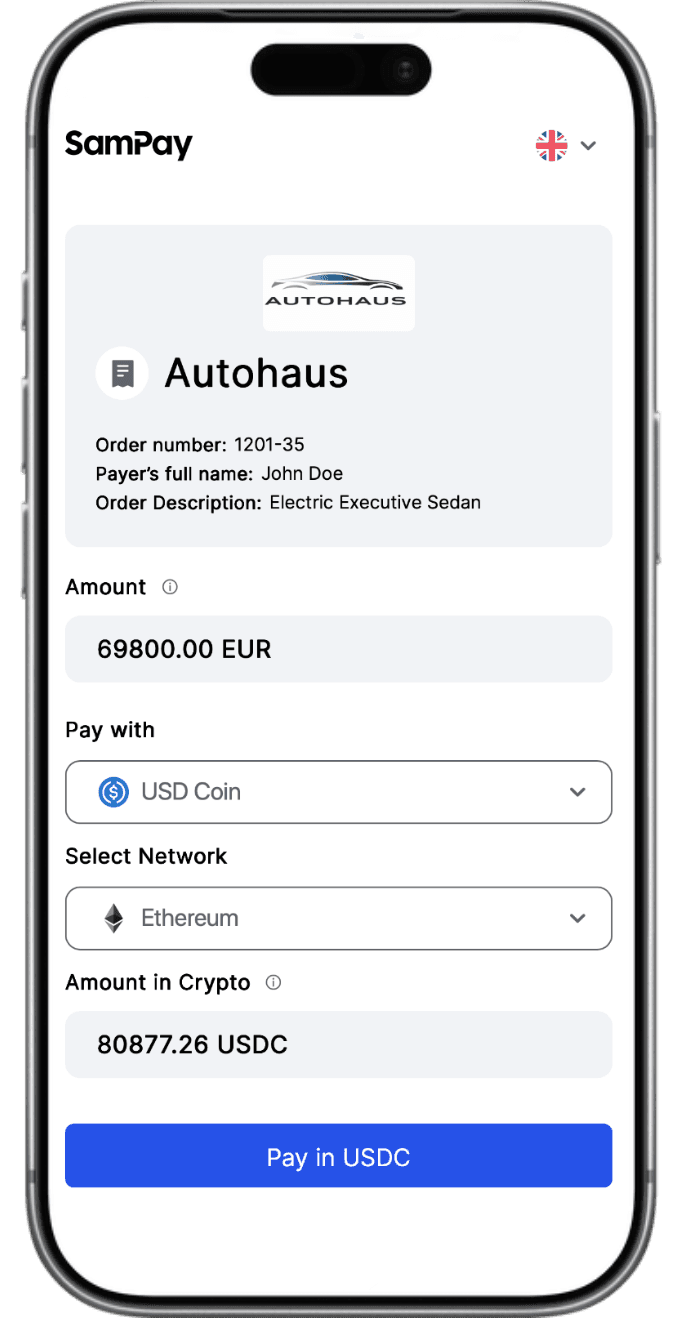
Before getting into the settlement side, it helps to visualize what a merchant-friendly process should look like from the very beginning: the amount is defined in euros, and your customer receives a clear request linked to that invoice.
Manual reconciliation becomes a real burden
The next problem appears inside your finance process. Let's say a customer sends crypto to your exchange wallet. Now someone has to match that transfer to the correct invoice, confirm the EUR value, record the conversion, track fees, and reconcile the bank payout once it arrives.
This is exactly the kind of operational friction that makes finance teams resist crypto. Not because they reject new payment methods, but because they do not want unclear records, extra manual work, and unexplained exceptions in month-end closing. If your process cannot fit into normal accounting logic, it will create internal resistance very quickly.
For most traditional businesses, the goal is not to become better at handling crypto. The goal is to keep the business operating normally. You sell cars - you continue selling cars. You sell real estate - nothing changes. You receive EUR, always.
Compliance becomes your problem
This is where the real risk begins. The moment your business receives crypto directly, questions follow immediately. Where did these funds come from? Can you prove the source if your bank asks? What happens if a transaction is linked to suspicious activity? How do you explain that a large incoming payment came through a wallet transfer before being converted?
These are not theoretical questions. In Europe, if you want compliant crypto payments, you need to think about AML, KYC, and transaction monitoring in business terms. Not as technical features, but as protection for your company, your bank relationship, and your ability to keep operating without disruption.
An exchange may offer its own compliance controls for account holders, but that does not automatically create a merchant-ready compliance workflow around every client payment. There is a difference between a platform checking its users and a payment system checking each incoming business transaction in a way that supports merchant settlement.
In a proper business setup, every payment should be screened automatically before it becomes your problem. That way, you do not have to wonder whether the funds will raise questions later.
That is why compliance cannot sit outside the payment process. It has to be part of it from the start, so the merchant does not need to build a separate risk-control layer around each transaction.
Banking friction does not disappear after conversion
Many companies assume the hard part ends once crypto is sold for euros. In practice, that is often where another problem starts. Your bank does not only care that you now hold EUR. It may also care how those funds originated, how the transaction was processed, and whether the flow fits your declared business activity.
If your setup looks improvised - crypto received directly, manual conversion, irregular withdrawals from an exchange - you may create unnecessary banking questions. And for a traditional business, that is not a small inconvenience. A delayed transfer, compliance review, or strained banking relationship can be more damaging than the original payment opportunity was valuable.
This is why the core issue is not "Can I accept crypto?" The real issue is whether the payment arrives in a structure your business and your bank can comfortably support. That is a business infrastructure question, not a wallet question.
What a payment provider does differently
A payment provider is built around merchant flow from the start. The logic is simple: the customer can pay in crypto, but your business continues operating in EUR. The provider handles the crypto side, checks the transaction, converts it, and sends the payout to your bank account through normal settlement rails.
That means the model looks like this: crypto → conversion → EUR → bank account.
The difference is not cosmetic. It changes who carries the complexity. With an exchange-based setup, the merchant often ends up coordinating payment instructions, conversion, checks, and payout tracking. With a payment provider, that complexity is handled inside the service.
The workflow stays familiar for your team
For a business, this matters more than any technical feature. Your team should be able to create a payment request in euros, send it to the client, wait for confirmation, and receive settlement in euros. No one inside the company should need to monitor wallets or manage coin balances.
In practice, this is what makes crypto payments for business usable rather than merely possible. The workflow feels like a payment operation, not an asset operation. Sales can focus on closing the deal. Finance can focus on reconciliation. Management can focus on growth instead of exception handling.
A merchant-oriented setup also improves the customer experience. The request is structured, the amount is clear, and the payment page guides the client without forcing your team into back-and-forth explanations.
Settlement becomes predictable
Predictability is what finance teams care about. If you are evaluating how to accept crypto payments in Europe, you are not looking for novelty. You are looking for control. You want to know what amount will be settled, where it will be sent, and how it will appear in your reporting.
This is where crypto to EUR conversion inside a payment provider becomes critical. Instead of holding crypto on your balance sheet, you receive euros by bank transfer. Instead of taking volatility risk, you settle in the currency your business already uses. Instead of creating a separate treasury problem, you keep accounting and cash management stable.
That is the point many merchants miss at first: the safest way to accept crypto is often not to handle crypto at all.
Why SamPay is the right tool for this job
This is exactly the gap SamPay is built to solve. Not by teaching your company how to operate in crypto, but by removing the need to do so. Your customer pays in crypto. The payment is checked. The amount is converted into EUR. Your business receives EUR via bank transfer. You do not hold crypto, account for crypto, or build internal processes around crypto.
For a traditional merchant, that changes the conversation completely. You are no longer deciding whether to become a crypto business. You are simply deciding whether to let clients pay using a method they prefer, while you continue working exactly as before.
SamPay is designed for businesses that want compliant crypto payments without operational drag. That means built-in checks, structured payment flow, and settlement that fits the way your company already runs. The result is not "more crypto exposure." The result is less friction in getting paid.
Once the client completes the payment, the process should feel finished and reliable from a business perspective - not like the beginning of another round of manual checks and internal clarification.
Exchange or payment provider: the practical decision
If your goal is to trade, hold, or manage crypto assets, use an exchange. That is what it is for. But if your goal is to accept crypto payments as a business in Europe, settle in euros, reduce compliance burden, and avoid banking friction, then a payment provider is the correct tool.
That is not just a preference in software category. It is the difference between adding a payment option and adding a new operational risk layer to your company. One path forces your business to adapt to crypto. The other keeps crypto abstracted away from the merchant side.
For most founders, operators, and finance teams, the right answer becomes obvious once the comparison is made honestly. You do not need another platform balance to manage. You need a clean way to get paid.
The obvious way forward
If you want to accept crypto payments without turning your business into a crypto operation, a payment provider is the right instrument. It aligns with how real companies work: invoice in EUR, receive EUR, keep compliance built in, and avoid unnecessary banking and accounting complications.
That is why the exchange route usually feels attractive only at the very beginning, before the operational details become visible. Once you look at the full process, it is clear that merchant payments require merchant infrastructure.
SamPay solves this end-to-end. Your client pays in crypto. The checks happen automatically. The conversion happens automatically. The payout arrives in EUR to your bank account. Your business continues as usual, without holding crypto and without carrying the complexity around it.
If you are exploring ways to accept crypto payments in Europe, start with the model that keeps your operations safe and familiar. Explore SamPay, test the flow, and see how simple crypto acceptance can be when the merchant never has to deal with crypto directly.
Book a demo
Let your clients pay in crypto while your business keeps operating in euro.
Book a demo to see how SamPay helps merchants accept crypto payments with compliant EUR settlement and a familiar operational flow.